Want to be a Supporter of this Book? A Book Project Update

August 12, 2021

I made an announcement a few months ago on the blog that I started the book writing process focused on museums and the coronavirus pandemic. According to that announcement, I believe this will be a relevant book because the pandemic has made a significant impact on all around the world especially museum workers who engage with the public both within the community and inside the museum walls. I have included the original announcement in the links below in case you missed it. Since I made the announcement, I continued to accumulate more sources to write this book.

As of this message, I have accumulated six primary sources, 13 books, 14 journals and magazines, and six articles. I am continuing to add additional sources for this book as well as reviewing them to see what I would be able to include in the book. In addition, I created a draft of an outline for the book to help plan how the book will be organized.

       To support this book, I created a Buy Me a Coffee page offering paintings, memberships, and other rewards to show my appreciation for contributing to the book project. Once the book is completed, you have the option to be named in the book in the acknowledgment section.

If you wish to make contributions, you are more than welcome to do so. You can also share the links below to introduce more people to this book project. I have also included the link to my Buy Me a Coffee site.

Thank you in advance!

Links:

Original Announcement I made about my Book Project

Buy Lindsey a Coffee!

Buy Lindsey a Coffee Information Page

History Camp America: A Public Historian’s Experience during Virtual History Conference

July 29, 2021

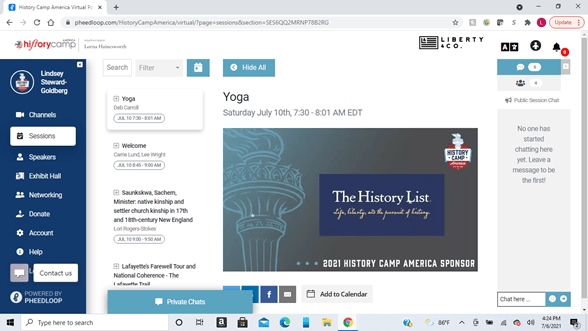
History Camp America platform

        Earlier this month I attended History Camp America, which was their first national History Camp virtual conference. It is produced by The Pursuit of History, a non-profit organization that engages adults in conversation about history and connects them with historic sites in their communities, and across the country through innovative in-person and online programming. There were more than 45 sessions that included but were not limited to presentations, historic site tours, history walks, culinary history demonstrations, trivia, and yoga. According to their website, this conference is designed to be a casual conference for adults, teenagers and children that are students, teachers, professors, authors, bloggers, reenactors, interpreters, museum and historical society directors and board members, genealogists, and everyone else, regardless of profession or degree, who is interested in and wants to learn more about history.

         Like previous virtual conferences, they were hosted on platforms designed to run their conferences; History Camp used the event automation Pheedloop which made organizing conferences, meetings, and trade shows easy with event management software that powers everything from mobile apps, registration, touch-free check-in, and live streaming, to floor plans, sponsors, badge printing, and networking since 2015. I decided to attend History Camp this year after I discovered their website because I wanted to learn what a conference that is not hosted by a museum association would be like to experience. I also wanted to participate in something that appeals to my interested in history and that is different from professional development programs I have attended in the past.  It is also important for history and museum professionals in the field to see how people are currently studying history and how they are interpreting history since the history and museum field are discussing the 250th commemoration of American Independence and a part of the discussion about the commemoration is to work on helping the people learn how to do history, in other words how to do their own historical research of the communities they live in. The following are a sample of sessions I attended during History Camp America.

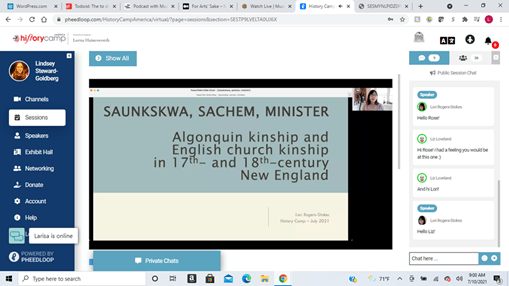
        One of the sessions I attended was Saunkskwa, Sachem, Minister: native kinship and settler church kinship in 17th and 18th-century New England led by Lori Rogers-Stokes, an independent scholar of 17th-century New England and the author of Records of Trial from Thomas Shepard’s Church in Cambridge, 1683-1649: Heroic Souls (published by Palgrave Macmillan). Rogers-Stokes shared her work in process research by discussing the political records and Congregational church records from 17th-century Massachusetts. Her presentation focused on sharing the similarities and differences she found on how the Algonquin people and English colonists defined and valued kinship; she revealed that, according to her research, the puritan church defined kinship in a similar way to indigenous kinship which led her to believe there was a potential connection that could have been a fruitful common ground for cooperation and respect but was unfortunately lost.  I thought the content was interesting and I chose to attend this session because I wanted to expand my knowledge on indigenous history; while the session focused on comparing the Algonquin people and English colonists views on kinship, it is an introduction to the Algonquin culture and history. I look forward to hearing about her completed work on this research.

         Once that session was complete, I moved on to a short spotlight session introducing The Daily Bellringer created by Jared Bruening. The Daily Bellringer provides short video overviews of U.S. History topics, and they are designed to be used for grades 5-12 as warm-ups, reviews, or introductions to content. I will go more in depth about The Daily Bellringer in a future post. This was not the only spotlight that occurred during History Camp America.

         There was also a spotlight on History Dame created by Larisa Moran who is a history blogger and creator of History In Under A Minute©. History In Under A Minute is a series on YouTube that discusses a variety of topics in history in less than a minute.  She is also a volunteer with The Pursuit of History and regional editor for The History List, the platform historical societies, historic sites, and other organizations use to attract and engage visitors and members through things including but not limited to listings of programs and exhibits, and resources for organizations of all sizes that provide research, tool, and insight to support history programming across the country. I will also explore more of History Dame in a future post.

        Another session I attended was “Thrown into the pits”: how were the bodies of the nineteen hanged Salem “witches” really treated? and the speaker was Marilynne K. Roach, author of The Salem Witch Trials: a Day-by-Day Chronicle of a Community Under Siege, and Six Women of Salem. She is a member of the Gallows Hill Group that verified the location of the hangings, a discovery Archaeology magazine hailed as one of 2016’s top ten discoveries in the world. Roach discussed her experience taking a closer look at the court records that may disprove assumptions of what happened to the bodies of those hung during the Salem Witch Trials in 1692. I thought this was an important session to attend not only because of my interest in Salem’s history but this is an example of why historical research is significant. Popular accounts starting with 19th century historian Charles Upham’s statement that the deceased were “undoubtedly all thrown into pits dug among the rocks” were usually based in available resources or lack thereof, and when records are discovered the interpretation begins to change to reflect what the primary sources state about moments in history such as the Salem Witch Trials.

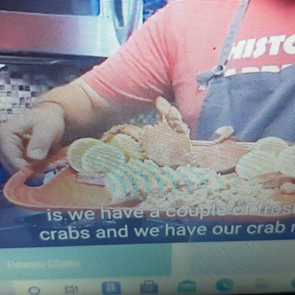
       During lunch, there was a demonstration and a short session that focus on the history of food. In this demonstration, Chef Justin Cherry cooked a recipe for crab cake in Dressed Crab – An Early American Favorite and participants had access to the recipe so they could follow along making their own crab cake. Chef Justin Cherry is the Chef/Owner of Half Crown Bakehouse which is a mobile 18th-century clay oven that specializes in colonial foodways. The recipe he used during the demonstration came from a manuscript written by Anne Chase in 1811; Anne Chase was the daughter of Samuel Chase, one of the signers of the Declaration of Independence. I thought it was interesting since not only participants learn more about history, but they can also prepare their own crab cakes as they watch. To my memory, I have not participated in a demonstration like this one before.

      In the next demonstration, Sarah Lohman shared photographs and discussed the history of soda fountains in Soda Fountain Favorites. Sarah Lohman is a culinary historian and the author of the bestselling book Eight Flavors: The Untold Story of American Cuisine, and she focuses on the history of food as a way to access the stories of diverse Americans. She focused her presentation on food history in New York and provided recipes of the classic sodas she talked about so participants can make them at home. Lohman shared stories behind some of the favorite fountain drinks including the egg cream and the popularity of seltzer, Dr. Brown’s Soda (specifically Cel-Ray), the Lime Rickey, and the Purple Cow. During the session, I recalled the first time I tried an egg cream when I first visited my then boyfriend (now husband) on Long Island.

        After attending the sessions live, I decided to take advantage of the recorded sessions so I can revisit the sessions and listen to other sessions that I did not attend on the day of the conference. I included a pdf file of the itinerary History Camp released to provide an idea of topics that were discussed, tours given, and demonstrations performed. I will also elaborate in future posts about other sessions I attended and tours of historic sites I participated in.

I’m on Buy Me a Coffee. If you like my work, you can buy me a coffee and share your thoughts.  More information about additional benefits for supporting my work can be found here: https://lookingbackmovingforwardinmuseumeducation.com/buy-me-a-coffee-page/

Links:

A Public Historian Explores History Camp

History Camp

Pheedloop

The History List

History Camp America Session Schedule

Pride Month and the Museum Field: Museums Interpret and Share LGBTIQ+ History

June 17, 2021

We should remember why we celebrate Pride Month and museums especially have the responsibility for educating the public about LGBTIQ+ history that has long been neglected to be told. June is LGBTIQ+ Pride Month which honors the 1969 Stonewall Uprising in Manhattan as it was the tipping point for the Gay Liberation Movement in the United States. Stonewall Inn was one of the most popular gay bars in New York City back in 1969, and until 1966 it was illegal to serve alcohol to a gay person in New York State. Throughout the United States, police raids on gay bars and spaces during this time. The purpose of Pride Month as a commemorative month is to recognize the impact that lesbian, gay, bisexual, and transgender individuals have had on history locally, nationally, and internationally.

        In more recent years we celebrate by having pride parades, picnics, parties, workshops, symposia and concerts, and LGBTIQ+ Pride Month events attract millions of participants around the world. Pride Month last year and this year has been different due to the pandemic. Last year, the museum field honored Pride Month on the virtual platform.  Hilary-Morgan Watt (the Digital Engagement Manager for the Smithsonian’s Hirshhorn Museum and Sculpture Garden) and Emily Haight (the Social Media Manager at the New-York Historical Society) wrote a short post for the American Alliance of Museums’ blog to advertise the #MuseumPrideParade on Twitter encouraging museums and museum professionals to share items in their museums’ collections relevant to LGBTIQ+ history. According to the authors, the campaign they created at the time of their post was the third global campaign organized by the Hirshhorn Museum and Sculpture Garden and the New-York Historical Society during the pandemic, following #MuseumBouquet and #MuseumSunshine. Watt and Haight pointed out that:

We decided Pride was the right opportunity for a third campaign, to help museums   celebrate in place of the exhibits, film screenings, programs, and parade-marching many would normally be participating in. How do you participate? It’s simple—showcase images from Pride marches and other LGBTQIA+ protests throughout history, or other objects and stories from LGBTQ history, using the #MuseumPrideParade hashtag, and choose another institution to tag as your virtual marching partner.

For example: We’re sharing [object] for the #MuseumPrideParade and marching with [@institution].

The Museum Pride Parade took place last year on June 10th at 11am on Twitter.

        While we are still going through this pandemic, we still honor Pride Month and each museum does so in varying ways depending on if they are planning to have events and programs in person, virtually, or hybrid. I included links to various events and programs museums are doing for Pride Month in the list below to show what is happening. Also, I included a couple of links from last year’s Pride Month in the list.

        A lot of the programs and events especially in museums aim to educate participants in LGBTIQ+ history. It is important for museum professionals to remember that LGBTIQ+ history is not just in one month. There are museums that not only incorporate LGBTIQ+ history into their programs but also do outreach in the LGBTIQ+ community, and I saw some examples of this in the December 2020 edition of the Journal of Museum Education called Queering the Museum. One of the articles was Benjamin Rowles’ “LGBTIQ+-Themed Education at the Kunsthistorisches Museum in Vienna-Guided Tours with a Drag Queen” in which he pointed out the museum he began working for in 2016 holds countless European Old Master paintings and some of them can be interpreted to reference queer themes, yet there was a lack of LGBTIQ+ outreach. Rowles decided that since in addition to working in a museum he also works as a drag queen, he will combine both to provide guided tours as a drag queen; his article shared the experience of the offered guided tours that lasted for a few years.

        Another example of an article in this edition of the Journal of Museum Education was “Intuition and Vulnerability: A Queer Approach to Museum Education” written by Eli Burke, the Education Director at the Museum of Contemporary Art Tucson. Burke’s article explored intuition and vulnerability through an intergenerational arts program called Stay Gold that is specifically for the LGBTIQA+ community and its relationship to museum education. The main point of the article is that it seeks to examine how queerness is connected to both intuition and vulnerability, and how the Stay Gold program impacts the lives of LGBTIQA+ participants through that lens.

       Danielle Bennett, who has previously worked on LGBTQIA+-related projects at Amy Kaufman Cultural Planning and the New York Historical Society, also contributed an article for the Journal of Museum Education called “Lessons from Glen Burnie: Queering a Historic House Museum”. She made a case in the article for including queer narratives in historic house museums since including queer history in public history settings is important in its own right and as a way to invigorate museum interpretations and appeal to wider audiences.

Also, in the same article Bennett dispels concerns about “outing” historical actors and describe some language and ways of thinking about historical sexuality to assist educators in their interpretation. Then it shifts into the case study of Glen Burnie, a historic house museum that completely revised its interpretation to center the house’s last residents and its preservationists, a gay male couple; Glen Burnie’s interpretive shift leverages the efforts of both men to create public and private domestic experiences that create an immersive new house tour experience and can be used to create a critique of the portrayal of gender roles and heteronormativity at many historic house museums. More articles can be found in the fourth edition of the 45th volume in the Journal of Museum Education, and I included a link to current and past editions.

How are you honoring Pride Month this year?

I’m on Buy Me a Coffee. If you like my work, you can buy me a coffee and share your thoughts.  More information about additional benefits for supporting my work can be found here: https://lookingbackmovingforwardinmuseumeducation.com/buy-me-a-coffee-page/

Links:

Library of Congress: Pride Month

Library of Congress: Stonewall Uprising

Journal of Museum Education

AAM Pride goes Virtual

Pride at the Smithsonian

World Pride at The Met

Western Museums Association Pride Month Sources

Celebrate Pride

New York City Pride

Pride Month 2021

Events in 2020

8 LGBTQ Objects to Celebrate Pride 2020

Book Review: Invisible Ink by John A. Nagy

May 20, 2021

Open Photo

I came across John A. Nagy’s Invisible Ink: Spycraft of the American Revolution in recent years, and I decided to take a closer look at this book. I especially wanted to read this book since my work at the Three Village Historical Society also focuses on engaging visitors on the history of the Culper Spy Ring which utilized the invisible ink method during the American Revolution. The book discussed various spy methods that were implemented during that time period. It also provided some history of spying to provide context for what spying during the American Revolution was like for both the British and the Patriots (colonists who opposed British rule over the colonies). As a historian and as an Education Committee member for the Three Village Historical Society, I thought it would be important to also take a closer look at the information Nagy utilized and described in his book.

         There were a couple of things I kept in mind when examining how Nagy discussed the Culper Spy Ring in his book. For instance, while there was some information he shared throughout the book, he did focus one chapter on the Culper Spy Ring (specifically in 15 pages) as part of the overall history of spycraft in the American Revolution. The Culper Spy Ring was not the main focus of the overall book.

         I noticed within the Appendix section that Nagy labeled the code in Appendix B as “Culper Spy Ring Code”. The issue I have with this description is that the code is actually known as Tallmadge’s Code; it is named for Benjamin Tallmadge, a dragoon officer during the American Revolution, who General Washington appointed as intelligence officer and Tallmadge would serve in this role between 1778 and 1783. Tallmadge recruited his childhood friends in Setauket, New York as the main spies in the Culper Spy Ring. At first, I thought Nagy may have called it “Culper Spy Ring Code” because I saw it on Mount Vernon’s website; the title of the webpage for the collections on Mount Vernon’s website was titled “Culper Spy Ring Code”. However, I did not see any reference to Mount Vernon in his bibliography section nor does he make a reference to the Appendix B within the text itself. Therefore, it cannot be confirmed where he got the Code from. To take a look at the Code Tallmadge developed, I included a link to the code book in Mount Vernon’s collection in the list below.

         Nagy’s bibliography section is split into two subsections: manuscript collections and printed materials. With the exception of Morton Pennypacker’s book General Washington’s Spies on Long Island and in New York (published by the Long Island Historical Society in Brooklyn, 1939), there were no resources about the Culper Spy Ring that came from Long Island in his book. The bibliography section included collections that came from New York City (Columbia University Libraries, New York Historical Society, and the New York Public Library) but from what I saw in the book there are no resources that were gathered and utilized in the book from Long Island. Pennypacker’s book was a significant one because until his book was released no one knew about the Culper Spy Ring and who were a part of the Culper Spy Ring. I recommend checking out resources provided by the Three Village Historical Society in East Setauket, Stony Brook University Libraries and Archives in Stony Brook, and the Emma Clark Library’s Culper Spy Ring page called It Happened in Setauket. The links for these resources are available in the list below.

         An important thing to keep in mind when reading history books is to take a look at the resources section and how those resources are utilized throughout the books.

I’m on Buy Me a Coffee. If you like my work, you can buy me a coffee and share your thoughts. https://lookingbackmovingforwardinmuseumeducation.com/buy-me-a-coffee-page/

Links:

Three Village Historical Society

Emma Clark Library: It Happened in Setauket

It Happened in Setauket Map

Stony Brook University Libraries and Archives: Culper Spy Ring

Mount Vernon: Culper Code Book

https://www.westholmepublishing.com/book/invisible-ink-john-a-nagy/

https://www.goodreads.com/book/show/6560959-invisible-ink

A Public Historian Explores History Camp

May 6, 2021

I recently came across History Camp while exploring museums virtually, and I thought it would be interesting to take a closer look. According to their website, History Camp is a casual conference generally for adults especially including but not limited to students, teachers, professors, authors, bloggers, reenactors, interpreters, museum and historical society directors, board members, genealogists, et. cetera regardless of profession or degree who is interested in and wants to learn more about history. The first History Camp was held on March 8, 2014 which presented 23 sessions and two panels, and welcomed 109 people to an IBM facility in Cambridge, Massachusetts. There are some local volunteer committees that manage History Camps while others are managed by non-profit organizations. In 2019, the non-profit organization The Pursuit of History was started to foster the development of more History Camps across the country.

       Other conferences in the past have been in person at various places including Boston, Colorado, Virginia, and Philadelphia. This year, however, their conference History Camp America will be a fully virtual History Camp participants can enjoy from anywhere in the world.

       Since I have not experienced History Camp America yet, I am not able to, at the time I am writing this blog post, to state what the experience is like. History Camp America will take place this year on Saturday, July 10th. I have signed up for their newsletter so I will know when tickets will become available. If you would like to check it out for yourselves, I have included a link below where you can sign up for their newsletter. Based on the information provided so far, the biggest differences between conferences I have attended in the past and History Camp America is there are no places where services are being shared and sale pitches. Another difference that I noticed is in each conference I have attended there are themes, and the sessions are in general based on those themes; History Camp America put emphasis on making the conferences as broad as possible to attract many people to attend, and they believe that ultimately, it is the speakers and attendees that define the scope discussions are focused on. On their website, they stated that:

        Since our first History Camp in 2014, history enthusiasts of all stripes have been enthralled by our casual conference format. This format encourages a wide variety of topics and participants learn about history and new research, engage with history in unique ways, share what they love about history, and challenge everyone to think about history in new ways.

Once the conference occurs, I will be able to share more about the experience of attending History Camp America.

        During the pandemic, they launched two new History Camp events called History Camp Discussions and America’s Summer Roadtrip. History Camp Discussions are free online weekly discussions that are live every Thursday at 8pm Eastern, and are also available as recordings in their archives section for replays. One of the History Camp Discussions that caught my attention was the discussion with Emerson W. Baker on his book A Storm of Witchcraft: Salem Trials and the American Experience. Baker is a Professor of History and Interim Dean of Graduate and Professional Studies at Salem State University in Salem, Massachusetts. The hour-long program discussed Baker’s book by focusing the discussion on his investigation of the key players in the Salem witchcraft crisis and explains why this tragedy unfolded the way it did according to the research he did for his book.

        Another History Camp Discussions that caught my attention was the discussion with Linda Jeffers Coombs on the topic of The Wampanoag and the Arrival of the Pilgrims. Coombs is an author and historian from the Wampanoag Tribe of Gay Head (Aquinnah) and program director of the Aquinnah Cultural Center. In the near hour-long program, she discussed the Wampanoag’s experience with the pilgrims’ arrival, and the effects of an epidemic that swept through and devastated the region just before the pilgrims arrived.

      America’s Summer Roadtrip is a free online event that brought participants to 12 historic sites across the United States without leaving home and where many of their guides offer special access to areas other tours usually do not go. The twelve historic sites across the United States are located in Massachusetts, New Jersey, Ohio, Colorado, New Mexico, Wyoming, North Carolina, and California.

      To learn more, I have included links below on their website and the programs they offer.

I’m on Buy Me a Coffee. If you like my work, you can buy me a coffee and share your thoughts. https://lookingbackmovingforwardinmuseumeducation.com/buy-me-a-coffee-page/

Links:

History Camp

About History Camp

Upcoming Events

History Camp America 2021

America’s Summer Roadtrip

History Camp Discussions: Emerson W. Baker’s A Storm of Witchcraft: Salem Trials and the American Experience

History Camp Discussions: Linda Jeffers Coombs on The Wampanoag and the Arrival of the Pilgrims

History Camp Newsletter Sign Up

Sneak Peak of Member Post: Women’s History Lesson Plan, A Closer Look at My Capstone Project

April 22, 2021

       In 2013, I was getting ready to prepare for graduation from Central Connecticut State University’s Public History graduate program. In order to graduate from the program, I had to work on a capstone project which took the entire last semester to complete; I completed all of my required courses so I could dedicate my time to this capstone project.  Since I was working at the Stanley-Whitman House, a National Historic Landmark, as a museum educator while I was attending classes, I decided to develop a lesson plan designed to educate students about women’s history by focusing on the women who lived in the house. I also knew that I wanted to be a museum educator after I earned my masters degree, and designing a lesson plan would be the appropriate capstone project to complete. In case you are not familiar with the National Historic Landmark, the following information is background history of the museum and the families that lived there.

      Stanley-Whitman House is a museum and living history center that collects, preserves, and interprets the history and culture of 17th to 19th-Century Farmington, Connecticut. It has operated under the auspices of the Farmington Village Green and Library Association, which is a nonprofit 501(c)(3) educational organization, since 1935. This house is a Post Medieval-style house with a center chimney flanked by a parlor and a hall with two chambers (bedrooms) above which provided both living and storage space. The colonists built their homes from wood, and used post and beam construction for the frame. The second floor extends beyond the first on the front façade, creating an overhang. While the original purpose of the overhang is unknown, it did provide more space in the upper chambers. The lean-to addition that extends across the width of the back of the house was added some time in the mid-18th-century, giving the house its distinctive saltbox shape.  According to their website, the records indicate that the house was constructed sometime between 1709 and 1720.

The above sample is from the membership post in which I discuss previous projects I worked on, the thought process behind them, and my thoughts on them years later. I discuss my the capstone project I worked on for the Stanley-Whitman House in Farmington, Connecticut. I included a link below to learn more about this museum.

I developed a lesson plan that not only focuses on educating students about the women who lived in the house but also encourages students to learn more about the women in their communities. Also, I shared the process I went through to develop the lesson plan and what I would do if I were developing the lesson plan now.

If you are interested in reading this post, consider becoming a member of this website. More information on membership benefits and how to join is available on the website’s Buy Me a Coffee Page.

Link:

https://www.stanleywhitman.org/

Sneak Peak of Member Post: Let’s Revisit Butler-McCook House Genealogical Research: Then and Now

March 30, 2021

When I was working at Connecticut Landmarks’ Butler-McCook House in Hartford, Connecticut, I contributed to an online literary journal, Poor Yorick: A Journal of Rediscovery. Founded in the spring of 2013, its mission is to publish creative works inspired by objects and images of material culture contained in museums and elsewhere. One of my former co-workers at the time was a creator on the Journal at the time, and she asked me if I could write about the research I was doing about the Butler family and McCook family genealogy. As part of my responsibilities as an educator and an interpreter at the Butler-McCook House, I needed to review the information each staff member was given to learn and incorporate more into our educating experience. I remember that what inspired me to start this project was looking at the poster board of the Butler-McCook family tree Frances McCook (the last member of the family who lived in the house) worked on and was not completed. I decided to take a look and learn about the ancestors.

It has been a while since I wrote the original post, and I decided to revisit the project and post after all this time because it is one of my earliest projects that also focuses on women’s history. I thought it would be appropriate since this month, as I am writing this post, is Women’s History Month. Another reason I wanted to revisit this project is to share how I previously approached this the research and what I learned.

While I was working at the Butler-McCook House, one of the things I really appreciated was the women’s involvement in preserving not only their family history, but Hartford history as well. Frances McCook, who was part of the fourth generation of the family who lived in the house, had a passion for history and her efforts to preserving Hartford history is admirable.

Here are the links to learn more about the Butler-McCook House, Connecticut Landmarks, and the original post I wrote for Poor Yorick Journal back in 2016:

Butler-McCook House Genealogical Research: Then and Now on Poor Yorick

Connecticut Landmarks

Butler-McCook House

If you are interested in reading more about this experience, please consider becoming a member of this website through my Buy Me a Coffee page. As a member of this website, for only $4 a month, you will be able to:

  • Access new blog posts before they are posted on my website
  • Be one of the first to find out updates on ongoing projects for the blog and website
  • Participate in group discussions on my Discord server, Looking Back Moving Forward in Museum Education‘s server
  • Access members only content where I revisit past projects I have created in my museum career, and share what I would do differently if I were creating them today
  • Send in requests on what you would like to see on the blog
    • Is there a question about the museum education field, public history, blogging, et. cetera you would like me to answer? I will create a post to answer your questions.
    • Do you want my thoughts on a book or film based or not based in history? Let me know.
    • Anything else on your mind? You can send me your requests.

You can check out my Buy Me a Coffee page here: https://www.buymeacoffee.com/lbmfmusedblog

A Public Historian’s Perspective on Women’s History Month

March 25, 2021

This past month we all have dedicated our time and efforts to honor women’s history. Women’s history month is especially significant for me since I am a cis woman who appreciates the focus on women’s significant contributions throughout history. However, we all need to not only acknowledge women’s history does not occur one month out of the year, but we should be honoring all women-women of color, transwomen, indigenous women-who have made an impact and are often ignored when discussing women’s history. Over the years, we celebrate women’s history month by sharing achievements women have accomplished from the past to more recent years.

Museums also take part in celebrating women’s history month by developing, promoting, and implementing exhibits and programs focused on women’s history. For instance, the Museum of the American Revolution hosted a virtual Zoom presentation called “Remember the Ladies”: The World Premiere of a New Choral Work by Dr. Melissa Dunphy that is presented with their exhibit When Women Lost the Vote: A Revolutionary Story, 1776-1807. The experience is a live broadcast from the Museum for the choral world premiere of Dunphy’s “Remember the Ladies,” which sets excerpts from the letter for a cappella mixed chorus, performed by the 40-voice community choir, PhilHarmonia. The Wisconsin Historical Society has a free online panel discussion on exploring how women’s stories and experiences can be told in new ways.

Wisconsin Historical Society’s online panel discussion Sharing Women’s History: Exploring New Stories and Formats for Engaging Audiences discussed examples of innovative programming and best practices for interpreting complex stories that will aim to engage new audiences. A couple examples include DyckmanDISCOVERED at the Dyckman Farmhouse Museum, which investigates the stories of enslaved people belonging to the Dyckman family and the community that is now called Inwood in New York City, as well as virtual programs and poetry festivals at The Emily Dickinson Museum. Some of the panelists include Mary van Balgooy, Vice President of Engaging Places, LLC, and Director at the Society of Woman Geographers; Meredith S. Horsford, Executive Director at the Dyckman Farmhouse Museum; and Brooke Steinhauser, Program Director at the Emily Dickinson Museum. Their discussion also included the added challenges of and possibilities for engaging new audiences through virtual engagement.

The Old North Church has a Digital Speaker Series, and it is called Revolutionary Women, Live! Presented by Old North Church Historic Site and the Freedom Trail Foundation, it was an hour-long program with two historians engaging participants in learning about the unique ways women of Boston influenced and shaped the world around them throughout the centuries. They focused on some women including Anne Hutchinson, Phillis Wheatley, and Melnea Cass. Anne Hutchinson was a spiritual preacher in Massachusetts Bay Colony in the seventeenth century and Melnea Cass was one of Boston’s most beloved and effective advocates for African Americans in Boston. At the end of the program, there was an interactive question and answer session to help participants delve deeper into women’s history.

Three Village Historical Society has a lecture series that has been on the Zoom virtual platform over the past year, and this month the virtual lecture was The Founding Mothers of the United States. Guest lecturer author Selene Castrovilla discussed her book she wrote about founding mothers, both well-known and others that were previously not part of the narrative in our history. From the program’s description, the lecture will address that:

Many women helped shape a free and independent United States of America. These smart, brave women were ambassadors, fostering peace between Native Americans and Europeans. They risked their lives by writing, printing, and distributing information about the fight for independence. They supported their husbands during battle and even donned disguises to join the army.

Throughout the presentation, Castrovilla shared content from her book about the founding mothers in the United States. In addition to discussing the well-known founding mothers, she shared information about founding mothers whose stories are not told as much as founding mothers such as Martha Washington. For instance, there were a group of women in North Carolina who had their own protests against the unfair taxes on tea and clothing.

On October 25, 1774, about a year after the Boston Tea Party, 51 women in Edenton, North Carolina drafted and signed a declaration that they will boycott British tea and clothing until the products were no longer taxed by England. The protest became known as the Edenton Tea Party. Another example of women Castrovilla discussed about was Phillis Wheatley who was an enslaved poet.

Wheatley was born in West Africa around 1753 and was abducted by slave traders and was forced onto a ship to America when she was seven years old. She was enslaved in Boston, Massachusetts, her owner noticed how smart she was and decided to educate her which was rare since most slaves suffered under harsh conditions and were not allowed to learn to read and write. Wheatley began to write poems when she was thirteen, and her first published poem appeared in a Boston newspaper on December 21, 1767. In 1773, she sailed with her owner’s son to England where a book of her poetry was published. She was given her freedom shortly after her book was published and her return to Boston. While she wrote a poem celebrating George Washington’s selection as army commander, she also believed the issue of slavery prevented the colonists from the true heroism they could have achieved during the American Revolution. Castrovilla also shared the story of Nanyehi/Nancy Ward who was an Indigenous woman born in Chota, the Cherokee capital, which is now part of Tennessee, in 1738.

Nanyehi fought alongside her husband in a battle between the Cherokee and another Native Nation, the Muscogee Creeks. When her husband was killed during the battle, Nanyehi picked up his rifle and led the battle where she earned the title Ghigau, or “Beloved Woman”, for her bravery. She later became a leader of the Women’s Council of Clan Representatives where she excelled as negotiator and ambassador. While they were in war, Nanyehi tried to achieve peace between Indigenous people in North America and the settlers. When the Revolutionary War began, the Cherokee fought alongside the British to prevent losing more Cherokee land to the settlers, and Nanyehi warned the settlers of Cherokee attacks since she did not want increased hostilities between her nation and the settlers.

  If interested in learning more about Castrovilla and her works, she has a website that promotes most of her books. To learn more about the TVHS lecture series and purchase her book, I included links in the list below. 

Castrovilla’s book reminded me of Cokie Roberts’ book Founding Mothers: The Women Who Raised Our Nation, except the major difference between these two books is her book is geared towards young adult audiences while Roberts’ book focuses on addressing women’s history on academia audiences. I appreciate, as a public historian with an interest in Early American history, that there are programs that discuss women’s contribution and involvement in before and during the American Revolution. Also, I appreciate indigenous women’s stories are being more included in these programming options since I not only enjoy learning more history, but it is also a lot more that I am learning now about indigenous people than what was being taught when I was attending school as a child. We need to continue to do more to acknowledge and understand indigenous history as well as remember that we are on land first occupied by indigenous people.

The previously listed examples of how museums honor and celebrate women’s history month are only a small sample of what I noticed and does not represent what all museums are doing. I have included more links to examples museums have honored and celebrated women’s history month and resources they have available on women’s history. If there are any that I have not listed, please tell me about them and if possible, share a link.

I’m on Buy Me a Coffee. If you like my work, you can buy me a coffee and share your thoughts. ☕ https://buymeacoffee.com/lbmfmusedblog

Additional Resources:

Women’s History in the National Women’s History Museum

Boston Women’s Heritage Trail

Facing History and Ourselves: 6 Virtual Exhibitions and Teacher Resources for Women’s History Month

Women’s History Month website

Why March is National Women’s History Month

National Women’s History Alliance

Links:

Museum of the American Revolution’s When Women Lost the Vote: A Revolutionary Story

Museum of the American Revolution’s When Women Lost the Vote: A Revolutionary Story, Virtual Exhibit

Wisconsin Historical Society

Dyckman Farmhouse Museum’s DyckmanDISCOVERED

Emily Dickinson Museum

Old North Church Events, Digital Speaker Series

Three Village Historical Society Lecture Series

Selene Castrovilla’s website

The Founding Mothers of the United States by Selene Castrovilla

Founding Mothers: The Women Who Raised Our Nation by Cokie Roberts

Boston Women’s Heritage Trail: Melnea A. Cass

National Women’s History Museum: Anne Hutchinson

Facing Today: “Making Space for Women’s History”

Facing Today: “Teaching in the Light of Women’s History”
Book Review: The Cabinet by Lindsay M. Chervinsky

March 4, 2021

The most recent book I have been reading is Lindsay M. Chervinsky’s The Cabinet: George Washington and the Creation of an American Institution which was published on April 7, 2020. I wanted to read this book since my current work in the museum field also focuses on George Washington (during the American Revolution, specifically with the Culper Spy Ring), my museum background is mostly in early American history. After I heard about this book, I decided to check it out and provide my thoughts on this book.

Lindsay M. Chervinsky, who is a White House historian at the White House Historical Association, provided detailed account of Washington’s early years in his presidency and his Cabinet. According to the book flap, Chervinsky’s book described the political history of Washington’s Cabinet:

              On November 26, 1791, George Washington convened his department secretaries- Alexander Hamilton, Thomas Jefferson, Henry Knox, and Edmund Randolph-for the first cabinet meeting. Why did he wit two and a half years into his presidency to call his cabinet? Because the US Constitution did not create or provide for such a body. Washington was on his own.

              Faced with diplomatic crises, domestic insurrections, and constitutional challenges-and finding congressional help lacking-Washington decided he needed a group of advisors he could turn to. He modeled his new cabinet on the councils of war he had led as commander of the Continental Army. In the early days, the cabinet served at the president’s pleasure. Washington tinkered with its structure throughout his administration, at times calling regular meetings, at other times preferring written advice and individual discussions.

I took the time to read the book and I appreciate its great attention to detail as well as the way Chervinsky delineated the narrative in this book. Within the book, there are eight chapters, an introduction and an epilogue that went into detail of after the Revolutionary War, when Washington became president, his presidency in the early years, the Cabinet emerges, and how the Cabinet worked after it was created.

        Also, I appreciate Chervinsky’s efforts to outline and organized resources she used to write her book. When I read history books, I like to pay attention to how resources are cited and displayed not only because it was how I learned to read these books while earning my bachelor’s degree in history and master’s degree in public history, but it helps me see the primary sources used for this book to provide context to what I am reading. Inside the book, she has a notes section that includes additional information relevant to a point made in the book that did not fit into its flow. It also lists the resources she used including primary sources such as presidential papers and diaries, and secondary sources including books, articles, and journals (such as Journals of the Continental Congress and Journal of the House of Representatives of the United States) throughout her book. Each chapter had at least between 80 and 100 annotations, and the introduction and epilogue have 15 and 26 annotations, that direct the reader to the notes section.

         In addition to the structure of the book, I appreciate the dedication to telling this significant part of the United States’ political history and leaving the reader to ponder on the influence of this Cabinet on following presidential cabinets in almost 250 years of the country’s existence. The Cabinet discussed the resulting consequences that followed Washington’s choices on figuring out the roles of his advisors and how they will conduct their roles. In the same book flap, it stated that:

The tensions in the cabinet between Hamilton and Jefferson heightened partisanship and contributed to the development of the first party system. And as Washington faced an increasingly recalcitrant Congress, he came to treat the cabinet as a private advisory body to summon as needed, greatly expanding the role of the president and the executive branch.

           While the cabinet has evolved in step with the federal government, Washington established a precedent whose powerful legacy endures. Each president since has selected his closest advisors, Senate-appointed or otherwise—whether political allies, subject experts, or a coterie of family members and yes-men.

This book is definitely a relevant book for understanding political and presidential history in the United States. I believe reading books like Chervinsky’s The Cabinet would be helpful to understand the role of the Cabinet in more recent presidencies. When Washington became the first president of the United States, he was trying to figure out what that means for the new country and ultimately setting the example for future presidents to follow. He had to think about what the responsibilities are of the president and how to handle the responsibilities, and his approach to the presidency came from what he knew about how to be a leader when he was the general in the Revolutionary War. As I read her book, I appreciated that she began the book within the war since as readers we need to see the foundations of Washington’s leadership and how his interactions with cabinet members can be influenced from the efforts to be able to create a new nation. From my experience educating and discussing Washington’s role in the Revolutionary War, I can understand how he modeled his cabinet on the councils of war he had.

At the Three Village Historical Society, we focus one of our main exhibits on the Culper Spy Ring and share Washington’s involvement in leading espionage in the Revolutionary War, especially on Long Island. Among the many roles Washington had as the General, he appointed one of this Dragoon Majors, Benjamin Tallmadge, as head of the spy ring on Long Island since Tallmadge was originally from Long Island and expected that he would receive the most accurate information. I recommend visiting the TVHS website to learn more about Washington and the Culper Spy Ring.  

I also appreciated the connection Chervinsky made towards the modern presidencies in the book by discussing legacy. The epilogue especially focused on how Washington’s legacy influenced the presidents directly after him and the more recent presidents. One of the ways Chervinsky illustrated his legacy was:

“Rather than following a written guide or legislative direction, each president would decide how his or her cabinet operated. The flexibility of the institution offered an excellent opportunity for strong leaders but could serve as a liability for weaker presidents” (309).

Since there was so much flexibility, it made sense why there are so many differences in how each president handles their role and their relationships with the cabinet. It also explains how little or big of an impact changes made in the country due to the advice from the fifteen departments of the cabinet: the State, Treasury, Defense, Justice, the Interior, Agriculture, Commerce, Labor, Health and Human Services, Housing and Urban Development, Transportation, Energy, Education, Veterans Affairs, and Homeland Security.

      Overall, I recommend taking a look at the book itself if you are interested in learning more about George Washington, political history, and Early American history.

I’m on Buy Me a Coffee. If you like my work, you can buy me a coffee and share your thoughts. ☕ https://buymeacoffee.com/lbmfmusedblog

Links and Resource:

Chervinsky, Lindsay M., The Cabinet: George Washington and the Creation of an American Institution, Cambridge, MA: The Belkap Press of Harvard University Press, 2020.

https://www.lindsaychervinsky.com/book

Three Village Historical Society

Public Historian Revisits Childhood During Historians at the Movies: The Princess Bride

February 18, 2021

Since I was a kid, I loved the film “The Princess Bride”, the fantasy film starring actors such as Cary Elwes and Robin Wright. The first time I watched this movie was when I was at a friend’s birthday party. I remember watching it so many times over the years since then. There were days that when I was not feeling well, I watched this movie. Most of the time, I watched this movie when I wanted a good laugh. My friends and I used to reenact scenes from the movie, and quote this movie on a number of occasions.

“Inigo Montoya: Fezzik, are there rocks ahead?

Fezzik: If there are, we all be dead.

Vizzini: No more rhymes now, I mean it.

Fezzik: Anybody want a peanut?

Vizzini: DYEEAAHHHHHH!”

I also bought the book the film was based on, and read that book many times including the sequel that was in my copy of the book. Plus, I loved watching the behind-the-scenes stories of filming this movie.

For Valentine’s Day, the Historians at the Movies Twitter conversation took a closer look at this film on DisneyPlus to talk about history and what time period the film portrays. When I heard about this, I was really excited, and I decided to write a post about this discussion.

It has been a while since I covered a Historian At the Movies, and if you want to read about the first experience I had, check out the link below after you read this one.

My husband and I participated in watching The Princess Bride and Historians at the Movies on Valentine’s Day. The memories came flooding back as we watched the film, and once again I had an awesome time tweeting with all of the participants. All of us had a lot of thoughts throughout the movie, and there was a lot of commentary on Twitter. For instance, the following are samples from the Historians at the Movies conversation:

We also answered questions to open discussions while we were making commentaries on the film. The first one was an introduction to what we liked most about the film, what our Valentine’s Day dinners are, et. cetera. I was going to answer each question, but I did not have the answer off the top of my head and there were thoughts I wanted to express about the movie itself. To answer the rest of the questions, it is hard for me to imagine any other actors in the roles and I have not thought about who would be good in the roles if I were to cast the roles today; my husband and I had Indian cuisine from our local Indian restaurant we ate at home.

        I also appreciated the discussion about what the time period this movie would be set in. In the tweet, I stated that based on the clothing I could see the film being set between the 15th and 16th century. Also, in response to other individuals’ tweets that point out it could not be past post-Renaissance I stated:

While my expertise is not in historical clothing, I thought it was consistent enough to not be jarring and they help distinguish between the story scenes and the scenes between the grandfather and grandson.

If you are interested in joining the discussions with Historians at the Movies, follow their website, Facebook page, and the conversations on Twitter using the hashtag #HATM.

What do you think of The Princess Bride? What time period do you think this film is set in? Are there moments from the film that are memorable to you? If you have not seen it, what movies are you nostalgic about?

Links:

A Public Historian’s Participation in Historians At The Movies

Historians at the Movies website

Historians at the Movies Facebook page

I’m on Buy Me a Coffee. If you like my work, you can buy me a coffee and share your thoughts. ☕ https://buymeacoffee.com/lbmfmusedblog