Day at the Museum: Field Trips for Kids and Museum Educators

Added to Medium, July 27, 2017

Before we know it, it will be time for kids to return to school. The highlight of the majority of the students’ school year is the field trip or two. Both kids and museum educators look forward to these field trips for different reasons. Kids enjoy time away from the classroom to play and to, ultimately, learn. Museum educators look forward to interacting with the students to show them ways to bring the material they learn to life, and to assist teachers in teaching the material the students learn in the classroom. To successfully fulfil our institutions’ missions as well as our schools’ expectations, we learn about what the teachers’ standards are for in the classroom they make sure to follow to help their students fulfil the requirements. By seeing how field trips effect kids and museum educators, we can understand how field trips are appealing and continue to be appealing for years to come.

Museum educators go through a number of steps in preparing for students and teachers’ visiting the institutions. Throughout the year, museum educators attend professional development programs when there are opportunities to do so. Museum educators from various institutions gather together to learn about methods that work in educating school groups. Also, museum educators use a number of resources to learn about what teachers need to know about education standards including Common Core Standards.

Teachers plan their school field trips during the summer for their students in the upcoming year. As museum educators, we prepare for school visits by promoting school programs to teachers with flyers so the teachers know what programs are offered. While at the Long Island Museum, for instance, I assisted in keeping a list of teachers in each school district up to date which is continually updated each school year. Then I use the labeling machine to put the address labels on the school program brochures. Once the school program brochures are distributed, teachers interested in booking programs call to schedule field trips for their students to participate in. After the programs are booked, the supplies are prepared to make sure there is enough for each type of program booked.

Once the preparations are made museum educators wait for the school groups to arrive and then guide the groups through the program once they arrive. There are many things for museum educators to consider when gearing their school programs towards the students and chaperones.

Museum educators can learn a lot about what field trips are like from the other side. Tara Young’s Alliance Labs article “Museum Fieldtrips From the Other Side” went into detail about what it is like as a museum professional to be a participant in the field trip experience. She shared takeaways from a field trip to Lexington and Concord she participated in as a chaperone. Young pointed out in her article a number of takeaways from her experience as a chaperone that museum educators should keep in mind when planning school programs including kids need guidance in making connections, the experience is about so much more than the content, a schedule is just a suggestion, and the skill of the interpreter(or interpreters) makes or breaks the whole experience.

As museum educators, we understand that when we teach school programs there has to be at least some flexibility to make sure that students not only have a positive experience but be able to learn as much as we can teach them. Also, when we treat our schedule as a guideline rather than the rule we are able to be prepared for whatever comes including but not limited to when school groups arrive late and have to leave the museum by a certain time, and technical difficulties. The flexible schedule also allows the students to have a special takeaway from the experience rather than focusing on the school program schedule. By attending professional development programs and training sessions, we would be able to be better interpreters to guide students in the interactive programs we teach.

Young also stressed that it is important to address the physiological needs of the students visiting museums such as water breaks when it is hot outside especially when the majority of the visit is outside . Museum educators need to allow time and space for teachers as well as parents to address those needs, which leads to the whole group being better able to focus on the trip’s curricular goals.

These takeaways are important because to understand the lessons our programs teach the kids need to interact with the material in a way that makes them active participants in their education.

Another way to be able to provide a memorable experience for students attending field trips is to think about your own experience attending field trips when you were a student. For instance, I thought about all of the museums and sites I visited as a kid and what I remember the most about each of these experiences is being able to interact with the activities as well as to be educated. As a museum educator today, I remember my inner student and translate that experience into my own teaching methods.

What do you remember about your own field trip experiences? Has it effected the way you educated school groups that visit your museum or institution? Is there an example of a day that showed how much impact your programs had on the students visiting?

To read Tara Young’s original article, click here: http://labs.aam-us.org/blog/museum-fieldtrips-from-the-other-side/

How Creativity is Necessary in the Museum

Originally posted on Medium, June 8, 2017.

What is Creativity? Why is it so important to have creativity in our practice as museum professionals? Questions like these two are what we ponder every day to fulfill our museums’ missions and our career goals. Creativity allows us to be able to express ourselves and provides another outlook on the world around us. Museum professionals especially need to express their creative sides to help their organizations continue to grow and adapt to their changing communities. This is not a new topic but we can always learn something new when we express our creative side. I learn a lot when I allow to express my creative side whether it is drawing, writing, or making projects; and I use my experiences inside and outside of museums to inspire me to create something different and sometimes the same subject from a different perspective.

Since I was young, I made various drawings of many things including animals and landscapes. As I developed my interests in museums, I began drawing museums I have been to and museums I have worked with. For instance, I drew the Butler-McCook House in Hartford, the Stanley-Whitman House in Farmington, Connecticut, Noah Webster House in West Hartford, and Connecticut Historical Society. I drew many of these drawings from my own memory, and one was drawn using a photograph as reference. Also, I used either pens or pencils to make my drawings (depending on which utensil was available at the time). I learned to use my creativity to assist in my museum experience, and I continue to use references from books and professional development programs discussing creativity.

Connecticut Historical Society, pen, drawn 2015

  Noah Webster House, pen, drawn 2015
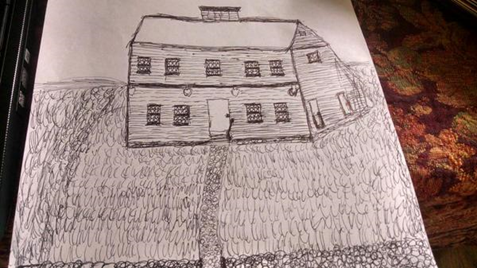
Stanley-Whitman House, pen, drawn 2014

Butler-McCook House, pencil, drawn 2014
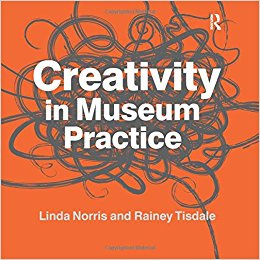
One of the resources I used and continue to use is Linda Norris’ and Rainey Tisdale’s Creativity in Museum Practice to help me get inspired. Norris and Tisdale express the importance of allowing creativity to inspire work in the museum no matter which department they work from. In their book, they state that they believe “the daily life of museum workers behind the scenes both needs and deserves more attention in order for museums to reach their full potential.” Norris and Tisdale shared colleagues’ stories from across the museum field of what creative practices have worked for themselves and their museums. Also, they shared their own tips on how to jumpstart one’s creative practice using no-cost or low-cost activities. Throughout the book, Norris and Tisdale discuss many ways museum professionals can find creativity in their daily tasks, and use whatever inspiration they find in the environment they are surrounded by. The style of this book is written as both a textbook and a workbook to help museum professionals spark their own creativity.

Norris, Linda and Rainey Tisdale, Creativity in Museum Practice, Walnut Creek, CA: Left Coast Press, 2014.

One of the professional development programs I participated in was a NYCMER workshop in October called “Exhibition Designs for Educators” at El Museo del Barrio. This program was an example of how educators can learn to express their creativity to design exhibits and programs simultaneously. There was a challenge in which we were not told what the object was, and we were expected to create an exhibit with an unknown artifact (what appeared to be a cement block). The group I worked with received the prompt to create this exhibit as a warm and friendly environment; we brainstormed various ways we could create the exhibit using the prompt. For more information about this activity, check out the post “Writing about Museum Education: Using Professional Development to Our Advantage.” By brainstorming together as a group, we were able to express our collective creative experience that led to the concept we designed.

“Exhibition Designs for Educators” Activity, October 2016
Creativity is especially used in museum education programs to not only entertain its audiences but to educate them on the subject matter of the museums’ expertise including but not limited to art, history, and science.

There are many examples of when I used creativity as a museum education professional. For instance, while I was working in historic house museums in Connecticut, I taught and assisted participants in making crafts and cooking recipes for school and camp programs. One of the crafts I helped kids make were cornhusk dolls during the summer camp program at Noah Webster House & West Hartford Historical Society which not only was a fun activity but they also learned about what kinds of dolls kids during the eighteenth century played with and created themselves to find ways to entertain themselves. I have also helped fifth grade students make apple pies and Irish-style mashed potatoes at the Stanley-Whitman House in Farmington. At Connecticut Landmarks Butler-McCook House, I helped kids create Samurai helmets out of gift wrap and yarn during the New Year’s Eve celebration, First Night Hartford. The Samurai helmet activity was inspired by the Samurai armor that the McCook family have in their old 18/19th century house; Reverend McCook and his daughter Frances traveled to many places on the way to and from China to visit another daughter Eliza, and one of the places they visited was Japan where he purchased the Samurai armor to bring back to Hartford.

One of the most recent examples include creating activities for kids to participate in during down time in school programs and during general tours at the Long Island Maritime Museum. I created activities such as cross word puzzles, word searches, matching games, and a scavenger hunt. To create these activities, I used information about the Long Island Maritime Museum and the maritime history it shares with its visitors. For instance, I created a crossword puzzle about one of the historic buildings on the museum’s property called the Rudolph Oyster House based on the information about the Oyster House and oyster business; the Rudolph Oyster House was built in 1908 by William Rudolph for his oyster company established in 1895, and it was used as an oyster culling and shucking house until 1947 and was acquired by the Long Island Maritime Museum in 1974.

Another example of activities I created was a breeches buoy search to teach participants the parts of the breeches buoy, an early contraption that pulled victims from shipwrecks, by writing down the names of the parts next to the corresponding letter (I included a word bank so they see the appropriate names). The next example of activities I created is a Name These Boats activity that challenges participants to use their memories of the boats stored in the museum’s Small Craft Building. I included a word bank to limit the possibilities, and participants would write down the name of the boat next to the photograph of a boat.

I also had the opportunity to observe a children’s program that the Maritime Explorium in Port Jefferson participated in. Children created sound-sandwiches for them to take home and play music on by blowing into them like harmonicas. The sound-sandwiches were made with tongue depressors, two pieces of straw, and rubber bands. To make them, one of the two tongue depressors needs a large rubber band wrapped around it from one tip to another; then the two tongue depressors and two small pieces of straw are tied together with smaller rubber bands at the ends. Sound-sandwiches can be adjusted until a humming or vibrating sound is heard. This was not only a fun activity for children to participate in but they also learned how to create sound by using the materials they were given.

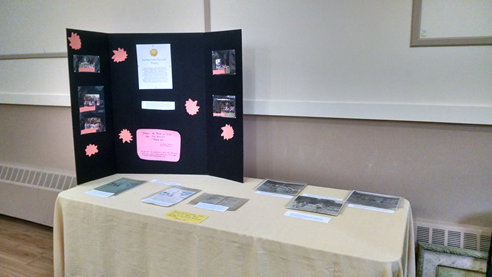
Last weekend I created another exhibit for my childhood church to share the community’s summertime fun since the season would be around the corner soon and I wanted this exhibit to focus more on the parishioners as well as their interactions with the community around them. I included photographs from the Summer Festival the church participated in in 1975, and photographs from a Church picnic that took place by the beach in the 1960s. I also included bulletins that included announcements of activities planned for the summer, ways to get involved in the community, and current events to remind parishioners to be good Christians and learn more about the issues discussed as a result of events. I designed little suns to decorate the exhibit with to represent summer. This exhibit is an example of how creativity is especially useful during the exhibit design process.

Summertime Fun with Trinity exhibit, opened June 4, 2017

Tomorrow I am also participating in another professional development program about creativity, Creativity Incubator. It is a New York State Council on the Arts (NYSCA)/ Greater Hudson Heritage Network (GHHN) Partnership Program which encourages museum staff to test out experimental interpretive approaches through hands-on activities. I will travel to the Raynham Hall Museum in Oyster Bay, New York where it is being hosted. Creativity will continue to be a significant part of our work as museum professionals, and we need to find ways to inspire creativity in our work and inspire creativity with our visitors.

What ways have you found to inspire creativity work for you? Do you have a favorite moment where you accomplished a creative project, museum-related or not? Have you been inspired by something outside of the museum field that helped you complete a project?


Reflections on the NYCMER 2017 Conference

Originally posted on Medium, May 25, 2017.

On Monday, I went to New York City to participate in the New York City Museum Educators Roundtable Conference located this year at the School of Visual Arts. This is my second NYCMER conference I have attended since coming to New York, and both times I enjoyed the learning experience each one offered. Last year I attended with a team and this year I attended on my own. This year’s theme was “Inclusivity: From Within and Beyond” which discusses inclusion and diversity in the museum education field in New York. As with each conference I have previously attended, it was very hard to pick which sessions to attend and I wish I would be able to multiple myself to attend each session offered. The total amount of sessions presented at NYCMER was about 27 sessions, and that does not include the poster session and peer group meet & greet over treats sessions. In this post, I will go into some depth of my experience the second time around providing the highlights of the day, and my experience participating in networking events.

In the morning, I traveled to the train station to take the train into New York City for the conference. Once I arrived at the School of Visual Arts, I checked in, received the schedule, wrote out my name tag, and attended the Keynote Session. The Keynote Session is a session that announces NYCMER business and introduces the conference’s theme. Also, the Keynote also included a discussion about this year’s conference theme with speakers Amy Bartow-Melia (the MacMillan Associate Director for Audience Engagement at the National Museum of American History), Laura Huerta Migus (the Executive Director at the Association of Children’s Museums), and moderator Esther Jeong (Global Tech Diversity Business Partner at Google). The discussion and speeches talked about building a diverse museum workforce where the realities of museology were discussed and the case study of the American History Museum on how the museum developed exhibits and programs that defined what it means to be an American. After the Keynote Session, I attended the first session in one of the School of Visual Arts buildings.

Rainy Train Ride into the City

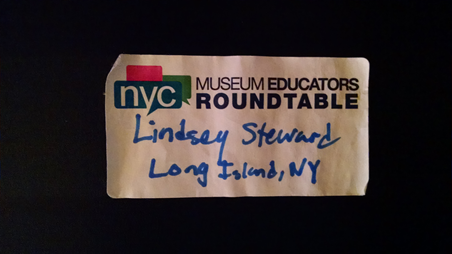
My name tag from the NYCMER conference

The session I attended was called “Designing Professional Development Experiences which Increase Inclusive, Visitor-centered Teaching”. I enjoyed this session especially because it started with a brainstorming game for how we learn as learners; those include but not limited to retention, visual guides, experiential learning, auditory reflection, and team building. The presenters from the Guggenheim Museum presented examples of ways to create opportunities for educators to learn from their audience or community, and presenters from the Children’s Museum of the Arts based their professional developments on grant goals and the museum’s goals to identify internal best practices with consultants, design sustainable peer to peer learning structure, change practices and institutional approaches, identify tools that benefit all children and empower all staff. After that conference, I met with peers to go have lunch and we traveled the area to find out where to have lunch; we also stopped to admire puppies as we looked at places to eat.

Puppies I saw while looking for a place to eat for lunch
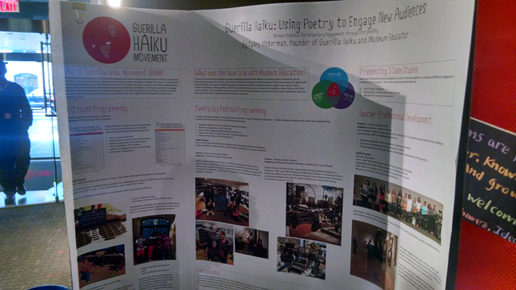
Once we had lunch, I went to the Poster Session which is where professionals give informal presentations on aspects in the museum education field. For instance, one of the posters I saw was for the Guerilla Haiku Movement which presents the argument that poetry can be used to engage new audiences. There is also an activity which challenges participants to create a haiku with 17 syllables about what we learned at the conference so far and our perspectives on museums. I had created one that had one less syllable which states: “Museums provide a learning environment for all learners.” All learners are, by definition, inclusive and it is important that every person who visits museums can learn what they have to offer.

Guerilla Haiku Movement Poster, Poster Session

Haiku I created during Poster Session

The third session I attended after seeing the posters and networking with colleagues was Resource Workshop: Designing Accessible Materials. This workshop was divided into a few sections where each presenter shared their experiences and handed out resources for participants’ references. Then the fourth and last session I attended was The Challenges of Confronting Difficult Content. In this session, the presenters from the National 9/11 Memorial and Museum discussed the school programs they developed and explained how their lessons approached difficult content. This session was interesting since these programs provided a way for students from third grade to seniors to express their thoughts on the events through art and discussion. The takeaways from the session are to address the common question: How to translate difficult content in ways that allow all visitors to correct with sensitive subject matter? And the second takeaway was as a differentiated and inclusive practice, strategy transcends content by incorporating storytelling and historical contents and current resonances/present day connections. Once the session ended, I attended the concluding reception at the Revel Restaurant.

The Revel Restaurant provided a place for NYCMER participants to network and unwind after a long day of attending sessions. The closing reception was a cocktail hour and hors d’oeuvres event where I could meet more museum professionals. I enjoyed meeting everyone who I made valuable connections with both during the sessions and the concluding reception. The conference experience I have had in the past has always made me feel inspired and fulfilled in gaining knowledge and making meaningful connections, and this conference is no exception. I have enjoyed the NYCMER conference, both last year’s and this year’s, and I look forward to the next one.

What are your favorite parts of a conference or conferences you have attended? Is there a session that made you reflect on your own experiences as a museum professional (or professional of your chosen field)?

EdComVersation: Developing a Strategy for Inclusion and Diversity

Originally posted on Medium, April 27, 2017. 

During the months of April and March, there has been a lot of discussion about inclusion, equity, and diversity. First, there was discussion about equity and inclusion in museums (https://medium.com/@steward.lindsey/equity-and-inclusion-in-museums-9abf113c861b). Second, there was the blog post on EdComVersation discussion about the Journal of Museum Education edition on Race, Dialogue, and Inclusion (https://medium.com/@steward.lindsey/edcomversations-and-journal-of-museum-education-race-dialogue-and-inclusion-1a6bdc61ebb5). Third, there was discussion about gender equity in museums(https://medium.com/@steward.lindsey/gender-equity-in-museums-an-important-issue-that-should-be-addressed-723341320b03).

To continue the discussion on inclusivity and diversity, I recently participated in this month’s EdComVersation about developing a strategy for inclusion and diversity. One of the two panelists for this webinar was Dina Bailey, the CEO of Mountaintop Vision, a consulting firm that focuses on working with organizations in change management and strategic initiatives in to embrace diversity and inclusion in communities. The second panelist was Chris Taylor, the Chief Inclusion Officer at the Minnesota Historical Society which preserves Minnesota’s past, shares the state’s stories and connects people with history. By participating in this program, I found the resources very helpful and informative since after learning more about inclusion, equity, and diversity I can continue my understanding of these topics by learning how to implement inclusion and diversity.

This month’s webinar’s format included questions from Sheri Levisky-Raskin, who moderated the discussion, and from participants in the webinar. Bailey and Taylor shared their answers to questions posted and their insights on creating strategies for inclusion and diversity. To begin the discussion, they shared their definition of inclusion and definition. According to Bailey, diversity is having different types of people in one space or program and inclusion is the action of coming together to do something. To add to these definitions, Taylor added that diversity is the intended outcome for an organization while inclusion is the process of how we get there and how we make decisions. Both Bailey and Taylor pointed out that in general people have used the terms “diversity” and “inclusion” interchangeably without realizing this; while these terms refer to the same subject both terms are different. The discussion continued with the difference between Strategy and strategy when developing a strategy for inclusion and diversity.

While defining inclusion and diversity, Taylor also brought up the point that while we are looking at the definitions of these terms we should also look at the definition of strategy. He stated that there is a difference between Strategy and strategy. Strategy with a capital “s” is the strategic planning with the question of what are the outcomes in mind; meanwhile, strategy with a lowercase “s” raises the question of what can you do within your team, and figure out how to do the day to day activities.

Bailey and Taylor answer the question of what can you do to come up with an inclusion plan towards diversity. They stated that it is better to either define diversity and inclusion for the organizational culture or to keep the definitions broad and genetic. Taylor reiterated this answer by pointing out inclusion comes from us and the organizational culture should contain one of the most important things to bring the work internally. Also, Bailey revealed that it is important to make it personal since it is difficult to maintain goals when terms are defined broadly.

The discussion continued by allowing participants to ask themselves where do inclusion and diversity sit in your institutions and gave additional advice on how to start integrating inclusion and diversity in the institutions. Bailey and Taylor stated that diversity must be a part of what you do and by having someone responsible for inclusion there would be someone to evaluate and implement written documents to support diversity in the institution. Other advice both gave are to include leadership in the process and volunteer to do stuff if higher levels do not have time to work on since it shows that you think it is important as well as passionate about diversity; find someone you trust to collaborate with; and use the resources available, and there are plenty, for inclusion and diversity.

Both Bailey and Taylor explained it is alright to have a small group of staff to start with on these discussions and to start on small projects. There are ways to start without spending a lot including getting to know who you are as a staff and institution to allow themselves to become more aware of our own stereotypes, prejudices, etc. then the understanding of oneself gets better. Other ways to start is to share the resources such as books, websites, and webinars by forming small gatherings such as book clubs. They also suggest that articles can also be shared in the lunchroom weekly, send email informing the rest of the staff resources are available in the room, and at the end of the month offer to discuss it if they have read them.

I leave it here to ask you these questions: Has your staff worked on an inclusion plan towards diversity within your institutions? What methods have you worked on to raise awareness on inclusion and diversity?


Women Represented in Historical Narrative and Museums

Originally posted on Medium, March 23, 2017.

In honor of women’s history month, I thought I would discuss women’s roles in history and how women are represented in museums. I specifically will talk about the women in the historical narrative of the museums I worked for. Also, I will discuss a lesson plan that I wrote for my capstone project, Women of the Eighteenth Century at Stanley-Whitman House, as a requirement for my Master’s degree in Public History at Central Connecticut State University. The lesson plan I wrote focused on the women who lived in the Stanley-Whitman House in Farmington, Connecticut, and women’s role in 18th century America.

In addition to my experience writing this lesson plan, I also worked at Connecticut Landmarks’ Butler-McCook House where strong independent women once lived in and heavily involved in the Hartford community. For instance, there was Frances McCook who was a substitute organist at her father’s (Reverend John James McCook) church at St. Joseph’s Episcopal Church in East Hartford and was an active member of the Antiquarian Landmarks Society (now called Connecticut Landmarks) who saved a historic building from being torn down by suggesting it is moved onto her family property. Women’s roles in history as we are reminded this month are significant in our society.

Women have an impact on our society in large and small ways. My experience on teaching Hartford history and the women’s role in preserving that history is an example of this. Stanley-Whitman House is a living history center and museum that teaches through the collection, preservation, research, and dynamic interpretation of the history and culture of early Farmington. My lesson plan was written based on this mission and on my experience teaching programs there. The purpose of this lesson plan was to aid school-age children in becoming more aware of the study of Early American women’s history and its significance to the overall local and American eighteenth-century history. According to my capstone project, it is based on the requirements of a Teaching with Historic Places lesson plan which focuses on eighteenth century New England women and it takes a specific look at the lives of two women who lived in the Farmington, Connecticut, Mary Steele Smith and Susannah Cole Whitman.

Mary Steele Smith was born in 1709 to Ebenezer Steele and Sarah Hart. She inherited the house from her father who purchased it from Deacon John Stanley, whose father (John Stanley) built the house between 1709 and 1720 using wood and stone, and used post and beam construction for the frame. At the time of her father’s death, he did not have male heirs who would have inherited his property so therefore Mary inherited the property. In 1725 18-year-old Mary and her 25-year-old husband Thomas Smith moved in, becoming its first occupants. Smith was a professional weaver who also farmed along the banks of the Farmington River. Mary and Thomas Smith lived in the house for ten years before selling the property and moving to another house in Farmington.

The second family that lived in the Stanley-Whitman house was the Whitman family. Reverend Samuel Whitman, a minister of the First Church of Christ, Congregational in Farmington, purchased the property in 1735 for his son Solomon Whitman who was born in 1711. Solomon married Susannah Cole (Cowles), born on October 22, 1721, in 1736. Susannah was the daughter of Caleb Cowles (1682–1725) who was a deacon and Abigail Woodford (1685–1736). Cowles and Woodford were both descendants of the parties that followed Thomas Hooker to Connecticut in the 1630s; James Cowles, Caleb’s great grandfather, came over to New England with his family from Essex County in England and sometime in 1633 his family traveled to where they settled Hartford, and Woodford was the granddaughter of Thomas Woodford who was one of the parties led by Thomas Hooker to Hartford, of which he became one of the founders in 1633. Based on these connections, Susannah would have come into a lot of wealth, land, and prestige.

Both were economically comfortable, two white New England women who were members of the First Congregationalist Church. Also, both Mary Smith and Susannah Whitman were landowners, mothers, daughters, faithful Christians, and servants within their communities, one in the early eighteenth century, and the other before the Revolution. The lesson includes background information about the history of Farmington and about women of different social and economic status to inform students that not every individual who lived during the eighteenth century lived the same way Mary and Susannah lived.

The capstone also includes background information on the history of Farmington taken from research materials found in the Stanley-Whitman House library and collections as well as Central Connecticut State University’s Elihu Burritt Library for more background information about eighteenth century New England. Farmington was settled in 1640 when English settlers arrived in the Tunxis Native Americans territory. For the first 100 years in Farmington, the main occupation was farming. By 1700, the self-reliant community included carpenters, blacksmiths, tailors, shoemakers, tanners, weavers, and coopers. As the number of industries grew in Farmington in the late 1700s, the town became increasingly prosperous. After the Revolutionary War, the town became a trading center, selling Yankee wares in the South and importing goods from as far away as China. Townspeople began wearing silks and satins, buying luxuries such as pianos and phaetons — light horse-drawn carriages — and spending money on fine new homes. The lesson plan has an impact on the Stanley-Whitman House because it provides them another lesson plan for visiting students who come to the museum.

This project provided a way to teach eighteenth century New England women’s history to students. The capstone project began with a paper called “Eighteenth-Century Women’s Roles in the Stanley-Whitman House: Typical or Extraordinary?” which discusses the question of whether Mary Smith and Susannah Whitman were typical women of their time or were exceptional; based on the available evidence, I discovered that Mary Steele Smith and Susannah Cole Whitman were largely typical women of their respective eras within their socio-economic class. After the paper, the capstone project continued with the lesson plan. The lesson plan was divided into sections: an introduction to the history of Stanley-Whitman House, about the lesson which has a citation and where the curriculum fits into the national and state learning standards, objectives for students, and materials for students. Another section in the lesson plan was teaching activities which includes a map activity, a few reading comprehension activities that include narratives of Farmington and women’s history especially the women who lived in Stanley-Whitman House, and object-based activities inside the house that help students compare the women in the house as well as the 18th century. The experience of writing this lesson plan provided an opportunity for me to learn more about women’s roles in the local community.

I continued to learn more about women in the local community by learning more about three women who were dedicated to preserving their family history and Hartford’s history. Connecticut Landmarks, originally known as the Antiquarian Landmarks society, obtained two historic houses from members of the organization in Hartford.

The first property was the Butler-McCook House located on Main Street across the street from Capitol Street; it was originally owned by four generations of the same family from the 1780s until 1971, and the last living member who owned it was Frances McCook (1877–1971). In 1907 and 1908, she traveled around the world with her father stopping in places like Spain, Italy, Egypt, Korea, Japan, and Hong Kong and then visited her sister Eliza in China; Eliza McCook was a teacher who moved to China to become a missionary. As a member of the Antiquarian Society, she offered to save Amos Bull House by having it moved onto her property.

The eighteenth-century building was originally a dry goods store and a residence and then it was used as a hardware store, an auto dealership, insurance offices and a restaurant; Amos Bull (1744–1825) was born in Enfield and grew up there and in Farmington. He completed his home in late 1789 and advertised that he was open for business in December 1789; his store sold linens, hardware and household items. In 1968, the building was threatened with urban renewal-related demolition but with the efforts of the community and Frances’ generosity the endangered building was moved to the rear of the Butler-McCook House.

Toward the end of her life, Frances decided to make the McCook house into a museum and spent years organizing family letters and diaries as well as taking care of the house. She wanted people to enjoy the house for its architectural significance as well as her family’s role in the Hartford community and the history of Hartford. What I have learned from these experiences and throughout my life is that women have contributed so much to our society, and they inspire me to be continue to achieve my goals as a person, historian, and museum educator.

Find out more about these women and places they lived in here:
http://www.ctlandmarks.org
http://www.stanleywhitman.org

What have you learned about women in history? If you had to choose a favorite female historical figure, who would it be? Do you have any women in your life you look up to for inspiration?


Museum Education Programs: The Challenges of Having Chaperones Be Effective Participants

Originally published on Medium and Student Voices, January 27, 2017.

I think many museum educators agree that from time to time we all have chaperones accompanying school groups that do not engage with the program and not participate in encouraging kids involvement in the programs. I recently had a conversation on Twitter about this subject which began with this question to the online discussion group, #MuseumEdChat: “how do you engage chaperones to be effective partners in your programs? Without losing kid interest or pandering”. Not many people on Twitter have found solutions to this posted question but we attempted to answer this question by coming up with our own answers. I thought it would be best to create a program that would encourage chaperone participation by allowing them to collaborate with the students so that way kids are not discouraged from participating and chaperones can set a good example for kids to become active learners. Also, chaperones are therefore seen as more than “crowd control”. The conversation on Twitter made me think about my own experiences with school field trips and chaperones.

As a museum educator, I have had mixed experiences with chaperones. Some of the chaperones encouraged kids to participate in the school program activities while others passively sit there not engaging with kids or the educators. Chaperones who have not interacted with the program have either text or talk amongst themselves. These museums I have taught school programs taught me various lessons on how to handle these mixed experiences. At the Old State House in Hartford, for instance, I taught the “I Spy” program for kindergarten students on my very first day of my museum education internship. The “I Spy” program is an activity in which students created their own spy glasses made from paper towel rolls and decorated various stickers, crayons, and color paper; then once their spy glasses were finished, the educators, chaperones, and myself took the group of kids around the Old State House using the spy glasses to make observations about what they saw. While they were being made, chaperones and teachers not only brought kids around with Old State House staff to participate in the activity together but they also assisted me and the Old State House staff helping students decorate their spy glasses as well as made sure they could understand the instructions. After the first day of my internship at the Old State House, I learned that students and teachers can participate together on the activity and can encourage students to participate in the activity. Another experience taught me how to handle challenging situations while teaching programs.

When I was at the Stanley-Whitman House, I taught various programs including a life in eighteenth century Connecticut program for kids aimed at fourth and fifth grade levels that included a cooking lesson assisted by myself and another museum educator. One of the fifth-grade groups were a rowdy bunch that were rough housing and not listening to a word one museum educator and myself were instructing the students about the cooking lesson on making Irish-style mashed potatoes and apple pie. The group was so rowdy that because of the rough housing and not paying attention, the recipes came out poorly and one student cut his finger with the knife used to cut potatoes. The museum educator and myself followed protocol to get first aid to clean and put a band aid on his finger. Then I called the rest of the group to sit down in silence until the program was finished. Meanwhile, the teacher who was with this group sat by and did nothing to help discipline the group nor showed interest in what we were teaching this group throughout the whole cooking lesson. What I kept thinking was: If the teacher was not willing to engage with the session, then why should the students? This experience has taught me to figure out how to handle tough groups, and showed me one of the early examples of what it is like to be around inactive teachers and chaperones. Another example of mixed experiences I have had with school groups and chaperones revealed that each visiting school chaperones behave differently and museum educators prepare for various situations.

At the Noah Webster House, I have had various teachers and chaperones that had different levels of involvement in the programs. Some chaperones were willing to assist the groups in making sure the students were paying attention as well as assisting with activities. Others were either passively sitting by as I teach the session or were destructive in the students learning process. For instance, there is a program called Living History in which museum teachers and students assume 18th century identities and pretend to be living in that period in West Hartford (or West Division as the town was called in the 18th century) learning different ways the Webster family performed chores i.e. cooking and cleaning. Some teachers and chaperones would continuously refer to 21st century items and ideas which distracts the students and encourages the students to do the same thing even though the pre-visit materials they received before the field trip warned against doing so. Then at the Long Island Museum, one of my most recent experiences, I taught a program that took place in the museum’s 19th century School House to teach students about what school and life was like on Long Island during the 19th century.

The program starts with a comparison on what school is like back then and now by asking students about their school and informing them about the 19th century rural community. I asked the students what their schools was like, and then asked inquiry-based questions about what they think it is like in the School House; for instance, I ask how many rooms are in this school house as well as how many grade levels are inside and after hearing their answers I inform them there is one classroom with eight or nine grade levels. After the short introduction, I informed the students we are pretending to be traveling back in time and share that they will be participating in reading, writing (using scratch pens, or pen and inkwells), and arithmetic (math) activities as well as behave how 19th century students would have in school. After the students participates in the lessons and the recess using toys students back then used, we pretended to travel back to the 21st century so they can go back on the bus to go back to school. There were different reactions chaperones had to the program and different ways chaperones interacted with the students. Some assist with the activities and even asked to also participate in the activities such as working on penmanship using scratch pens and inkwells. Other chaperones had a less active approach including sitting back and chatting with other chaperones. All experiences showed me that each chaperone had different expectations about what the chaperones’ roles should be.

I decided to take a closer look at any research and published works written about chaperones to see how museum educators can answer the question about chaperones being effective partners in school programs. I found an article from Volume 28 of the Journal of Museum Education by Maija Sedzielarz called “Watching the Chaperones: An Ethnographic Study of Adult-Child Interactions in School Field Trips”. Sedzielarz, at the time of the article, was the School Visits Coordinator at the Science Museum of Minnesota in St. Paul where the research for the article took place. This article was a synthesis from her master’s thesis research at the University of Minnesota; it was a study of the types of chaperones that participate in school field trips to museums by using ethnography to record observations between adults and children. This study was conducted at the Science Museum of Minnesota where they began to design materials that tap into the chaperone’s expectations of field trip outcomes, directly addressing chaperone needs as well as assumptions then share these findings with the teachers planning trips to the museum. According to Sedzielarz, she stated that she found in the recent study of the chaperones’ behavior in elementary school field trips, in which she observed and interviewed almost thirty chaperones at the museum and additional five chaperones at three other local museums, she “heard comments that revealed what each chaperone felt was important about the trip and what kinds of outcomes they expected and consequently experienced” (Sedzielarz, 21). The article went into detail about how the chaperones Sedzielarz observed felt they had multiple roles to fill: guide, learning leader, teacher, role model, security guard, learner, group facilitator, and timekeeper. She explained chaperones frustrations on what roles they should be focusing more on during their visits with school groups.

From my own experience, chaperones are not necessarily included in most of the programs taught and this causes them to think the programs are only for the students; therefore, it leads to most chaperones taking inactive roles in the field trips. What I understood from the article is that we as museum educators need to remind chaperones that the most important role that they are there to learn as well. Sedzielarz stated that “If we believe that school field trips are valuable learning experiences, we also need to regard all members of the field trip as learners” (24). Each museum has their own materials and ways of presenting this material to the school groups, and it is up to museum educators to make sure the chaperones’ role have a part in being learning partners with the students and museum educators.

How are your museum(s) or cultural institutions handle working with teachers and chaperones? Do you have ideas on how chaperones can be learning partners in your programs? What are your experiences working with chaperones like in the past?

Maija Sedzielarz (2003) Watching the Chaperones, Journal of Museum Education, 28:2, 20–24, DOI: 10.1080/10598650.2003.11510478

https://mystudentvoices.com/museum-education-programs-the-challenges-of-having-chaperones-be-effective-participants-96cced3d449c

Books I Want to Read on Museum Education in 2017

Originally posted on Medium. January 12, 2017.

After I read a blog post from Museum Hack called Ten Inspiring Museum Reads for 2017, I was inspired to write my own list of I want to read about the museum education field in 2017 except I created a list of books written for the field. I used Amazon and American Alliance of Museums websites to research available literature for this field. Keep in mind not all books written about the museum education field are included on here because this blog post would take you all days to finish reading. Each book includes descriptions of what they are about as well as publication information, and I also explain why I put these books on the list. The books on this list are in no specific order; I chose these books based on when I first came across them. I will later discuss the books I already have on the field in another future blog post. Enjoy the list! What books do you want to read this year, both on museum education field and other books capture your interests? Do you have a book you have read on the museum education field?

I want to read the following:
1. The Manual of Museum Learning by Brad King (Rowman & Littlefield Publishers, 2nd edition, 2015, ISBN 978–1442258471): This book offers practical advice for creating successful learning experiences in museums and other institutions including galleries, zoos, and botanical gardens. The first edition was published in 2007, and in the second edition focuses on the ways museums staff and the departments they work in can facilitate experience that point out connections between institutional strategic planning and its approach to museum learning. The book acknowledges that not all institutions run the same way so it identifies various approaches and enables museums to find the paths for which they are individually best suited, that will help them identify their own unique approaches to facilitating museum learning. I put this book on the list because in the past I thought that each department work separately to fulfill one mission but the longer I worked in the museum world the more I realize that education is a part of museums’ mission. Also, I read a book review of King’s book in the Journal of Museum Education, the publication of the Museum Education Roundtable. It is important to recognize that museum learning should be incorporated into a part of museums’ strategic planning. I want to see the various approaches King presents in the book to have a better understanding of how museum education is presented in different types of institutions.

2. Engagement and Access: Innovative Approaches for Museums by Juilee Decker (Rowman & Littlefield Publishers, 2015, ISBN: 978–1442238756): The book addresses how museums forge two-way communication and engaged participation by using community curation, social media, collaboration, and inquiry-based learning. Decker collected case studies that advocate for doing and listening, or in other words the institutions mentioned in the case studies can understand the importance of meeting the audience’s needs both onsite and online. This book is part of a series called Innovative Approaches for Museums which offers case studies, written by scholars and practitioners from museums, galleries, and other institutions; each case study present original, transformative, and sometimes wholly re-invented methods, techniques, systems, theories, and actions that demonstrate innovative work being done in the museum and cultural sector throughout the world. The contributors come from various institutions and each volume offers ideas and support to those working in museums while serving as a resource and primer, as much as inspiration, for students and the museum staff and faculty training future professionals who will further develop future innovative approaches. This book is on my list because I am interested in seeing different ways other museums approach engagement and access for their visitors.

3. Museum Learning: Theory and Research as Tools for Enhancing Practice by Jill Hohenstein and Theano Moussouri (Routledge, 2016, ISBN: 978–1138901131): This book is not released yet but the reason why I included this book is I think it is important to review educational theories to make sure museum educators revitalize their skills for school and public programming. I hope to gain both methods to retain my skills as a museum educator and different insights on how learning as well as teaching in museums would benefit our education.

4. Identity and the Museum Visitor Experience by John H Falk (Routledge, 2016, ISBN: 978–1598741636): Falk’s book reiterates that understanding the visitor experience provides essential insights into how museums can affect people’s lives. Visitor experiences have various meanings, such as personal drives, group identity, memory, and leisure performances, for each individual and that experience extends beyond the four walls of an institution in time and space. Falk reveals there are five different types of visitors who attend museums and identifies the processes that inspire people to visit time and time again. I would like to read this book since by finding out different aspects on why people visit museums it would help museum professionals like myself to increase our ability to retain visitors as well as gain more visitors to our museums.

5. The Multisensory Museum: Cross-Disciplinary Perspectives on Touch, Sound, Smell, Memory, and Space by Nina Levent and Alvaro Pascual-Leone (Rowman & Littlefield Publishers, 2014, ISBN: 978–0759123540): Levent and Pascual-Leone’s book brought together scholars and museum professionals to highlight new trends and opportunities for using scent, sound, and touch to offer more immersive experiences as well as diverse sensory engagement for visually- and other impaired patrons. The book also reveals that education researchers discover museums as unique educational playgrounds that allow for various learning styles, active and passive exploration, and participatory learning. I include this book on this list because I believe museums can provide people of all abilities access to education, and I find the psychological and museum connection would be fascinating to get a more in-depth knowledge of.

6. Creating the Visitor-centered Museum by Peter Samis and Mimi Michaelson (Routledge, 2016, ISBN: 978–1629581910): Samis and Michaelson’s book brought up numerous questions that are answered with cases and additional resources to help transform their museums into visitor-centered museums: What does the transformation to a visitor-centered approach do for a museum? How are museums made relevant to a broad range of visitors of varying ages, identities, and social classes? Does appealing to a larger audience force museums to “dumb down” their work? What internal changes are required? I think we can always learn more ways to help adapt our museums to the changing viewpoints of visitors.

7. The Museum Effect: How Museums, Libraries, and Cultural Institutions Educate and Civilize Society by Jeffrey K. Smith (Rowman & Littlefield Publishers, 2014, ISBN: 978–0759122956): The book explores how museums, libraries, and cultural institutions provide opportunities for people to understand and celebrate who they are, were, and might be. According to Smith, the “museum effect” is a process through which cultural institutions educate and civilize us as individuals and as societies. I think it is an interesting book to read since I have known from when I was a kid that museums can provide ways to educate visitors and help them identify with what museums offer. By reading this book, I would gain another perspective on how my work as a museum professional can affect our society.

8. Contemporary Curating and Museum Education by Carmen Mörsch, Angeli Sachs, and Thomas Sieber (will be released February 2017): The writers of this book share insight that international scholars discovered as they answer the question: How does museum work change if we conceive of curating and education as an integrated practice? This is the second book that has not been released yet but I believe I would enjoy this one because not only it would supplement the knowledge I gained about creating an exhibit to design an education plan through a NYCMER workshop I attended, Exhibition Design for Educators, but the book can offer additional insights that would allow me to explore more the intertwining of curatorship and education.

9. All Together Now: Museums and Online Collaborative Learning by William B. Crow and Herminia Wei-Hsin Din (American Alliance of Museums, 2011, ISBN: 978–1933253619): Crow and Wei-Hsin Din’s book discusses the potential of online learning for museum professionals and visitors from all over the world. The book reveals that online collaborative learning offers museums and visitors new possibilities for learning, both in small, “narrowcast” groups and at the larger institutional level. The writers included extensive case studies and practical advice for museum educators. As an online learner, I think the concept of museum education in the online community is fascinating and would be a possible move for more museums to engage in online learning. I also think it would be able to help the museum education field reach out to more people as fewer field trips are booked each year due to limited school funding. I also like that this book is endorsed by EdCom (American Alliance of Museum’s education group) and the Media and Technology Committee of AAM because it reassures me as a reader that the United States’ museums organization sees online learning as a possible outlet for museum education to branch out to various audiences inside and outside the museum.

I am sure that this list is not set in stone, and I will continue to find more books that I will add to my list for 2017. I hope you all read many books this year, museum education related or not. Thank you all so much for reading! I really appreciate all of your support for this blog, and if you know of anyone who is interested in the museum education field please refer them to this blog. Thank you to all of you who are currently following this blog. It really means a lot that you continue to be interested in what I have to write about. I am so touched that there are more and more people reading these posts. Thank you all again and stay tuned for more blog posts.

The Future of Museum Education

Originally posted on Medium. January 5, 2017.

2017! It has been a few days since it has officially become the new year, and it has been so far so good. Everyone around this time of year hopes to start accomplishing their new year’s resolutions and I am no exception. To start the new year, I am going to be fulfilling my resolutions to be a better person and a better professional. I always strive to be a better person but it is important to remind myself about the important things in life, and if we all strive to be better people I believe we can make the world a better place for the individuals we treat well. In addition to fulfilling personal resolutions for the new year, I have also been researching about the future of museum education and the trends of museums.

I read Trendswatch 2016 published by American Alliance of Museums Center for the Future of Museums. For each year, the American Alliance of Museums has written a guide for museums to help shape their futures based on cultural, political, and economic challenges by doing the following: monitoring cultural, technological, political, and economic trends that are significant for museums; assist with museums to share with their communities challenges that will be faced for decades to come; and builds connections between museums and other sectors in the country. Trendswatch 2016 is written about trends that occurred in 2015 to predict what may occur for 2016, and it discusses the future of jobs as well as the use of technology especially digital technology used in museums and the relationship between museums and identity. This report discusses the 2015 trends in five articles after introducing the guide as well as providing examples of how organizations could use the report.

The first article was written about labor continuing to be reshaped by technological, cultural, and economical changes in the United States; technological advances will continue to reshape the nature of work, culture, and our economy. The second article discusses the 25th anniversary of the American Disabilities Act being passed and hypothesizes what the next 25 years will be like for creating equity for all people in diverse states; advances in technology has allowed museums to expand the spectrum of human physical, sensory, and cognitive abilities. In the third article, it shares information about augmented reality and virtual reality technologies that hold promise and peril for museums and argues that if AR and VR experiences become widely accessible and affordable museums will need to sharpen their positions and value the proposition within their communities. The fourth article pointed out that museums have found themselves entangled in the struggle over representation, identity and material culture. The fifth article argues that it is important to remind ourselves to make us happy we need to measure how we feel rather than money by revealing that people as well as organizations are rebelling against the focus on finance to point out the government has fostered accumulation of wealth at the expense of health, sustainability, and wellbeing. If we redefine success to include not just cash, museums will have the capability to make sizable contributions to our communities.

While I read these articles, one question came to mind: What will Trendswatch 2017 look like when it is published? If I was writing about trends in Trendswatch 2017, I believe a lot of the trends introduced in the most current report would reveal they continue to develop in 2016 and then start discussing how museums would be effected by introducing the new presidential administration. Then I read about trends for museum education to help me foster and improve my knowledge of the field.

I read Building the Future of Education: Museums and the Learning Ecosystem, also published by the Center for the Future of Museums and published in September 2013, is a bunch of essays by educators, students, researchers, and reformers that explore how leaders from the worlds of education and museums to combine its assets to create ways to make education better for the future. Each essay reinforces the idea that it is important to help schools and education organizations see museums can tailor their educational programs to the needs of state and local curriculum standards. Also, the essays discuss possible futures for education including vibrant learning grid (all who care about learning create a personalized learning ecosystem to meet the needs of all learners) and a fractured landscape (families who have the time, money, and resources to customize or supplement their learning experience have access to learning that adapts to their needs). They also emphasize the need to allow students to work on projects that are related and adapted to the real world of museums, businesses, organizations and communities.

It is important to figure out the future of museums and museum education all staff members need to emphasize the significance museums have in our communities now. What do you think about where education is going in our country?

New Year’s Resolutions in Museum Education Field for 2017

Originally posted on Medium. December 30, 2016.

All museum educators, including myself, strive to improve our programs for the people we teach and ourselves as educators. 2016 was an interesting year for me as a museum educator. I transferred from historic house museums in Connecticut to New York to work at the Long Island Museum; I started working there and found out that it was not the right fit. Afterwards, I ended up doing some work for various historical organizations including the Long Island Maritime Museum. With each year I have had as a museum educator, I gained experiences that help me to become a better educator and museum professional. At the Long Island Museum, I learned new skills that I have never had before.

For instance, before I started there I educated the children and the rest of the public in various programs focused on eighteenth and nineteenth century Connecticut history; later in my career, I started work with colleagues at Connecticut Landmarks to improve the quality of the visitor experience by researching a theme introduced in the interpretive framework. When I started at the Long Island Museum I learned about how education programs for audiences such as schools, Alzheimer’s patients, and public programs were booked; I had the opportunity to schedule and supervise docents for school programs; wrote introductions for presenters in Arts & Alzheimer’s Conference and helped run the Arts & Alzheimer’s Conference; and collaborate with the education and communications department on promotional flyers for education programs, then I was responsible for mailing them to the county libraries. These are some of the examples I have done at the Long Island Museum, and I am thankful for the experiences I have gained because I learned a lot more about the field including the difference between how historic house museums and larger American Alliance of Museums-accredited museums are run. As I began work with the Long Island Maritime Museum, I also learned more about the museum field.

When I discovered the Long Island Maritime Museum, I acknowledged that I had limited knowledge about maritime history and thought that it would be an enlightening experience for me. I was not disappointed. My first experience at the LIMM was assisting school groups go to each station to learn about boats and boat building, the oyster business in an actual Oyster House, what life was like as a bayman inside the Bayman’s House, and lifesaving stories from storms, shipwrecks, and pirates. As I saw the kids invested in each station, the smiles on their faces reminded me of why I love being a museum educator in the first place; to get kids invested in what we teach them is a rewarding experience and to know we can make an impact on their learning experience gives me hope for future generations. Another experience I had was working on transferring collection information to digital databases by scanning books and photographs, and adding information from the Excel spreadsheets to the PastPerfect software. By looking through the photographs and information, I learned about the collections and the unique history of the local area. I also answer phone calls, and sell admissions and gift shop items; while I have done similar tasks in Connecticut, there are different procedures to learn and perform. I enjoy my time at the Long Island Maritime Museum so far because the staff is dedicated to working together to run the museum, and we enjoy our time together while we work. Being able to work together in a close community is what I value as a museum professional since each role in a museum is significant to keep a museum running. I hope to apply the experiences I have gained and the lessons I learned to my current and future endeavors.

This time of year, many people make lists of New Year’s resolutions they hope to accomplish in the new year, and museums and museum professionals are no exception. My New Year’s resolutions include developing my skills as an educator and improving my knowledge of museum administration. I participate in professional development programs as well as utilize resources museum organizations including American Alliance of Museums and New York City Museum Educators Roundtable provide. I also am researching online programs that provide information on museum administration. Also, I continue to utilize my growing experiences at places like the Long Island Maritime Museum. 2016 became a year of big changes for me, in more ways than one, that have opened my eyes to many opportunities to grow as a person and a museum professional. Let’s see what 2017 has in store for all of us especially museum professionals.

What are your New Year’s resolutions? Whether they are personal or professional, it is important to have goals to help you become a better person and professional.

To all of you who have been reading my blog posts so far, thank you so much! It really means a lot to me to see so many people have an interest in what I have to say. I have read and responded to all the replies you have made, and I am glad to hear all of your insights on topics I have written about. I am also happy to hear that there are people who have been inspired by what I write about, and have supported me as I continue to use my voice in the field. For those who have just started reading my posts, welcome and thank you for reading! If there is something you want more insight on or want my perspective on, please let me know. Expect more blog posts in the upcoming year. Happy New Year!!

Happy Holidays! Museum Education during the Holiday Season

Originally posted on Medium. December 15, 2016.

“It’s the Holiday Season…while the merry bells keep ringing Happy Holiday to you!”

It is that time of year again when everyone prepares for the holiday season by decorating their homes, shopping for gifts, and visiting family and friends. During my over seven-year experience in the museum education field, I found that especially between mid-November and the end of December not many school programs are scheduled and taught but there are plenty of family programs that encourage kids and family members to play as well as create together. For instance, at the Stanley-Whitman House there was a family program that took place around Thanksgiving. At Connecticut Landmarks’ Butler-McCook House, the historic house museum participated in First Night Hartford by allowing parents and kids to create hats and masks for the New Years’ Eve parade. At Noah Webster House & West Hartford Historical Society, they have Gingerbread Day in which both kids and adults create miniature gingerbread houses made from fresh-baked gingerbread, icing, and candy. At the Long Island Maritime Museum, the museum has a Dutch Christmas event which includes a lantern-led tour of the museum’s property, ornament-making for the kids to decorate Christmas trees that will be given to families in need, and a visit from Sinterklass (Santa Claus); the museum also hosts a Gingerbread workshop to teach people how to design gingerbread houses. All the events mentioned not only encourage families to visit the museums but they allow families to spend time together, and the holidays are about spending time with family and loved ones. In addition to spending time with family and loved ones, this is also a time to appreciate the time spent on our passions especially if you work in a museum. This is the season when holiday parties are held at various organizations, and museums are no exception.

At the Noah Webster House & West Hartford Historical Society, all staff members including museum educators and volunteers have pot luck lunch and brought various desserts as well. Also, the staff played trivia games, and played the movie “It’s a Wonderful Life”. The most recent holiday party I attended was at the Long Island Maritime Museum which was a pot luck lunch volunteers and staff gather together to celebrate the end of the year as well as the hard work put into running the museum. In addition to working and participating in these events and holiday parties, I also enjoy reading Christmas themed books. Around the holiday season I always like to refer to Stephen Nissenbaum’s The Battle for Christmas ever since I read it during one of my first history courses when I was a college freshman.

Nissenbaum’s The Battle for Christmas discusses the origins of Christmas and the transformation of the holiday into the celebration we know today. His book went into detail about the origins of Christmas by discussing the Puritan’s views on the holiday. The Puritans outlawed Christmas since it was at the time Christmas was known as a holiday filled with drunkenness and rioting. Nissenbaum then discussed the transition from the drunken celebration to a holiday of gift-giving and spending time with family. During the nineteenth century, Christmas became a holiday of domesticity and consumerism, and most of the traditions people partake in during the season started during this time. Some of these traditions include the story of St. Nicholas, the Christmas tree, and giving gifts to children. After I read this book, I came to appreciate the holiday more since I understood how Christmas has evolved over centuries to become the holiday my family and I celebrate, and it also confirmed that my views on Christmas have changed since I was a child. While I was a little more focused on gifts as a little girl but the more I grew up to becoming the museum professional I am today I not only appreciate the time spent with family but I also enjoy seeing the joy in the next generation’s eyes when they experience Christmas. During this holiday season, I am thankful for my family and for the journey my career has taken me. I hope you all take the time to appreciate the people around you this holiday season and to enjoy the little things that come your way. Happy Holidays!!

What are some traditions you enjoy most? Does your museum/organization have their own holiday traditions? If so, what do you like to do at your holiday gatherings?