Philadelphia Museum Impressions: Museum of the American Revolution

September 26, 2019

I wrote last time about my museum impressions on Independence Hall when I was down in Philadelphia for the AASLH Annual Meeting. Another place I visited during the first day of the conference was the Museum of the American Revolution. Since I was participating in a networking event later in the day, I did not spend the time I would have wanted to spend in the Museum since as soon as I entered the exhibit I knew I could spend an entire day exploring the place and utilizing the interactive supplemental materials.
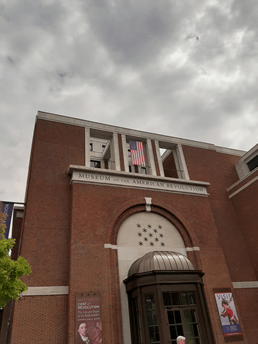
The Museum’s Entrance

Located not too far from the Independence Hall, the Museum of the American Revolution explores the American Revolution through its unmatched collection of Revolutionary-era weapons, personal items, documents, and works of art. Since it opened in April 2017, the Museum’s aim is to inspire visitors to gain a deeper appreciation for how this nation came to be and feel inspired to consider their role in the ongoing promise of the American Revolution. After getting my admission ticket, I decided to start by going upstairs to see the exhibits.

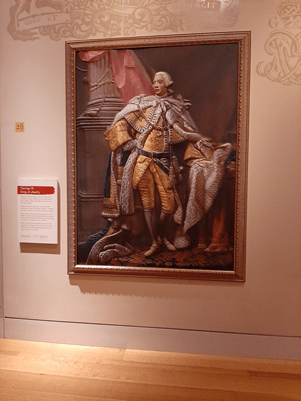
Portrait of King George III

The second floor contained the core exhibition which explores the origins of the American Revolution, the fight for independence, and the on-going legacies of the Revolution.  Throughout the exhibition, the collections and the narrative were guided by these questions which invites visitors to answer them while they explore:

How did people become Revolutionaries?

How did the Revolution survive its darkest hour?

How Revolutionary was the war?

What kind of nation did the Revolution create?

I enjoyed that the Museum guides visitors through the exhibit by introducing these questions for them to keep in mind because it could help them think about what they see, read, and interact with and the significance of the Revolutionary War. Another example of having visitors think more about what really happened during the Revolutionary War were the “Closer Look” markers I found as I went through the exhibit. One of the “Closer Look” labels asked the question When was the term “American Revolution” first used? This question made me happy as a public historian since introducing these questions puts the visitor in the perspective of a historian and challenges the usual way history is taught in the American school system (assuming there is a clear answer for each question posed).

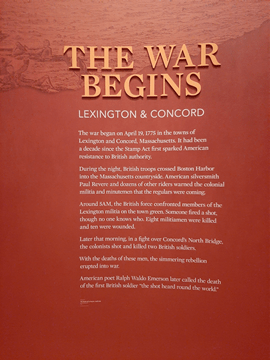
After exploring the origins of the American Revolution section of the exhibit, I proceeded to the fight for independence section. I read about the Battle of Lexington and Concord and saw the collections from the era.
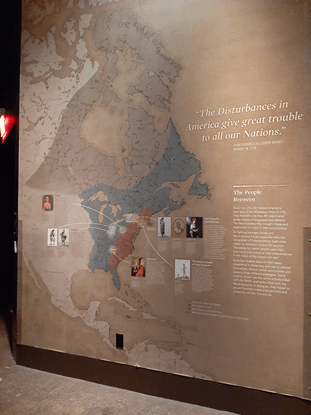
As I moved through the exhibit, I noticed several more interactive supplements that made the experience more engaging. For instance, there is a map that lights up when a button is pressed to show the soldiers movements during battles such as the Battle of Princeton (1777). Also, in the room where the life-size replica privateer ship is located, there is a piece of the replica tar-covered rope inside a box, visitors were encouraged to smell it.

I also appreciated that within the exhibit there is a section within the exhibit that discussed the narrative of the forgotten allies, the Oneida Nation, that joined the colonists in the fight during the American Revolution. Not many talks about the Native American involvement and contributions to the American Revolution, and this exhibit includes a video describing how the Oneida Nation decided to join the colonists.
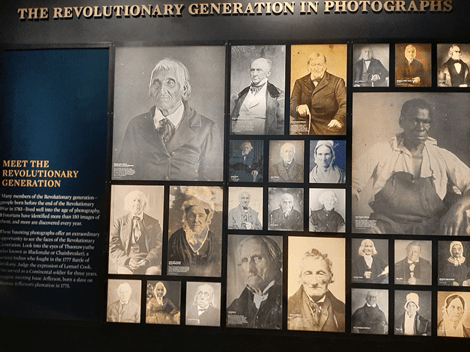
Towards the end of the exhibit, there is a section dedicated to the Revolutionary Generation through photographs. According to the Museum’s text, the last known Revolutionary War veterans had their photographs taken and died shortly after the Civil War. Also, I liked that the exhibit ended with visitors meeting the future of the American Revolution which has a wall covered with mirrors since it is a subtle way of explaining to visitors what these veterans were fighting for.
I did not explain everything I have seen because there was so much that the post would be too long, and I really encourage everyone reading the blog to visit the Museum of the American Revolution when one gets the opportunity. Since my visit, I found out that there is a virtual tour available on the Museum’s website so if one is not able to get there in person yet there is another way to see the Museum. It is a museum I am willing to visit again when I can visit Philadelphia again.

To find out more about the Museum, click here for the Museum’s website: http://www.amrevmuseum.org/

If you have been to the Museum, what were the things that you observed? If you have not visited yet, what would you like to learn more about or expect to see?

Digital Resource Examination: The Inclusive Historian’s Handbook

September 19, 2019

Resources for public historians and museum professionals are numerous, and as both fields are talking about and taking action to being more inclusive there is a demand for resources to help museums, historic sites, and its staff become more inclusive. There are books, professional development sessions, webinars, articles, et. cetera professionals develop and utilize to move the fields forward. I participated in the American Association for State and Local History (AASLH)’s webinar this afternoon about the new digital project, The Inclusive Historian’s Handbook first released in August 2019 during the AASLH Annual Meeting in Philadelphia. The Inclusive Historian’s Handbook is co-sponsored by AASLH and the National Council for Public History (NCPH). In the webinar, Kimberly Springle (Executive Director of the Charles Sumner School Museum and Archives and an advisory committee member) and Will Walker (associate professor of history, Cooperstown Graduate Program, SUNY Oneonta and an editor for the Handbook) presented the website and explained how they envision the site to be used.

The Inclusive Historian’s Handbook is a digital resource that is free and open to all on the internet, and the authors of the entries on the site are experienced public historians and museum professionals. According to Springle and Walker, the goals for the Handbook are

To share a knowledge base that invites more people to engage in history projects,

To center equity, inclusivity, diversity, and public service,

To provide concrete examples of how to make history work more relevant.

I always appreciate projects that has several professionals collaborate to make a difference in the field. I appreciate that one of their approaches for being more inclusive is inviting individuals of varying backgrounds from professionals to individuals who work with historical collections but do not call themselves historians. By having so many contributors, we would have a lot of perspectives represented in each entry. When contributors send in their entries, there are editors and advisors that work together with contributors to make sure their content is as clear and concise as possible. The topics are limitless, and the list the presenters shared proved how extensive the list is and there is always more to write about for the Handbook.

They first shared a list of twenty-one current entries in the Inclusive Historian’s Handbook. A few examples of current entries include accessibility, civic engagement, heritage tourism, memorials and monuments, sexuality, and historic preservation. They also had a list of entries that are in progress of editing including but not limited to activism, oral history, leadership, K-12 history education, and Holocaust history. Lastly, they included a list of proposed entries including but limited to advisory boards, Civil Rights history, decolonizing museums, difficult history, boards and governance, documentary films, gender, and hiring. The editors and Advisory Committee members are still encouraging individuals to contribute to the Handbook by using the contact form on their website.

Participants in the webinar also were asked to answer two short polls in which of the 20 proposed entry categories. In the polls, we chose three categories from each one we were most interested in reading about. I think this would also be helpful for the Handbook to include these polls for visitors to the website so it will help both the Advisory Committee, editors, and contributors know what entries need to be included in the Handbook. Also, I like that the target audience for the Handbook is more inclusive.

Springle and Walker emphasized that the audience for the Handbook is anyone who is seeking to be more inclusive, equitable, and service-oriented in their work not just for paid professionals or academic scholars. Their hope with this digital resource project is that the content is accessible to all individuals who are doing historical work. Also, they had a list of suggested ways to use the Handbook including but not limited to personal reflection, staff development/team building, teaching/mentoring, collaboration/partnerships, resource mining, and contribute. Each suggested way to use the Handbook is significant to help the study of history evolve and inspire people to continue discussing important topics we need to keep fresh in our minds. It will also help museum professionals move forward within the field by delving into important topics we need to continue to address (especially hiring and boards and governance). This is a living digital resource that will be useful for all who seek inclusivity in history, and hopefully future editions will help continue important discussions.

To learn more, check it out here: www.inclusivehistorian.com

Museum Impressions: Independence Hall

September 12, 2019

On the first day of the AASLH Annual Meeting, I decided to not attend workshops and walk around Philadelphia to visit various sites. I mentioned in the previous blog post that I went to Philadelphia as a teenager with my family, and because it has been sixteen years since I visited, I decided it would be a better decision to explore the city. The first place I visited on the first day was Independence Hall where I participated in a tour led by the National Park Service Rangers.

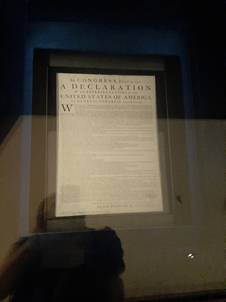
Since my tour was not going to begin for about 10 to 15 minutes, I was able to explore the grounds and visit the Great Essentials Exhibit in the West Wing of Independence Hall. According to the website, the Great Essentials Exhibit displays surviving copies of the Declaration of Independence, the Articles of Confederation, and the Constitution of the United States, along with the silver inkstand that, according to tradition, was used during the signing of the Declaration and Constitution. The copies that I saw were not signed since the ones signed are located in Washington, D.C., and while I was there a Park Ranger stated there were many copies made to be distributed throughout the colonies to spread the news of the Declaration and Constitution.

After visiting the exhibit, I went in line to wait with the group for the timed tour to start. I liked that one of the Rangers had a brief introduction before going in to remind people to not bring in food and drinks, and to not be on cellphones while on the tour. To me it showed that not only Rangers made sure history is being protected but they emphasized the importance of the history as well as the importance of engaging with the surroundings instead of calling and texting during the tour. We were then brought inside the East Wing of Independence Hall to sit down for a brief introduction of the history of Independence Hall and then we went onto the tour.

The group I was in was led outside to walk into the main building. Inside there were two rooms we went into to learn more about the Pennsylvania State House which is later known as Independence Hall. While it was known as the place where the Declaration of Independence was written and approved, there is so much more to this building’s history. According to the National Park Service, the Pennsylvania State House originally housed all three branches of Pennsylvania’s colonial government. The rooms we saw were the Courtroom of the Pennsylvania Supreme Court and the Assembly Room.

We went into the first room which was the Courtroom of the Pennsylvania Supreme Court. After taking pictures, our Ranger guide started to tell us more about the room and more history about Independence Hall. A couple of examples we were told about was that the Supreme Court of Pennsylvania sat in this room in the 1700s. Another example was that on July 8, 1776, an act of defiance occurred here when a group of Pennsylvania militiamen stormed in and tore down British King George III’s coat of arms; then a hundred years later, visitors came to this room during the Centennial to experience the National Museum, a collection of artifacts celebrating the founding of the nation.

Once we were finished in the Courtroom, we went into the Assembly Room where the Declaration of Independence and the U.S. Constitution were signed. The Assembly Room later became a shrine to the founding of the nation with a proudly displayed Liberty Bell and original paintings of the Founding Fathers. The tour concluded in this room after about twenty minutes in each of the rooms previously mentioned.

I would have liked to see more of Independence Hall such as the Long Gallery and Governor’s Council Chamber located on the second floor. The Long Gallery served as a reception area for visitors meeting with Pennsylvania’s governor, and the Governor’s Council Chamber was where Pennsylvania’s Supreme Executive Council met in this room in the 18th century then later was used as the location fugitive slave trials in the 1850s. There seemed to be at least a few opportunities to have further discussions about challenging the historical narrative that glorified the past briefly mentioned in the tour. While I was confused when I noticed how short the tour was, because this is one of the most popular landmarks in the United States there are numerous visitors the National Park Service bring through Independence Hall they would need to get each tour group through as swiftly and smoothly as possible.

Museums are moving forward to creating more engaging and interactive experiences to be more visitor-focused, and I wonder: should Independence Hall do the same and if so, what approaches should be done? I believe that there should be interactive opportunities at least on the property as another option to do while waiting for tours to begin like a pop-up museum that are easily moved for weather conditions. I do think that if one has not visited Independence Hall one should visit at least once to learn about the significance of it’s part in the birth of the United States and learn about the building beyond this significance.

Share your experiences. If you have visited Independence Hall, what were your experiences like?

Resources:

https://www.nps.gov/inde/index.htm

https://www.nps.gov/inde/planyourvisit/independencehall.htm

https://www.nps.gov/inde/learn/historyculture/places-independencehall.htm

https://www.nps.gov/inde/learn/historyculture/places-independencehall-assemblyroom.htm

https://www.nps.gov/inde/planyourvisit/westwing.htm

https://www.nps.gov/inde/learn/historyculture/places-greatessentialswestwing.htm

Remembering 9/11: 18 years later

September 11, 2019

Normally I would be posting a blog post on Thursdays but today I decided to write a short post in addition to my Thursday post because I had a number of thoughts as I remember the 18th anniversary of the 9/11 attacks. I read various articles today about remembering those attacks on the World Trade Center and the Pentagon, and the people who have lost their lives on that day. I saw comparison pictures of the New York City skyline and area the day of the attacks and what they look like today. It is hard sometimes to think that it had been so long ago, and yet it felt like it had been a short time ago at the same time. Eighteen years later, I can still vividly remember where I was when I learned about the news and saw the attacks on the television. When the attacks happened, I was in middle school in my hometown of Franklin, Massachusetts and I was in class as I learned about what was happening in New York City. Even though we were in the middle of a history lesson, my teacher turned the television on so my classmates and I can learn about what is going on as it happened. I remember talking about what happened with my mother and sisters after school on the ride home, and later watching the news coverage.

Now that I live on Long Island, New York, I see more of how New Yorkers felt on that day and how they remember. I am also happy about how many people are able to help those in need on that day and even now as 4,000 New York volunteers board the Intrepid to pack a million non-perishable meals for New York families and 100,000 non-perishable meals for victims of Hurricane Dorian (according to an article I read on amny.com released the day before). These actions remind me of how our country, even as it faces so much over the past few years, can still come together to remember and help others. I am happy that we still commemorate this day to remind us of not only what happened and those who have lost their lives on that day but those men and women in the police and fire departments, and volunteers, who worked hard to save lives. I will never forget!

Below I have included articles I have read today and the 9/11 Memorial Museum website for more information:

https://www.amny.com/news/intrepid-9-11-volunteer-1.36140377

todayincthistory.com/2019/09/11/september-11-9-11-terrorist-attacks-hit-close-to-home/

https://americanhistory.si.edu/blog/handwritten-note-september-11-2001

gvshp.org/blog/2019/09/11/remembering-the-world-trade-center-and-its-aftermath-of-its-destruction/

abcnews.go.com/US/us-marks-18th-anniversary-911-terrorist-attacks/story?id=65530195&cid=social_twitter_abcn

https://news.yahoo.com/911-then-and-now-18-years-later-182946226.html

https://www.911memorial.org/

#AASLH2019: Conference Recap

September 5, 2019

Last week I attended the AASLH Annual Meeting for the first time located in Philadelphia. If you were following along with me on Twitter, I tweeted a lot about the sessions I attended, the events I participated in, and the places in Philadelphia I visited on my own. I included a highlight of tweets from the Annual Meeting in this post, and to see all of tweets I posted they can be found on the page here @Steward2Lindsey. Because I have not been to Philadelphia since I was a teenager, I was naturally excited to return and explore the area while I could during the conference.

I started tweeting about the conference the night before since I was so excited. I got the song “One More Sleep ‘til Christmas” from The Muppets Christmas Carol stuck in my head thinking about one more night until I leave for Philadelphia which inspired this tweet:

I will admit that it was hard for me to sleep the night before because I was so excited to be going back to a city I have not been in many years. In the morning, I left with my Three Village Historical Society colleagues to the Philadelphia 201 Hotel where the conference took place.

We arrived in Philadelphia later in the morning to check into our rooms. Once we put our things in our rooms, we went to the registration table to check in and get our totes that include conference programs, leaflets, and tickets for lunches as well as events. My colleagues and I went our separate ways to do our own plans in the city. Wednesday is technically the first day of the conference since there are several workshops that require an additional registration fees for each workshop. Since I have not been to the city in years, I decided to not sign up for them opting to explore the area instead. I went to take a tour of Independence Hall, visited the Liberty Bell, explored the Museum of the American Revolution, looked inside Carpenter’s Hall, and walked through the 18th Century Garden. After attending the International Coalition of Sites of Conscience reception, I walked to Chinatown to get some dim sum.

On the official first day of the conference I attended the opening plenary (opening panel discussion), first time attendee reception, and sessions. When I was sending tweets from the conference, I followed the social media guidelines AASLH provided to show where one was tweeting from such as #plenary, #keynote, and if one is attending a session the hashtag starts with “#s” then the session number (i.e. #s10) listed in the program.

After attending the morning sessions, I went to the Educators and Interpreters Affiliation Luncheon which had three courses including an irresistible chocolate cake. During the luncheon, we learned more about the Museum of the American Revolution and its education program offerings.

I attended afternoon sessions after the luncheon including, and these are a few of my favorite moments from the sessions:

In the evening, I went to an evening event that took place at the Eastern State Penitentiary. After getting off the bus, the first thing I did was participated in a twenty-minute introduction tour. Then I walked around the Penitentiary on my own looking at various cells including Al Capone’s cell. At the Penitentiary, there are a few food stations that offered various cuisine; for instance, there is one station that served Philly Cheese steaks and another one that served sushi and dumplings. I also went through an exhibit called Prisons Today: Questions in the Age of Mass Incarceration that illustrates what prisons are like in recent years in both general facts and in more personal experiences. In a future blog post, I will talk more about my experiences at this museum. While waiting for the bus heading back to the hotel, I watched part of the animation films, made by people currently in prison, that were projected onto the Penitentiary’s wall outside the main entrance.

On the second day, the Three Village Historical Society colleagues and I participated in a poster session to talk about the Founder’s Day program which won a Leadership in History Award from AASLH. Then I attended a luncheon for historic house museums, and sessions about reworking historic house tours and advocacy for equity. In the evening, I joined the rest of the Three Village Historical Society conference participants and staff/colleagues who were able to come down to attend the Awards banquet as the Historical Society received the award.

On the last day of the conference, I attended morning sessions about finances in historic house museums and revamping school programs. While the rest of the day were more workshops, I decided to walk around Philadelphia before I left the city. I went to places including Betsy Ross’s House, Elfreth’s Alley, the Science History Institute, Christ Church and Burial Ground, and the Quaker Meeting House.

Overall, I enjoyed the conference and it made me want to go to Philadelphia again so I could see more of the city. The sessions were informative and are helpful as I move forward in my career. To see more tweets from the conference, they are available on my Twitter page.

If you have any questions about the sessions I attended, please reach out to me on my social media pages or here.

Services Examination: Explorable Places

August 22, 2019

As a museum professional, there are so many services I learned about that offer various ways to facilitate museum practices. For instance, there are services that help museum educators run booking and scheduling school programs. There are also services that help education programs get attention from parents and teachers to learn about field trip opportunities at museums; one of those services is Explorable Places. According to their website, Explorable Places helps parents and teachers find great learning experiences outside the classroom.

I learned about Explorable Places during this past year’s New York City Museum Educators Roundtable (NYCMER) conference. It was in the session I attended called Technology in Museums: when it works, and when it doesn’t, which discussed when it makes sense to add technology to museums; the session asked questions such as: When does introducing technology actually take away from our objective? How can we figure this out before pouring thousands of dollars and hundreds of hours into a “new” technology product? The speakers, one of them was the founder of Explorable Places, discussed their partnerships to draw more teachers and students to their museum. Since attending the session, I decided to take a closer look at the website to see how this service works.

On the website, there is a place where one can find trips, assemblies, and performances by typing in one’s zip code. At the time of this post, the featured cities are New York, Kansas City, Metro-Denver, and Philadelphia.  In the modify search and search results page, there are five sections to help adults find opportunities and connect with museums to book programs. One can look for experiences by subject, grade level, activity, cost, and accommodations such as lunch space and special education programs. Also, one can look for programs that have the option to book online. When I clicked on one of the museums, a profile of the museum I selected appears which provides a brief description of the museum, pictures, and contact information.

Each profile also includes information on lunch spaces so they know if the museum has a place to eat or if there is a place nearby students can eat, and they provide information about bathrooms. Also, the profile has a section that showed tags for subjects, activities, grades, cost, and accommodations the museum has based on the search results. For instance, I went onto the Children’s Museum of the Arts profile and found the subjects educators teach are technology, arts, art, visual arts, and media/film. Profiles have a section called Learning Experiences which list educational opportunities with information such as a brief information, grade levels, capacity, price options, and duration of program. If a museum’s profile has this feature, adults could book online through Explorable Places portal which will take them to the museum’s calendar of availabilities and will guide them through the steps to book a program at the museum. I see the potential of helping more museums, parents, and teachers form connections to provide and participate in opportunities. Explorable Places’ home page includes links to pages for cultural partners, parents, and teachers to help them find what they are looking for.

For cultural partners, Explorable Places wants to help parents and teachers find them and the programs they offer. If an institution was not found on the Explorable Places site, they can reach out so Explorable Places can add them to the list to spread the word to site members. There are three tiers available for those considering reaching out to the site. The first tier, which is free, allows one to manage the page to include a photo of the site or program, one hundred words to describe what the museum/site does, up to five subject tags (verified for accuracy), and contact information and link. Each tier after the first one has additional features such as highlight learning experiences and unlimited bookings.

For parents and teachers, after clicking on the link it directs visitors to the places webpage. There are places in the states of Pennsylvania, Kansas, Colorado, New York, Delaware, and a couple of places in Massachusetts. Some of the places that are listed on the website are but not limited to Four Mile Historic Park, Old Sturbridge Village, Winterthur Museum, Garden & Library, and the Gore Place. Also, there is an opportunity to sign up to become a member so one could be informed about new museums or sites added to the cultural partners list.

To learn more about what Explorable Places offers and see if it is right for your site, students, or children, I included the website in the resources section.

Announcement: I will be attending this year’s AASLH Annual Meeting in Philadelphia next week from August 28th to August 31st. Instead of writing a blog post next week, I will be posting my reactions on social media and compile highlights for a post when I return. To follow my reactions to the sessions and events live, follow me on Twitter at this username: @Steward2Lindsey

Resources:

https://www.explorableplaces.com/

NYCMER 2019: https://lookingbackmovingforwardinmuseumeducation.com/2019/05/16/nycmer2019-the-yesterday-today-and-tomorrow-of-museum-education/

Humanities Indicators Results Reaction: Visitors Historic Sites and Museums on the Rise

August 15, 2019

This past Monday, I discovered an interesting study that was examined and presented by Humanities Indicators. For those who are not familiar with them, Humanities Indicators is run by the American Academy of the Arts and Sciences. The Academy is an honorary society that recognizes and celebrates the excellence of its members, and it is an independent research center convening the leaders from across disciplines, professions, and perspectives to address significant challenges. Humanities Indicators, according to the website, presents data which are quantitative descriptive statistics that chart trends over time in aspects of the humanities that are of interest to a wide audience and for which there are available data. As the title suggests, the results from the study revealed the number of visitors coming to historic sites and museums is on the rise.

On the results page, it revealed that the results were updated this month, so we know they continuously update the information as new studies have been completed. In the report, it stated according to the National Endowment for the Arts’ Survey of Public Participation in the Arts (SPPA), the percentage of people making at least one such visit fell steadily from 1982 to 2012, before rising somewhat in 2017. The recent results make me hopeful that the numbers will continue to increase especially since we need to preserve the historic sites, parks, and collections for future generations to learn about our past, and learn how we remember and preserve the past. It is important now more than ever to help educate people and future generations why history is significant in understanding how the country came to the current state it is in. I continued to read the study to learn about the findings they discovered about historic sites and museums.

There were a few findings and trends they reported on the webpage to explain the rise of visitors to historic sites and museums. For instance, the number of American adults who visited historic sites has changed in a few ways:

In 2017, 28% of American adults reported visiting a historic site in the previous year. This represented an increase of 4.4 percentage points from 2012 (the last time SPPA was administered), but a decrease of 8.9 percentage points from 1982 (Indicator V-13a). The bulk of the decline in visitation occurred from 2002 to 2008.

The Indicator V-13a refers to the bar graph that measures the percentage of U.S. adults by age who toured a park, monument, building, or neighborhood for historic or design value in the previous 12 months between 1982 and 2017. What did not surprise me too much was the bulk of the decline between 2002 and 2008 since it was the years leading up to the recession and I assume not many people were willing or able to travel as much (of course there is more than one reason for the decline). Other findings and trends that were shared by Humanities Indicators include:

From 1982 to 2017, the differences among age groups with respect to rates of historic site visitation decreased. For example, in 1982, the rate of visitation among 25-to-34-year-olds (the group most likely to visit a historic site in that survey) was approximately 11 percentage points higher than that of the youngest age group (18-to-24-year-olds), and more than 17 points higher than that of people ages 65–74. By 2017, however, the visitation rate of 25-to-34-year-olds had dropped to within five percentage points of the younger cohort and was virtually identical of that for the older group.

Much of the recent growth in visits to historic sites occurred among parks classified as national memorials and was driven by a particularly high level of visitation at sites that did not exist in 1995, such as the Franklin Delano Roosevelt Memorial (3.3 million visitors in 2018), the Martin Luther King, Jr. Memorial (3.6 million visitors), and the World War II Memorial (4.7 million visitors). As a result, visits to national memorials increased more than 300% from 1995 to 2016, even as the number of sites increased just 26% (from 23 to 29). In comparison, visits to national monuments increased only 3%, even as the number of sites in the category increased by 9% (from 64 to 70). From 2016 to 2018, the number of visits fell in every category, with the largest decline occurring at the memorial sites (down 10%), and the smallest drop at national monuments (3%).

When I read the study not only was I beginning to see hope in the future of museum and historic site visits, but I also began to get curious about how historic sites and museums visits were influenced by people outside the country visiting the United States. Is there a study out there that showed foreign visitors at the historic sites, parks, museums? Were the patterns like what has been presented in this study?

I would also be interested in the number of families that visit the historic sites and museums. Are there similar patterns found in this study for family visitors? It would be worth looking into both foreign visitors and families.

To find out the rest of the findings and the charts that visually represented the results they discovered, I included a link to the original site they presented the study. They also included a study on attendance of art museums, and I included the link to this one as well.

Resources:

Historic Sites Visits: https://www.humanitiesindicators.org/content/indicatordoc.aspx?i=101

Art Museum Attendance: https://www.humanitiesindicators.org/content/indicatordoc.aspx?i=102

American Academy of the Arts and Sciences: https://www.amacad.org/

Humanities Indicators: https://www.humanitiesindicators.org/default.aspx

Museums I Visited While I Was in College: Springfield Museums

Added on August, 8, 2019

One of my previous blog posts had my memories of visiting the Salem Witch Museum as Historical Society Club Treasurer in college, and to learn more about the experience check out the link here after reading this post. Another museum I visited during college was Springfield Museums which was not far from where I went to college in Springfield, Massachusetts.

Springfield Museums is in downtown Springfield and provides access to five museums under one admission. According to their website, the Museums inspire exploration of our connections to art, history and science through outstanding collections, exhibitions and programs. The mission was apparent during my visits to the Springfield Museums. My first visit was during another Historical Society trip, and the museums I remember visiting were the George Walter Vincent Smith Art Museum, the Michele and Donald D’Amour Museum of Fine Arts and the Lyman and Merrie Wood Museum of Springfield History.

The George Walter Vincent Smith Art Museum is an art museum which holds the eclectic collections of George Walter Vincent Smith (1832-1923) and his wife, Belle Townsley Smith (1845-1928) in an Italian palazzo-style building established in 1896. Their collections include but not limited to examples of Japanese lacquer, arms and armor, ceramics and bronzes; and one of the largest collections of Chinese cloisonné outside of Asia. Also, the collection contains significant American 19th-century paintings (especially landscape and genre), Italian 19th-century watercolors, a fine assembly of Greek and Roman antiquities, a rare plaster cast collection, objects created for 19th-century International Expositions and examples of lace and early textiles.

The Michele and Donald D’Amour Museum of Fine Arts was established in 1933 and located in an Art Deco style building. It includes a comprehensive collection of American, Asian and European paintings, prints, watercolors and sculpture and representative examples of drawing, furniture, metalwork, textiles, glass and ceramics. Inside the museum, it houses a comprehensive collection of European Art (French, Dutch, and Italian) and the Currier & Ives (active 1834-1907) Collection is the largest holdings of lithographs in the nation.

The Lyman and Merrie Wood Museum of Springfield History is known for its local history research facility. Also, the museum is known for its comprehensive program of changing exhibitions, its diverse educational offerings, and the wide-ranging collections that illuminates the history of the Connecticut River Valley.

I visited the museums not only as part of a Historical Society trip but for classes as requirements for my studies at college. I took a culture course on France and French Caribbean, and one of our assignments included a visit as a class to the Michele and Donald D’Amour Museum of Fine Arts to see and discuss the French art collection. Another course I took was an art course in which I visited the art museums to use resources available to complete assignments.

At each visit to Springfield Museums, I visited the Dr. Seuss National Memorial Sculpture Garden. The Garden celebrates Theodor Seuss Geisel, also known as Dr. Seuss, in the city in which he was born and raised. After Dr. Seuss’ death, his wife, Audrey, authorized the museums to create the memorial which features bronze sculptures of his characters. At the time of my visits, it was the only connection to Dr. Seuss that the museums had in its campus. When I was still a college student, they were still working on establishing a museum dedicated to his life and work.

Now there is a museum called The Amazing World of Dr. Seuss Museum that is devoted to Dr. Seuss. According to the website, it features family friendly, interactive exhibits that explores his Springfield roots and provides opportunities to experiment with new sounds and vocabulary, play rhyming games, and invent stories. The museum also features a recreated studio and living room of Geisel’s, and never been publicly displayed art, family photographs, and letters.

Since there is so much to see, I did not see everything in the museum system. For instance, I have not seen exhibits in the Springfield Science Museum. It houses permanent collections of Natural Science, Anthropology and Physical Science. The Science Museum also includes Seymour Planetarium which consists of the historic Korkosz Starball, the oldest operating star-projector in the United States. I recommend if one can do so to visit the Springfield Museums and see the vast collections; be sure to dedicate a lot of time to see as much as possible.

Resources:

https://springfieldmuseums.org/

https://lookingbackmovingforwardinmuseumeducation.com/2018/10/04/patron-request-museum-impressions-salem-witch-museum/

Virtual Museum Experiences: Impressions of Museum Education Roundtable’s Journal of Museum Education

August 1, 2019

This week Museum Education Roundtable released the forty-fourth volume, number three edition of their journal, Journal of Museum Education, online. In case you are not familiar with the journal, the Journal of Museum Education is a peer-reviewed journal released by the Museum Education Roundtable four times a year that explores and reports on theory, training, and practice in the museum education field. Each journal is divided into at least four sections, and in the latest edition they are: Editorial; Articles; Tools, Frameworks and Case Studies; and Book Review. In this edition of the Journal, there are four articles focused on virtual reality, five pieces in the Tools, Frameworks and Case Studies, and a book review of the book Intentional Practice for Museums: A Guide for Maximizing Impact by Randi Korn.

On Museum Education Roundtable’s website, they released links to the articles from this edition Virtual Visits: Museums Beaming in Live focusing on using virtual reality for museum experiences. I believe that utilizing virtual reality in museum education is a helpful tool for visitor experiences, and while it does not replace the in-person experience, but it especially is a benefit for individuals who are not able to for various reasons be in the physical space. I have limited experience with virtual reality, but I continuously seek professional development opportunities to advance my skills as a museum educator; which is why I took advantage of reading these articles.

At the Long Island Explorium, a children’s science museum, I have worked with virtual reality programs for educational and entertainment purposes. Each visitor had the opportunity to wear a virtual reality headset and participate in a couple of programs that came with the Microsoft virtual reality system. One of the programs allowed visitors to tour through the solar system wearing the headset and using the handsets participants can click on each star, planet, etc. to learn more about everything about solar systems. The second program gives participants two ancient ruins and their modern landscapes to tour through to learn the history of each civilization; participants can tour through either Peru or Rome. What was different about this program from the solar system program is participants can move around a little bit as if they were really standing in the locations. The Microsoft system we used connected to the PC and Smartboard which allowed individuals who were not wearing the headset to view what the person wearing it sees.

Since I was guiding visitors and showed the rest of the museum staff how to use the virtual reality, I have gained some experience using it and recognize the value of virtual reality in museums. Both programs provide an educational opportunity for visitors to explore space and civilizations where they are most likely have not been before. When I read the latest edition of Journal of Museum Education, I shared the sentiment the Editor-in-Chief, Cynthia Robinson, shared in the journal

“Although virtual access does not provide some of the authenticity of a physical encounter, it is no less meaningful than reading a history book to learn about and imagine the past, or viewing a filmed documentary of a place we would otherwise not visit.”

By including virtual reality in museums, museum professionals can provide another medium they will utilize for programs and exhibits to reach out to visitors. My experience with virtual reality showed me the potential of its use in a children’s science museum and based on the programs I worked with I have no doubt it could work with varying types of museums.

Individuals can take advantage of virtually visiting museums and participating in museum programs that are far from home, or places that are not entirely handicapped accessible. According to one of the articles, “Virtual Visits: Museums Beaming in Live”, Allyson Mitchell stated

“Museum educators already interpret the collections and content of their institutions through educational programming to meet the needs of family, school age, adult, senior, and community audiences. IVL [Interactive Virtual Learning] programs provide a similar real-time connection to a museum professional who facilitates personalized learning experiences that actively engage groups visiting virtually to forge deeper connection to cultural institutions and lifelong learning.”

IVL programs provide live interactive broadcasts that offer visitors at a distance real-time connection to a museum professional and resources. I had my first experience with an IVL program during a professional development program. During last year’s New York City Museum Educators Roundtable (NYCMER) conference, I participated in a session called Virtual Field Trips: Traveling Through Time and Space to Connect Museums and Audiences in which session speakers discussed the benefits and challenges of running and planning virtual field trips. Also, they performed a demonstration what a virtual field trip is like using Skype by giving us a brief demonstration of what it would be like to be in space without wearing a space suit. As I continued to read the Journal of Museum Education, I realize the continued potential of virtual reality use in museums not only in programs but with museum collections.

In the article “Defining Interactive Virtual Learning in Museum Education: A Shared Perspective”, Kasey Gaylord-Opalewski & Lynda O’Leary discussed how all cultural institutions can benefit from a top-notch virtual learning program in terms of outreach, diversity, and promotion of collection. According to Gaylord-Opalewski and O’Leary, there are multiple benefits of using

“The world of IVL is commonly viewed as an addendum to an onsite experience with cultural institutions such as zoos, museums, libraries, science centers, and the like. Through dedicated virtual educators trained to interpret collections using synchronous technology, IVL programs serve not just as an addendum to onsite experiences, but rather as a conduit for greater outreach and promotion to audiences that may never have the opportunity to visit the collections of a museum in person – due to budget, physical limitations, or distance.”

While the program I used at the Long Island Explorium was used as one of the additions used onsite, I believe in the potential to reach out to many current and potential visitors who do not always have access to museums in person. Museum professionals have always investigated ways we can draw more visitors to our museums and sites, and as technology continues to develop we continue to figure out different ways we can reach out to people to share resources and collections.

Discussion Questions: Have you used virtual reality, whether it was in a museum or not? What is your reaction to virtual reality? Do you think virtual reality could be useful in museums? Why or why not?

Resources:

www.museumedu.org/jme/jme-44-3-virtual-visits-museums-beaming-in-live/

https://lookingbackmovingforwardinmuseumeducation.com/2018/05/24/social-media-journalists-at-conferences-my-experience-as-one-at-nycmer-2018/

Mental Impact of Historic Sites on Individuals

July 25, 2019

As a member of the American Association for State and Local History, I receive a copy of History News, the magazine that connects the people engaged in history work to new questions, ideas, perspectives, and each other. This week I received the Spring edition of the History News which focused on the power historic places hold on visitors. One of the articles featured in the magazine is “More Than a Feeling: Measuring the Impact of Historic Sites on the Brain” which discusses the impact of historic places on people’s mental state. After reading this article, I thought about my own experiences visiting historic places and my own emotional and intellectual response to these experiences. I covered a lot about the places I have visited on my blog in the past which I will include links to at the end of this post. I decided to revisit the ones I have written about to point out the emotional and intellectual connections I made to the places I visited to show how my connections evolved overtime. By briefly sharing both the article and my experiences from the previous blog posts, we will see how important historic sites and places are to individuals’ mental state during their visits.

Written by Erin Carlson Mast and Callie Hawkins, the Executive Director and the Director of Programming at President Lincoln’s Cottage respectively, the article examines how the staff at President Lincoln’s Cottage investigate how visitors are emotionally and intellectually effected by this historic site. Carlson Mast and Hawkins pointed out that:

Though many have tried to explain the value of old places or the important role they play in our society, no one has created a replicable, scientific way to quantify what is often at the heart of our mission: deeply personal, qualitative experiences for individuals and communities.

The plan to study the emotional and intellectual effects in visitors is to use mobile electroencephalogram (EEG) technology to both measure and clarify brain states of visitors as they participate in the guided Cottage tour, with the goal of distinguishing between what does and does not have a significant impact on the visitors’ experience. There will be three groups of thirty participants who will participate in sub-groups of ten to mimic the average visit on a tour in the Cottage. As the tour is conducted, they will use the mobile EEG technology to measure excitement, interest, stress, engagement, focus, and relaxation and the participants self-reports will be used to clarify the data. I look forward to reading the follow-up to the study to see what the results would be.

I think that it would be interesting to discover what the emotional and intellectual connections to historic sites would be since we may have accurate data to use to help create more effective interactive as well as engaging exhibits and programs. The writers also brought up this point on the importance of this experiment:

Emotion is critical to enhancing learning, improving critical thinking, and inspiring people to act or think differently. Thus, having scientific data about the best ways the Cottage can illicit such responses will get us ever closer to fulfilling our mandate and proving the elusive power of place.

Museum professionals strive to create an engaging and educational experience for each visitor they serve within the community museums are located. As I reflect on my own experiences at museums as both a visitor and museum professional, I made note of the emotional and intellectual effects that it had on me.

For instance, one of the first museums I visited in my lifetime was at Plimoth Plantation in Plymouth, Massachusetts. In a blog post I wrote about my experience, I stated:

My first experience visiting Plimoth Plantation was when I came with my sisters, mother, and my maternal grandmother. I remember walking through the Village and meeting other visitors in the meeting house. Later I saw some pictures from that visit, and each of the pictures showed my sisters and I having an opportunity to use the broom to sweep one of the houses. Another picture I saw was of myself appearing to be giving a lecture which reminded me of the story my mother told me: I pretended to be a minister and encouraged visitors to sit down and participate in the mock service, and then I greeted each individual with handshakes. I went back a number of times during my childhood and then visited as a young adult.

Years later during college I visited Plimoth Plantation with the Historical Society club. As the treasurer on the executive board of the Historical Society, I planned the financial aspects of the trip. Once all the details were settled, all of the Historical Society members and other college students interested in attending drove to Plymouth.

My emotional connection to Plimoth Plantation is through my childhood memories of when I visited with family members. When I made another visit, it was when I was studying history in college and part of a historical society club for a both bonding and educational session. Both instances shared how my connections are reflections from my memory, and at the time of each instance I was creating bonding moments with family and peers that helped me connect with Plimoth Plantation’s narrative. When I was a child, I was focused on playing and enjoying my time in a setting I was not familiar with. Meanwhile, as a young adult I became more focused on the history of Plimoth colony and the Pilgrims and Native Americans who lived in the colony.

Another example of the similar emotional and intellectual connections made was when I visited the Salem Witch Museum located in Salem, Massachusetts. Known for the Salem Witch Trials and for the maritime history, Salem drew in many people to visit the tourist destinations. In my blog post about the Salem Witch Museum, I wrote about my experiences:

When I first made the visit to the Salem Witch Museum, it was in the 1990s and I was with my parents and my sisters. We waited in the lobby of the museum until the group we were in was able to sit in the auditorium to learn about the Salem Witch Trials. As my family waited for our turn, I remember looking through the brochures and saw pictures of the statues depicting the townsfolk. I was scared since in my imagination I thought that the creepy statues were going to move around in the dark room. Once our group was able to go in after the previous group left, I did not want to go in so one of my parents went into the gift shop with me until the rest of the family joined us. It was not until I was in college when I returned to the Salem Witch Museum.

The Historical Society club I was a member and treasurer of decided to visit the town of Salem during one of our day trips we typically go on a couple times a year. When I finally went inside of the Salem Witch Museum’s auditorium, I felt silly that I was scared of the statues since it turned out that they were only statues as a recording tells the history of the Salem Witch Trials while lights were used to give spotlights for the stationary statues.

As a child, I associated the Salem Witch Museum as a scary experience because of my impressions of what I was anticipating but when I was in college, I was able to see the presentation I missed during my last visit. Based on what I wrote in the blog, my emotion connection to the museum was caused by the stress of waiting for the experience and seeing visuals that made my imagination as a child run wild. Each of my experiences showed that time between visits effected my impressions and emotional connections to the museums.

If museum professionals in other museums can perform similar experiments, they could help their significantly effect not only how programs, events, and exhibits are developed but they could affect how staff can perform in their roles. The article pointed out that:

Proving the transformative nature of experiences at our sites and museums would mean that experiences like those shared by our visitors would be useful not only for advocacy and fundraising efforts, but also could better inform changes that would enhance the depth of our impact. We could apply that data to change how we recruit, train, and treat staff; how we interact with visitors; how we choose stories and how we tell them; and how we advocate for the field as a whole.

We will not know for sure unless we take a closer look into our visitors’ emotional connections to improve the quality of their experience.

Discussion question I will leave here: How do you feel about science experiments to study visitors’ experiences with museums?

Resources:

History News: https://learn.aaslh.org/history-news

Museum Impressions, Plimoth Plantation: https://lookingbackmovingforwardinmuseumeducation.com/2018/04/12/patreon-request-museum-impressions-plimoth-plantation/

Museum Impressions, Salem Witch Museum: https://lookingbackmovingforwardinmuseumeducation.com/2018/10/04/patron-request-museum-impressions-salem-witch-museum/