Thanksgiving: How We Are Changing the Way We Teach Kids Why We Celebrate

November 25, 2019

Thanksgiving is a few days away, and we reflect on how we teach the next generation about its history. Children in the past began to dress up as Pilgrims and Native Americans for school pageants, make Turkeys in arts and crafts, create headbands with feathers and clothing out of shopping bags, design hats with buckles on top, and listen to stories about the first Thanksgiving. When I was a child, I was taught these lessons and since I grew up in Massachusetts, I made a number of trips to Plimoth Plantation to interact with the living history interpreters. We were taught at a young age that Native Americans and the Pilgrims had their first Thanksgiving in 1621 when they shared food and learned to get along. This story was reinforced especially in the media, and rarely did the media challenge the story.

In the 1993 film Addams Family Values the camp Wednesday and Pugsley Addams attend put on a play based on the first Thanksgiving. Wednesday and other kids considered outcasts of the camp were assigned to portray Native Americans and the rest of the kids were cast as food and Pilgrims. The play began with the typical depiction of what our society has taught children about the first Thanksgiving including the Pilgrims finding common ground with the Native Americans. As one of the characters invited the Native Americans to their table, Wednesday breaks from the play and delivers this speech:

You have taken the land which is rightfully ours. Years from now my people will be forced to live in mobile homes on reservations. Your people will wear cardigans, and drink highballs. We will sell our bracelets by the roadsides. You will play golf and enjoy hot hors d’oeuvres. My people will have pain and degradation. Your people will have stick shifts. The gods of my tribe have spoken. They have said, “Do not trust the Pilgrims…”

Wednesday’s speech painted a different picture from the play attempted to tell, and is closer to the reality Native Americans face since their land was taken over. And now? The more we learned about Native Americans, the more we are moving away from this myth we were taught for generations.

I was introduced to the truth about the first Thanksgiving during one of my college History courses. Before we left for Thanksgiving, our professor assigned readings from the book The Times of Their Lives: Life, Love, and Death in Plymouth Colony by James Deetz and Patricia Scott Deetz. The Deetzes pointed out the myth of Thanksgiving which opened my eyes more to how this myth was used as a credible source to teach Early American history and the disservice it does to representing the true nature of the Pilgrim/Native American relationship. In recent years, we have started to move away from teaching children the myth.

Time magazine released an article, which will be in the December 2nd through 9th edition of the magazine, focusing on the change in the way American children are learning about the first Thanksgiving. Their article covered a workshop in Washington D.C. called “Rethinking Thanksgiving in Your Classroom” in which teachers learned a better way to teach the Thanksgiving story to their students and to do so they did a lot of studying to learn about the story. The teachers were part of the movement to change the way Thanksgiving is taught in schools that had been stuck in the 19th century’s nostalgic interpretation of the past. While the first Thanksgiving was celebrated in 1621, it was not a national holiday until President Abraham Lincoln declared it to be so to unite a country torn by the Civil War. The late 19th century saw a number of instances of rebranding people and events in the first Thanksgiving to fit the idyllic narrative, and by the 1920s Thanksgiving was the most talked about holiday in classrooms while leaving out details that made the settlers look bad. It was assumed that the Native Americans have disappeared which was why non-Native Americans feel comfortable dressing children in costumes; the reality is there are 573 federally recognized tribes today, and the active Native American culture and communities can be found across the country. The 1960s and 1970s civil rights movement, with the growth of the American Indian Movement, made the difference between reality and the story of Thanksgiving harder to ignore.

 Education Week also released an article that covered the turn to a different way to introduce the history of the first Thanksgiving. In addition to explaining the origins of how the celebration of Thanksgiving began and how the myth began to be taught in schools, they discussed when teachers noticed the need for change. Jacob Tsotigh, a citizen of the Kiowa tribe and the tribal education specialist for the National Indian Education Association, was quoted in the article stating that there is decreasingly less focus on the myth as people are made aware of the history being in actuality a myth as well as the realization that there is a different perspective which needs to be considered. While this myth has been shared for approximately 150 years, the Native American perspective has not been recognized in American schools. According to the article, Tsotigh recommended that to help students appreciate colonial oppression of Natives and the violence ensued from it the holiday should be reframed to honor representatives of Native communities who greeted the small number of European visitors at the time with open arms and believed in sharing with those less fortunate.

As we gather with family and friends this Thanksgiving, we should remember to not only express what we are thankful for but to also learn more about Native American culture and their perspectives about the holiday.

I have included additional resources about teaching Thanksgiving for more information. I am thankful to all of you who have either continued to read the blog since the beginning or have just started to read the blog.

Happy Thanksgiving!

Resources:

https://time.com/5725168/thanksgiving-history-lesson/

https://www.edweek.org/ew/articles/2019/11/22/as-thanksgiving-approaches-unlearning-history-continues.html

Deetz, James, Patricia Scott Deetz, The Times of Their Lives: Life, Love, and Death in Plymouth Colony, New York: Anchor Books, a division of Random House, Inc., 2000, pg. 22-24.

Additional Resources:

https://blog.nativehope.org/what-does-thanksgiving-mean-to-native-americans

http://www.seattleschild.com/This-Thanksgiving-educate-your-family-about-Native-history-and-culture/

https://www.smithsonianmag.com/blogs/national-museum-american-indian/2016/11/27/do-american-indians-celebrate-thanksgiving/

https://www.newyorker.com/magazine/2019/11/25/the-invention-of-thanksgiving?fbclid=IwAR3rQIfmcyD29tetwpltW15916fCVsdIoM3dg7V1IAUMgsOyhUe8vywd_wk

Museum Impressions: Henry Sheldon Museum

November 21, 2019

During the New England Museum Association conference earlier this month, I was able to visit a museum in Vermont before attending sessions. I knew that I was going to arrive the day before the conference officially began so I looked up what was in the area. When I found out I was going to Middlebury with a friend, I discovered the Henry Sheldon Museum and decided to visit it while my friend participated in pre-conference sessions. In my recent recap of the NEMA conference, I stated that

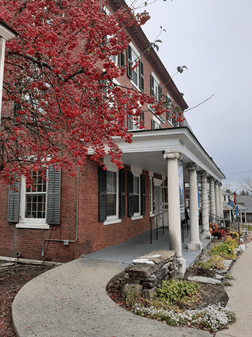
The Henry Sheldon Museum of Vermont History is the oldest community-based museum in the country opening their doors to visitors and researchers in 1884. Their mission is to serve the public by preserving the historic memory of the Addison County and surrounding communities, heightening the awareness and enjoyment of their rich cultural legacy, and stimulating the study of connections between Vermont’s past and broader historical themes. There are three main areas of the museum:

The Judd-Harris House, built in 1829, showcases a wealth of objects depicting small town life in nineteenth century Vermont

The Stewart-Swift Research Center houses one of the state’s premier archival collections, documenting the history of Middlebury, Addison County, and Vermont

The Walter Cerf Gallery hosts changing exhibits throughout the year.

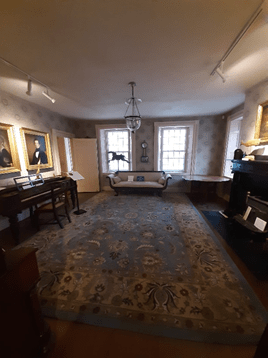
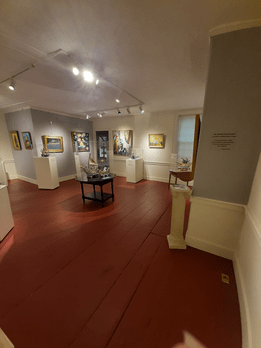
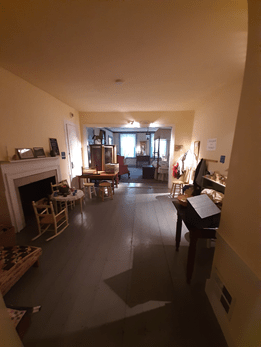
Before I entered the museum, I walked through the museum’s garden and then went inside for the museum. I first explored the Judd-Harris House with objects displayed to show what small-town life was like in nineteenth century Vermont. The first floor was set up as both a home and an exhibit space. When I was exploring the first floor of the museum, one of the things that stood out to me that I have never seen in a historic house museum before was an 124 year old stuffed cat sitting behind glass that was donated to the museum after the woman from Cornwall, Vermont who owned the cat had it stuffed by one of the students from Middlebury College.

At first, I was startled because I was not expecting to see a stuffed cat lying there in a case. The more I stared at it, the more impressed I was with how the cat was able to be preserved since about 1895. While I would not want to do this with my own pet, I understand why someone at that time wanted to keep their favorite pet around after its death. It also felt like a morbid time capsule that preserved what an animal that lived over a hundred years ago looked like.

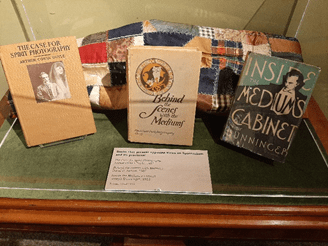
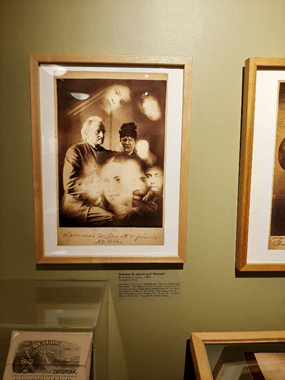
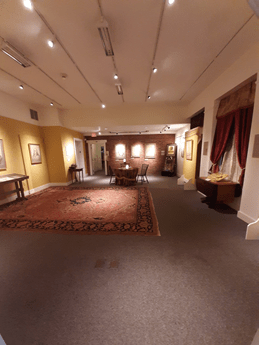
I also noticed that there were at least three exhibits located within the museum. The exhibits I explored the most were Conjuring the Dead: Spirit Art In The Age Of Radical Reform, The Animals Are Innocent, Ceramics And Paintings By Dana Simson, and Whimsical Wonders: Fairy Houses From Nature By Sally J Smith. In Conjuring the Dead, it presents spirit photographs and original spirit artwork from the Henry Sheldon Museum’s collections acquired by Solomon Wright Jewett (1808-94). According to the exhibit description from the Sheldon Museum, Jewett claimed he had supernatural powers that made him able to cure multiple ailments and bring people back from dead. Also, he was a strong believer in Spiritualism, which was a movement that preoccupied many people in the U.S. before and especially after the Civil War.

The Conjuring the Dead exhibit displayed Jewett’s collection of “spirit photographs” in which he appeared to be visited by notable figures, including President George Washington and Prince Albert of Great Britain. He also associated with and befriended a spirit artist, Wella P. Anderson and his wife, Lizzie “Pet” Anderson (a medium), who worked in New York City and Oakland, California. Jewett acquired from them eighteen pencil portraits that depict well-known historical and mythical figures spanning many geographical locations and historical times that apparently “visited” the artist under the influence of Jewett’s presence. Anderson’s drawings are now mostly known from photographs, and the original drawings in the Sheldon’s archives are rare.

In addition to the photographs and drawings, it also had ephemera, pamphlets, and objects that provide a rich context to the rise of Modern Spiritualism. It stemmed from a number of radical religious and social movements, including Mormonism, Millerism, utopianism, abolitionism and women’s suffrage, many of which originated and took a strong hold in Upstate New York and Vermont beginning in the 1820s. This exhibit occupied two floors, and I found on the second-floor drawings of spirits including one of Jesus of Nazareth. I also noticed a table with a Ouija board set up in the middle of the room which was most likely set up for exhibit related events.

After I explored the Spiritualism exhibit, I noticed on the door trim there was a subtle sign to show the next exhibit. In the Animals are Innocent, there are pieces that are part of a mixed media/ceramic exhibit of colorful, boat sculptures and paintings featuring animals, by Maryland artist, ceramist, author, and illustrator Dana Simson. Dana’s goal through her art is to how animals are losing both habitat and food sources, suffering the man-made effects of pollution and wilderness encroachment, and are imperiled by fossil-fuel enhanced climate change.  Simson’s message she conveyed within her pieces was very clear to me, and I recommend checking out her pieces to see an artistic representation of the pain animals are going through because of climate change on our planet.

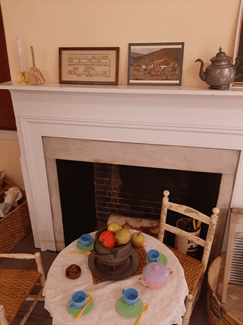
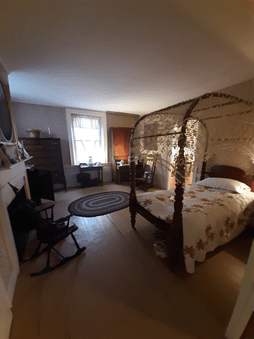
I was also impressed with other exhibits and interactive activities within the historic house setting. For instance, there is a children’s area where kids can both play and learn what 19th century life was like especially in Vermont. Also, there is an exhibit within one of the bedrooms called Whimsical Wonders: Fairy Houses from Nature.  Sally J Smith created fairy houses inspired by ones she made when she was a little girl; and like Simson, Smith considers herself an environmental artist. Her hopes with the fairy houses are to bring visitors back to nature, to invoke “a deeper respect and love for the Earth,” stressing the need for us to “reconnect with the Earth” in order to survive. One of the things I find fascinating about her fairy houses is the materials used to make them were found and gathered from the woods near her studio in Westport, New York. Located on shelves inside a closet behind glass, another thing I find fascinating about the fairy houses is the detail that goes into each house. There were no two houses that looked the same, and each one had its own unique character.

The last part of the self-guided tour was Henry Sheldon’s bedroom where a lot more treasures were found there including a set of keys laid on the bedside table and the Sheldon family crest. While I did not include everything I saw inside the museum, I strongly recommend seeing it for one selves and learn more about the history of Vermont.

For more information, check out their website: https://henrysheldonmuseum.org/

How Important it is to Teach Historical Thinking Skills

November 14, 2019

I have learned, as a historian and public historian, that having and utilizing thinking skills are essential for understanding history and the current events surrounding us in our communities. Therefore, I emphasize it is significant to continue as well as improve how we teach historical thinking skills in schools. Before I became a historian and a public historian, I was a student in the public-school system with a passion for history. In addition to going to museums at a young age with my family, I remember reading biographies and history books for kids in the school library where I discovered my childhood hero Albert Einstein (I admired how smart he was, and that we both played the violin).

While attending public school, my history classes focused on learning the significant events in our nation’s history then as I got older there was deeper conversations about historical events in U.S. and World history. It wasn’t until I started college that I was introduced to the historical thinking skills I am more familiar with today. These memories of how history was taught while I was in public school and how I was introduced to historical thinking were sparked when I came across a blog post from Future-Focused History sharing Mike Maxwell’s article in the Social Education, a peer-reviewed journal of articles on theoretical and practical ideas from the National Council for the Social Studies.

What are historical thinking skills? According to the American Historical Association, historical thinking skills are comprised of a number of skills that students should take away from a history class: chronological, historical comprehension, historical analysis and interpretation, historical research skills, and analysis and decision-making on historical issues. Students who study history should understand how to distinguish past, present, and future to identify how events take place in time while being able to look for, find, and interpret information from the documents found from the past, or primary sources. The question that needs to be addressed is: how can improve on helping students develop better historical thinking skills?

Mike Maxwell, in preparation for his article and his book Future-Focused History Teaching: Restoring the Power of Historical Learning, conducted a seven-year study of contemporary history schooling. He concluded that there are two factors that limit historical thinking skills’ potential, and those are: useful thinking requires useful knowledge to think about; and historical thinking skills aren’t exclusive to history.

Historical thinking skills are especially important for future generations of historians to develop and utilize to uncover forgotten history and to keep history relevant. If we do not do a good job in educating students on historical thinking skills, we would be doing a disservice for the next generation of life-long learners. While it is good to educate students about historical events to provide context, this practice encourages students to take the information at face value and not take the time to delve deeper into history with any thinking skills. When we do not use skills, we can lose the skills and serious consequences in interpreting history emerge.

One of the skills, for instance, I remember was taken away from lessons in school was how to read and write in cursive. The problem with taking away cursive is the majority of documents analyzed were written in cursive, and historians utilize those skills to read and interpret documents. Without that skill, we will not be able to interpret documents that have not been previously interpreted and learn more about our past.

Even students who are not interested in pursuing history as a career benefit from learning how to use and develop critical thinking skills. Maxwell’s article in Social Education argued that historical thinking skills could be used in other school subjects taught to students. His article pointed out that

Like history teachers, teachers of mathematics, language, science, and other school subjects may encourage their students to distinguish between fact and opinion; view circumstances in a wider context; seek valid evidence and corroborating viewpoints; consider underlying assumptions, alternative explanations, and unintended consequences. Because such critical thinking processes are general in nature, the educational system does not need a separate discipline of history dedicated to teaching them; other school subjects can adequately handle the job.

Historical thinking skills do not necessarily need to only be used for studying history. They can be utilized in varying subjects as they all require teachers to help their students develop thinking skills for solving problems, developing their own opinions, and have a better understanding of what facts are. Critical thinking skills are used as a part of life in varying situations, which would lead students to becoming more well-rounded individuals.

Discussion Questions: What are your thoughts on historical thinking skills? Can you share examples of historical/critical thinking skills you have used in your work and/or daily life?

Resources:

Maxwell, Mike, “Historical Thinking Skills: A Second Opinion”, Social Education, Vol. 83 Issue 5: pg. 290-294. https://futurefocusedhistory.files.wordpress.com/2019/10/ncss-article-102019-1.pdf

https://futurefocusedhistory.blog/historical-thinking-skills-a-second-opinion/

https://www.historians.org/teaching-and-learning/teaching-resources-for-historians/teaching-and-learning-in-the-digital-age/the-history-of-the-americas/the-conquest-of-mexico/for-teachers/setting-up-the-project/historical-thinking-skills

https://www.socialstudies.org/publications/socialeducation

#NEMA2019 Recap

November 13, 2019

I have once again participated in the New England Museum Association conference. It was in Burlington, Vermont this year and it was the first time that I have been in the state. I was not only excited to be participating in this year’s NEMA conference, but I was also looking forward to exploring the area. With a friend, I took a road trip to travel to Vermont for the conference. This year I decided to not only focus on sessions focusing on education but also sessions that help me get a better understanding of how to improve my leadership skills and of fundraising. As always, I found these conferences both informative, engaging, and entertaining to be with New England and New York colleagues. Thanks to all who have been following my tweets on Twitter covering the conference, and I have included a highlight of my tweets, photographs, and the sessions I attended during the week.

There were many beautiful views I witnessed as my friend and I went up to Middlebury, Vermont as the first stop before going to the hotel.

Once we arrived, she went to a pre-conference event and I decided to explore the area. The first place I went to was the Henry Sheldon Museum. The Henry Sheldon Museum of Vermont History is the oldest community-based museum in the country opening their doors to visitors and researchers in 1884. Their mission is to serve the public by preserving the historic memory of the Addison County and surrounding communities, heightening the awareness and enjoyment of our rich cultural legacy, and stimulating the study of connections between Vermont’s past and broader historical themes. There are three main areas of the museum:

The Judd-Harris House, built in 1829, showcases a wealth of objects depicting small town life in nineteenth century Vermont

The Stewart-Swift Research Center houses one of the state’s premier archival collections, documenting the history of Middlebury, Addison County, and Vermont

The Walter Cerf Gallery hosts changing exhibits throughout the year.

After visiting the museum, I walked around Main Street and window shopped along the street. I did go into a few stores including Vermont’s Own, which the majority of the products they sell were maple syrup which I could not help but purchase a sample. I went through a country store and the Vermont Book Shop. Eventually I walked back to meet my friend and explore the Middlebury College Museum of Art’s exhibit on the Women’s Suffragette.

Once we checked into the hotel, we walked down Main Street to visit the Lake Champlain Chocolate Store. As a former employee of a chocolate store, I purchased a number of samples for comparison. When we were done with exploring, we were ready for the next few days of conference sessions and events.

My first day of the conference began with learning about analysis of the open-ended questions and audience data. The panelists pointed out that using more than one method to analyze the data and multiple people to review the questions will be helpful for getting the results needed for what the museum is looking for.

I also attended the keynote session that focused on social justice. Dr. Gretchen Sorin, who is committed to encouraging museums to be more active in civic responsibility and social justice, discussed the upcoming book Driving While Black: African American Travel and the Road to Civil Rights and the PBS documentary produced by Ric Burns and Steeplechase Films, to be released in 2020.

The next session I attended focused on how to foster deeper connections between local teachers and museums; they argued that focusing education programming on supporting educators can lead to more quality student-site interactions, a deeper valuing of our museums in the community, and an expansion of museum capacity. Other sessions I attended were about summer camps and how to use camps to draw in new audiences as well as strengthen ties to schools and community (and listened to the experiences of teenagers who participated in the camps), and museum volunteers and how to create an impact measure for their roles.

That night I attended the opening evening event at the Echo Leahy Center for Lake Champlain. Echo Leahy Center inspires and engages families in the joy of scientific discovery, wonder of nature, and care of Lake Champlain. While enjoying hors d’oeuvres, I interacted with various exhibits including but not limited to Thomas Edison’s Secret Lab (which invites visitors to join the fun through interactive explorations that promote science, technology, engineering and math learning) and Into the Lake (which allows visitors to be immersed in the shipwreck at the bottom of Lake Champlain and learn about a twenty-foot serpent that may have lived in the lake). 

On the second day, I attended a number of sessions, an Educators professional affinity group (PAG) lunch, and another evening event at the Shelburne Museum. The first session I attended that morning was the importance of fundraising as a team effort (to learn effective ways to motivate staff and board members to be better fundraisers and hear strategies for attracting and retaining members). Also, the panelists led us in a half hour exercise around major gifts where we practiced “Making the Ask” or an elevator pitch to convince donors to help contribute to our museums’ upcoming major projects. One of the most important takeaways I learned from this session was:

Other sessions I attended were about emotionally intelligent leadership and how to incorporate evaluation practices into museum programming. In the session on emotionally intelligent leadership, we learned about assessing emotional skills, leveraging emotions and learning strategies to achieve results.

In the session on how to incorporate evaluation practices into museum programming, panelists shared practices and examples of incorporating evaluative thinking and reflective practice into the work as practitioners. It introduced practical, tested approaches for building evaluation capacity and using data to improve educational products and professional practices. At the Educators PAG lunch, we discussed the necessity of advocating for our needs as educators and had discussions among ourselves to ask questions, share ideas, offer each other advice, and connect with one another to provide inspiration, support, and resources after we leave the conference. 

The second night I attended the evening event at Shelburne Museum. After eating hors d’oeuvres, I walked through an exhibit that was not yet open to the public and a current exhibit. Time Lapse: Contemporary Analog Photography, which opened on November 9th (a couple of days after the evening event), is an exhibit that celebrates the work of 13 international and national contemporary artists who use the darkroom as a laboratory and find inspiration in the vast range of 19th-century photographic processes, from daguerreotypes to photograms. In the second exhibit, which is called Joel Barber & the Modern Decoy, the curator of the exhibit led us through a tour to discuss the life and artwork of architect, author, illustrator, and pioneering decoy collector Joel D. Barber.

After returning to the hotel, there was a lot of cars covered in snow which made me excited since I grew up watching the film White Christmas (majority of the film taking place in Vermont) and I was looking forward to seeing snow in Vermont. I was excited to see more snow on the ground the next morning, and while I was a little disappointed that most of it melted by the end of the conference, I was relieved that we were able to travel without worrying too much about the road conditions.

On the last day of the conference, I attended sessions about the introduction to assessment programs for museums, intangible histories, and a session of its kind called Recharge and Reimagine: Creative Break before attending the closing luncheon and annual meeting. The assessment programs session was intended to introduce, clarify, and spark interest in museum assessment programs such as AASLH StEPS, AAM MAP and Accreditation programs. In the intangible histories session, which was standing room only, panelists shared case studies from the Monticello (an exhibit about Sally Hemings), the Rokeby Museum, and Florence Griswold Museum to share techniques they used to show intangible histories and create meaning out of the memories and stories of individuals. As a public historian, this session was interesting to me because of the challenge intangible histories present and the importance of addressing underrepresented history.

Another session I attended which was different than ones I have previously attended was Recharge and Reimagine: Creative Break. I enjoyed it because it not only helped us tap into our creativity to inspire our work, but it also helped us wind down from an overload of information and excitement from the past few days. We participated in hands-on exercises that helped us use examples of ekphrasis, or the creation of one kind of art inspired by another kind of art. For example, one of the pieces of art shown to us Henri Matisse’s Open Window (1905) and we were encouraged to write any type of poem inspired by this painting. This is my poem:

Today I will look out my window. The colors are so vibrant. The shades of green bring the yard to life. The reds are these in my flowers helping them stand out on this beautiful day. The blues bring out the boats and the body of water. The water filled with so many waves of pink that channels happiness on this beautiful day. I welcome these colors into my window, and I watch as they emerge inside. The pinks and greens occupy the walls of my home. The blues join the greens and even some of the pinks joined the greens. All of the colors also reflect in my windows. I hope to never close my windows to these colors. I implore all who see colors outside to let them in. The colors bring me joy each day. Colors, please keep coming to my window. Tomorrow will be another beautiful day with you.

The drive back was beautiful because there was still snow on the ground. Once again, I enjoyed my experiences at the NEMA conference and will make efforts to exercise what I learned in all of the sessions.

If you are interested in learning more specific information about what I learned and my thoughts, please contact me here. Stay tuned for a new blog post tomorrow!

Resources:

https://henrysheldonmuseum.org/

https://www.echovermont.org/

https://shelburnemuseum.org/

Mini Blog Post: #NEMA2019

November 3, 2019

This week I will be attending the New England Museum Association conference in Burlington, Vermont. The New England Museum Association conference is a large annual professional development gathering of museum professionals in and out of the New England area; in most recent years, member of the Museum Association of New York are able to attend as NEMA members. Museum professionals have been gaining new insights, inspirations, and friendships through the NEMA conference since 1919. Since I am going to have a full schedule attending sessions and events, I will not be posting a full blog post on the usual Thursday date but I will be updating my experiences on my Twitter page throughout the week.

I will be in Vermont from November 5th through November 8th, and on November 5th I will be exploring the area before the official sessions begin. To learn about my experiences and my thoughts on the sessions as well as the events, follow me on Twitter: @Steward2Lindsey. Also, follow the conference itself by using the hashtag: #NEMA2019.

To learn about the previous NEMA conference, this is a recap from last year.

The History of Halloween and How Museums Celebrate

October 30, 2019

To celebrate Halloween, it is time to remind ourselves of how Halloween became the holiday we know in the twenty-first century. Halloween’s earliest root is the Pagan celebration and ancient Gaelic festival Samhain (pronounced “saah-win”) which marked the time of year when seasons changed, and many observers believed the boundary between this world and the outside world is at its thinnest to connect with the dead. Margot Alder explained in her book Drawing Down the Moon that Pagans, or Neo-Pagans, are varying religious groups with differing tradition, scope, structure, organizations, ritual, and names of their deities but regard one another as part of the same religious and philosophical movement; they share the same set of values and communicate with one another through a network of newsletters and websites, as well as regional and national gatherings. Her book went into detail about groups that attempt to recreate ancient European pre-Christian religions with leaders who developed key concepts and theories that are now common within the whole of Paganism. In an attempt to keep this post straight to the point, I will share how Samhain was celebrated, how it is celebrated nowadays, and how it led to the Halloween we now celebrate from resources I came across.

Early celebrations of Samhain involved a lot of ritualistic ceremonies to connect to spirits including celebrating in costumes (using animal skins) as a disguise themselves against ghosts, special feasts, built bon fires, and made lanterns by hollowing out gourds. During these celebrations, people would also tell each other fortunes. After the celebration was over, they re-lit the fires in their homes from the sacred bonfire to help protect them and keep themselves warm during the winter months.

Modern Pagans still celebrate the holiday with death as its central theme. According to Selena Fox of Circle Sanctuary, she pointed out

Although observances may include merry-making, the honoring of the Dead that is central to Samhain is a serious religious practice rather than a light-hearted make-believe re-enactment. Today’s Pagan Samhain rites, while somber, are benevolent, and, although centered on death, do not involve human or animal sacrifices. Most Samhain rituals are held in private rather than in public.

There are many ways that Pagans today celebrate Samhain. Like people of other faiths, they always honor and show respect for their dead but modern Pagans particularly mark these practices during Samhain. When loved ones recently die, they are remembered, and their spirits are often invited to join the living in the celebratory feast. They also spend time during Samhain formally welcome those born during the past year into the community. Because death symbolizes endings, Samhain is not only a time to reflect on mortality, but it is a time to take stock of the past and coming to terms with it before moving on and looking forward to the future. As Christianity grew, Samhain practices were adopted and branched out into religious holidays celebrating their saints.

When Christians adopted the practices, they celebrated it as All Hallows’ Eve on October 31st, followed by All Saints’ Day on November 1st, retaining the elements of remembering and honoring the dead. All Hallows’ Eve literally means “hallowed evening”, and both All Hallows’ Eve and All Saints’ Day paid homage to the holy saints, or “hallows”. The Church traditionally held a vigil on All Hallows’ Eve when worshippers prepare themselves with prayers and fasting prior to the feast. A third holiday, All Souls’ Day, was usually combined with the other celebrations and traditions from this holiday seem to be precursors of the modern Halloween celebrations. In some traditions, children went from door to door begging for soul cakes (or small cakes described as hot-cross buns, current-topped buns, or small round loaves) and state a traditional rhyme on the day: “A Soule-cake, a Soule-cake, Have mercy on all Christen soules for a Soule-cake”. This tradition evolved into trick-or treating that the candy-grabbing concept became part of the mainstream in the United States between early to mid-1900s when families would provide treats for children hoping they would be immune to the holiday pranks. How do museums relate to Halloween celebrations?

As with other holidays celebrated, museums look for opportunities to engage with visitors and participate within their communities. When museums began to focus on visitor engagement to remain relevant, more programs celebrating Halloween emerged. Current examples of Halloween museum programs are limitless so I will share some of the ones I came across.

Of course, the most popular place to visit during Halloween is in Salem, Massachusetts. There is a website about family friendly events that happen in Salem, especially during Halloween, called Haunted Happenings . Events include but not limited to The Salem Psychic Fair & Witches’ Market, Witch’s Brew Patisserie Tea, Black Cat Tales Book Signing and Discussion, Salem Haunted Magic Show presents Hysteria: Ghost Stories, 28th Annual Temple of Nine Wells-ATC Witches of Salem Magick Circle 2019 e.v. For Samhain Night Free Event, and Haunted Dinner Theater presents Clue Live.

Last Sunday, the New York Historical Society had an event called Beyond Spooky: Hallowe’en Family Party to celebrate their exhibition Beyond Midnight: Paul Revere. Some of the activities they had included get a ride on one of two visiting ponies, create your own horse on a stick, listen to spooky stories, craft secret messages with our Living Historian spymaster, and trick-or-treat for candy.

The Museum of the City of New York has a Halloween party on Halloween geared to families with children ages 6–12 years old. Adults and children attending the party can wear costumes to trick or treat on the spooky New York scavenger hunt, make fun Halloween themed accessories, and dance at the monster mash dance party. Not all Halloween celebrations in museums only target families to attend their public events.

In Connecticut, the New Britain Museum of American Art has an event called Spooky Speakeasy: 1920s Halloween Party! On Halloween partygoers will arrive at the Museum to experience the 1920’s-inspired nightclub to enjoy hors d’oeuvres, learn how to do the Lindy Hop and the Charleston from professional dancers, and listen to live music of the period performed by The Cartells. There is an event that is more for adults but kids can participate if they wish to participate in being scared.

On select dates between September 20th and November 9th, the Eastern State Penitentiary is holding an event for the Halloween season called Terror Behind the Walls at Eastern State Penitentiary which is America’s largest haunted house. It consists of six haunted attractions included in one admission price: Lock Down (zombie inmates and guards), Machine Shop (interactive attractions with maniacal surgeons, dentists, and nurses), Infirmary, Blood Yard, Quarantine 4D, and Break Out (inmates using visitors to aid in their escape). No matter how you celebrate this year, I hope everyone stays safe and has a wonderful time.

Happy Halloween! Blessed Samhain!

Resources and Additional Resources:  

Adler, Margot. Drawing Down the Moon: Witches, Druids, Goddess-Worshippers, and Other Pagans in America, New York: Penguin Group, 1979; revised edition 2006, pp. 3, 243–99.

Morton, Lisa. The Halloween Encyclopedia, Second Edition, Jefferson, NC: McFarland & Company, 2011.

Skal, David J. Death Makes a Holiday: A Cultural History of Halloween, New York: Bloomsbury, 2003.

https://www.countryliving.com/entertaining/a40250/heres-why-we-really-celebrate-halloween/

https://www.circlesanctuary.org/index.php/celebrating-the-seasons/celebrating-samhain

http://www.bbc.co.uk/religion/religions/paganism/holydays/samhain.shtml

http://www.bbc.co.uk/religion/religions/christianity/holydays/halloween_1.shtml

Halloween Event at the Jack the Ripper Museum, London: https://www.jacktherippermuseum.com/

Hershey’s Chocolate Tastings, Hershey, PA: https://hersheystory.org/hersheys-chocolate-tastings/

My Impressions of Salem Witch Museum: https://lookingbackmovingforwardinmuseumeducation.com/2018/10/04/patron-request-museum-impressions-salem-witch-museum/

International Museum Workers Day 2019 and #MuseumEdChat

October 24, 2019

October 24th is International Museum Workers Day. According to the official website, IMWD began as an educational project to introduce the general public to the myriad professions relating to the creation, research, discovery and presentation of heritage. The people behind International Museum Workers Day value the importance of soft power heritage diplomacy to help with exchange of views & ideas, promote knowledge of other cultures, and build bridges between nations. This year IMWD is supporting sustainable heritage by committing to stimulate communities to urgently embrace the UN’s 2030 Agenda for Sustainable Development Goals. The Agenda, developed by the United Nations, is a commitment to eliminate poverty and achieve sustainable development by 2030 world-wide. To learn more about the Agenda, take a look at the European Commission page on the Agenda and sustainable development here.

In honor of International Museum Workers Day, I participated in the #MuseumEdChat on Twitter that focuses on stress and how museum professionals deal with stress. We all need to remember how to take time for ourselves for our emotional, mental, and physical health. The first question we addressed in the discussion was:

Q1: What in your work tends to ignite stress? #MuseumEdChat

A lot of the discussion focused on boundaries not being set, working significantly beyond the job description, low wages, and lack of understanding from leadership about emotional labor as well as physical and mental work put into our work as the main triggers of our stress in the museum field. In my opinion it seems that the further removed from the emotional, physical, and mental work the more leadership is unaware of what museum staff can realistically accomplish.

Museum professionals who participated in the discussion seem to agree that it is a challenge to have a work-life balance because we are stretched beyond our capabilities to meet expectations of leadership and the nature of our work. Some museum professionals, in my experience from talking with colleagues and participating in professional development programs, feel that they need to stretch themselves out to make ends meet on unlivable wages. If we continue this path, we will continue to have both an increase in burn out and individuals leaving the museum field. The second question we addressed in tonight’s discussion was:

Q2: What methods or strategies do you use to manage your stress? #MuseumEdChat.

My response to this question was:

There are varying strategies museum professionals can do to manage stress. For instance, some watch favorite television shows and knitting. The third question we addressed in our discussion was:

Q3: In what ways can managers/supervisors help staff manage their stress? In other words, what support do you need?  #MuseumEdChat

My response to this question was:

In other words, staff and managers should set aside time away from the museum to attend painting classes, go for a hike, etc. which would help both parties set up work/life balances. It is important that leadership should set an example for a healthy work/life balance. Also, an open communication between leadership and staff is a must to improve the quality of the museum work we do.

All museum professionals would benefit greatly from equitable pay, benefits, feasible expectations, and a healthy work/life balance. We need to continue to advocate for these things for museum workers. When we think about our museums contributions to the communities surrounding them, and sustainability for around the world, we should not forget about improving the quality of the museum workers’ working conditions. Our recognition of museum workers should be acknowledged on more than one day, as the people of IMWD strive towards with International Museum Workers Day.

Resources and Relevant Posts:

http://museumworkersday.org/

https://lookingbackmovingforwardinmuseumeducation.com/2018/06/07/why-self-care-is-important-for-museum-educators/

https://lookingbackmovingforwardinmuseumeducation.com/2019/04/04/reaction-no-money-no-new-ideas-conundrum/

https://lookingbackmovingforwardinmuseumeducation.com/2019/06/06/moving-towards-an-equitable-museum-workforce-reaction-to-salary-doc/

Philadelphia Museum Impressions: Science History Institute

October 17, 2019

Another museum I visited during the AASLH Annual Meeting in Philadelphia was the Science History Institute. On the last day of the Annual Meeting, I decided that this will be one of the museums I wanted to see before I left. According to the website, the Science History Institute collects and shares stories of innovators and of discoveries that shape our lives. The Institute also preserves and interprets the history of chemistry, chemical engineering, and the life sciences. Inside the Institute, there are four programmatic areas that address specific parts of the non-profit organization’s overall mission: an archive and library for historians and researchers, a fellowship program for visiting scholars around the world, a community of researchers who examine historical and contemporary issues, and an acclaimed museum that is free and open to the public. The Institute also has a state-of-the-art conference center located within the building.

Because I did not have much time before I was leaving the city, I visited the museum and the exhibits. The Institute’s museum exhibits include an array of artifacts, scientific instruments, and art utilized to create exhibitions, public programs, and other materials showcasing the research and diverse collections. Making Modernity, a permanent exhibit, shows visitors how chemistry has touched our lives and visitors can trace the scientific progress in the laboratory, the factory, and their homes; the exhibit’s mission is to help visitors learn how chemistry created and continues to shape the modern world.  Throughout the exhibit, there are scientific instruments and apparatus, rare books, fine art, and the personal papers of prominent scientists. Making Modernity also have varying topics that range from alchemy, synthetics, and the chemical-instrument revolution to chemistry education, electro-chemistry, chemistry sets, and the science of color.

During my visit, I noticed that each part of the museum showcased scientific artifacts that described the evolution of everyday materials we may take for granted nowadays. For instance, one of the many sections I was impressed with was called The Chemical Body: A New View of Health which showed technical innovations in the 19th century that led to discoveries of vitamins and techniques for analyzing the body’s chemical and cellular makeup.

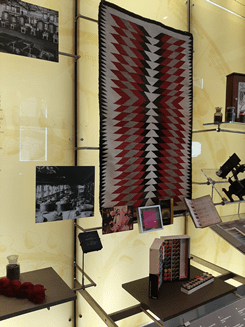
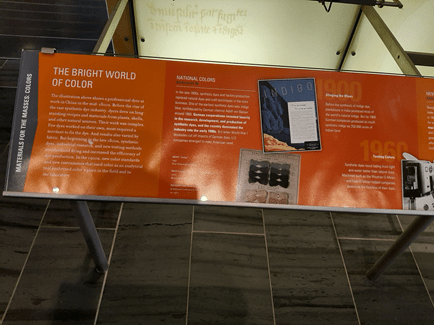
Another example of a section that stood out to me was The Bright World of Color which shares the changes in creating dyes from natural resources to using industrial research, synthetic dyes, and new testing methods to improve dye production. It reminded me of my research while I was in college about the history of cochineal used as red dyes. I enjoyed how much detail the exhibit labels went into each section of the museum exhibit especially in the Bright World of Color.

I was also impressed with another part of the exhibit which features an interactive multimedia learning experience which showcases the collections of art, scientific instruments, rare books, and other artifacts. The installation has a two-story high video column and a pair of high-resolution, interactive tables known as Object Explorer; visitors can explore the history and science behind various everyday objects by placing them on an interactive table to investigate the object’s history and the stories of the materials they are made of. For instance, I took a Pyrex measuring cup and placed in on the interactive table which revealed information about the history of glass and how the quality of glass was improved to eventually be used as the measuring cup.

Also, there was another exhibit I viewed while I was inside the Science History Institute called What Was the Real Age of Alchemy? Inside the exhibits there were various paintings and artifacts that revealed alchemy was change, creativity, and curiosity which shaped the modern understanding of modern science.

If you are visiting Philadelphia, I recommend spending a lot of time at the Science History Institute for there is so much to see and learn.

Resources:

https://www.sciencehistory.org

https://www.sciencehistory.org/museum

Who Decides the “Best Practices” in Museums?

October 10, 2019

Museums and museum professionals work towards making their programs, exhibits, and events successful based on best practices set for them to follow. I thought about writing on this topic when I saw a discussion on Twitter revealing their thoughts on paternity of best practices. When I hear the words “best practices”, the following questions came across my mind: What do “best practices” mean? How do we decide what the “best practices” are? Which ones should be followed, and which ones should not be followed? Do they work for my museum/institution?

The American Alliance of Museums stated that Best practices are commendable actions and philosophies that demonstrate an awareness of standards, solve problems and can be replicated. Museums may choose to emulate them if appropriate to their circumstances. In other words, there are many ways museums can demonstrate standards and are able to figure out which ones are appropriate for their institutions. As a museum professional, I noticed that best practices are continuously evolving as all museum professionals share and learn from one another what works based on the changing societal values. It is up to individual museums to figure out how to execute best practices that make sense for their museums.

Museums, however, do have best practices that each one should emulate that are ethical, legal, and equitable across the field. In the American Alliance of Museum’s Ethics and Best Practices in Museums document, it discussed general museum ethics and legal policies and practices while sharing its own best practices. According to the document, the American Alliance of Museums’ standards and best practices for museums in the United States require museums

  • is a good steward of its resources held in the public trust,
  • has “a formally approved, separate and distinct institutional code of ethics,”
  • is “committed to public accountability and is transparent in its mission and operations,” and
  • will “legally, ethically and responsibly acquire, manage, and dispose of collection items as well as
  • know what collections are in its ownership/custody, where they came from, why it has them, and their current condition and location.”

General best practices in museums could be applied to many museums. They can take the best practice and figure out based on local and state laws how they should be executed within the museum and their communities. When the best practices are specific to subjects and expertise (i.e. science, children’s, railroad, etc.) these institutions refer to other museum associations for resources on best practices.

There are numerous “best practices” museums utilize for their institutions, and various categories for best practices in museums. To answer a question of what the best practices are is a challenge to undertake. Many museum associations have their own list of best practices. On one of the American Alliance of Museum’s related webpages, for instance, they listed a number of museum associations that are specific to the field; the Association of Art Museum Directors, American Association for Museum Volunteers, American Association for State and Local History, American Historical Association, Association of Children’s Museums, Association of Railway Museums, Association of Science-Technology Centers, International Council of Museums, National Initiative for a Networked Cultural Heritage, National Park Service, Society for the Preservation of Natural History Collections, and the Southeastern College Art Conference. Each of them has their own lists of standards and best practices for museum professionals to use for their museums.

Professional development programs introduce best practices for specific fields and departments. Museum professionals learn about best practices implemented by other museum professionals in museum education, volunteer/internship, finances, development and fundraising, leadership, boards, and collection stewardship just to name a few. The American Association for State and Local History (AASLH), for instance, had a webinar on Best Practices for Developing History Internships that is available to be viewed since it is recorded. According to their website,

Best Practices for Developing History Internships is an AASLH Continuing Education recorded webinar. This webinar is about tips and strategies for creating an internship program that both you and your interns will get something out of. Creating an internship program at your historic site can not only benefit your organization, but should also benefit your interns and lets you help develop the next generation of history professionals. We’ll cover the ethics of internships, best practices for managing interns, and a look at some common challenges and possible solutions. You’ll leave with ideas you can use at every organization, no matter its size.

In each professional development program in various formats there are descriptions that share what participants should expect to take away from the experience and share with their museums; once this information is shared, it is up to the staff of the museums to figure out the best way for them to execute methods and practices discussed. The previously listed example pointed out that by creating an effective internship program all museums can create a partnership that will benefit both the museum and interns. Best practices need to be reviewed, adapted, and utilized by museums based on its capabilities.

Discussion questions I will leave here: Do you have examples of best practices in museums that you have heard about? How are museums taking advantage of what they learned about best practices?

Resources and Additional Resources:

https://www.nemanet.org/files/3413/8552/9233/Standards_and_Best_Practices_Compilation_-_Fact_Sheet.pdf

https://aaslh.org/event/best-practices-for-developing-history-internships/

https://iowaculture.gov/sites/default/files/History%20-%20Research%20-%20Collections%20-%20Collections%20Care%20-%20Objects%20-%20Field%20Guide%20for%20Museums%20%28PDF%29.pdf

https://www.amazon.com/National-Standards-Best-Practices-Museums-ebook/dp/B004EEOLU8

https://ncac.org/resource/museum-best-practices-background

http://ww2.aam-us.org/resources/ethics-standards-and-best-practices/standards

https://www.aam-us.org/wp-content/uploads/2018/04/BRIEF-ETHICS-AND-BEST-PRACTICES.pdf

https://www.aamg-us.org/wp/wp-content/uploads/2019/07/AAMG-Professional-Practices-2018-web-FINAL-rev043018.pdf

Interpretation: The Importance of Storytelling in Museum Programs

October 3, 2019

I recently started to have discussions about interpretation and storytelling for current projects I am working on, and they have inspired me to reflect on interpretation in museums and historic sites. Since officially beginning my career in the museum field in 2012, I learned about the importance of translating historical narrative for visitors to understand and to be engaged with the experience. As I continued my career, the discussions among museum professionals I noticed focus on using storytelling methods to get visitors’ attention.

Interpretative programs are significant for all history museums, historic house museums, and historic sites since how visitors see them and enjoy their experiences in these places would affect the way they viewed museums. The Technical Leaflet, a publication of the American Association for State and Local History (AASLH), called Telling the Story: Better Interpretation at Small Historical Organizations written by Timothy Glines and David Grabitske went into detail about interpretation and what small organizations can do better for their programs. Glines and Grabitske pointed out that Historical interpretation translates human stories from the past into meaningful thoughts for people in the present. As museum professionals our educational missions we strive for are to tell human stories people can identify with to have a better understanding of the history we present in our museums.

When I began graduate school and my career, I began to see the importance of relating human stories to the public and taking visitor input into account for interpretation. At the Connecticut’s Old State House, for instance, there were many frequently asked questions visitors have asked during tours that inspired staff to do more research to include in the tour narrative. In my blog post sharing my memories about the internship, I stated

I sat in on staff meetings to find out what common questions were asked during tours we did not already have answers for and I used those questions to do research to answer them. I regularly visited the Connecticut State Library to do research, and recorded answers into the Google Doc so we would be able to answer them in the future.

By finding out information visitors want to know most about, we would be able to have visitor input in the narrative. When interpretative programs are developed it is important to understand who the audience is and how to capture their attention to explain our relevance within the community and the overall historical narrative. Marcella Wells, Barbara Butler, and Judith Koke’s book Interpretive Planning for Museums: Integrating Visitor Perspectives in Decision Making pointed out that museum planners must apply intentional effort and deliberation if they are to fully integrate visitor perspectives into their plans. In other words, there must be full commitment to incorporate visitor perspectives when considering planning interpretive programs. I saw the start of fleshing out this important point when I was working in Hartford on an interpretive project.

Something I have thought about when I gave tours at Connecticut Landmarks before the project started is the amount of information I tell visitors. Throughout the tours, I would figure it out the appropriate balance for each group of visitors. Glines and Grabitske also stressed the importance of sharing the right amount of information when storytelling. According to Glines and Grabitske, they pointed out that: we must pay attention to the interests of our visitors by telling meaningful stories, making sure not to fatigue them mentally with breathless depth or fatigue them physically with no chance to take it all in. When I started giving tours, I noticed there was a ton of information provided to each educator giving tours. It would be impossible to include all of it in one tour which is why it is important for us to chose what information to include in the narrative we tell. I also noticed that at that point I was more focused on making sure I hit each point than telling a story. The interpretive project I worked on with Connecticut Landmarks seemed to be moving towards telling a story.

While I was at Connecticut Landmarks’ Butler-McCook House, I joined the rest of the staff in interpretive planning meetings to draw in more visitors to the historic house. We realized that by using a theme, not only were we working towards visitors making connections, but it also focused on telling a narrative. Because there are many themes that are found in the Butler and McCook family history, there are different narratives visitors can choose to learn about and keep coming back to see something different than their previous visits. I briefly talked about this experience in my memories blog on Connecticut Landmarks’:

During my time at the Butler-McCook House, I was a part of the team that worked on revamping the tours by picking a theme of the house and researching the theme for a more engaging visitor experience. Each of us picked one theme to research on our own to present to the rest of the Connecticut Landmarks team, and I chose the Industrial Revolution and its impact on Hartford and the family.

The purpose of the theme I chose for a new tour was to show the Industrial Revolution had an impact on the city of Hartford especially on its residents including the Butlers and the McCooks. I chose five key objects that will support the theme and its purpose including Tall Case Clock which was made approximately 1750 by Benjamin Cheney, and this is an example of a locally made piece that was made before the Industrial Revolution to show the differences between craftsmanship and factory made items. Another example of a key object was the Mill Ledger C, 1818-1826 which was John Butler’s, one of the family’s ancestors’, ledger which recorded payments to men and women who labored in his paper mill; this revealed what the employees were paid for their labor in early industrial work. After selecting key objects, I chose key documents and photographs then created a tour outline highlighting the narrative relevant to the Industrial Revolution theme.

To read a copy of the interpretive project, I included a link here. The Industrial Revolution was an important theme for the tour since we are all affected by technological advances, and to help visitors understand the impact of the Industrial Revolution it is important to use relevant examples.

Another example of using examples to help visitors connect with the historical narrative was while I taught school programs at the Noah Webster House & West Hartford Historical Society. In one of the chambers inside the house, I talked to the kids about the history of Noah Webster and his work on the first American published dictionary; I also discussed the objects that were displayed in the room. One of the kids asked me about how the bed warmer was used and I did so by describing the process and after asking them if they have seen the movie Pirates of the Caribbean I told them about how one of the characters used a similar bed warmer in one of the scenes. By connecting this object to something they have seen before in modern times, they were able to make that connection and use it to refer to it at a later point when they shared their experiences.

When I move forward in working on a current interpretative project, I will not only keep in mind the experiences I have had but incorporate more lessons I will continue to learn each step of the way.

Resources:

American Association for State and Local History, Technical Leaflet # 222, “Telling the Story: Better Interpretation at Small Historical Organizations”, History News, volume 58, number 2, Spring 2003.

Wells, Marcella; Butler, Barbara; Koke, Judith, Interpretive Planning for Museums: Integrating Visitor Perspectives in Decision Making, Walnut Creek, CA: Left Coast Press, Inc., 2013.

https://lookingbackmovingforwardinmuseumeducation.com/2019/02/07/museum-memories-connecticuts-old-state-house/

https://lookingbackmovingforwardinmuseumeducation.com/2019/04/25/museum-memories-connecticut-landmarks-historic-houses-in-hartford/

https://lookingbackmovingforwardinmuseumeducation.com/2019/05/23/museum-memories-noah-webster-house/