Earlier today I came across a group on LinkedIn promoting Curious Experience Design and I decided to take a closer look at their website to see what it is. It has been a while since I released a post examining services and websites geared towards museums, therefore I thought that I would find out what this was about. Curious Experience Design, according to their site and social media pages, designs immersive experiences that enliven the mundane and invite participants to get curious. On their website, they revealed that they not only provide services for museums, but they also worked on projects for festival entertainment, birthday parties, bachelor and bachelorette parties, concerts, open houses, corporate events, team building, brand activation, library programs, college events, prom after-parties, and more.
Their site also described what they designed within their site and in their portfolios they shared on the site. According to the site, they design multimedia games, immersive events, and education programs. They believe that at the core the art of game design is a process of designing experiences and the media is only a tool to create an engaging game experience. Also, I liked that they stated “You don’t need the flashiest technology to impress” because each museum has the opportunity to provide engaging interactive games/exhibits and education programs; while museums have varying budgets to spend on exhibits and programs, there are opportunities to create engaging ones with the resources they have to implement. For the immersive events, they blended live-action role playing and immersive theater, and encouraged participants to wear costumes and become characters themselves.
In addition to multimedia games and immersive events, they also developed educational programs for museums and classrooms between primary school and college. They expressed their belief that learning should be fun since learners can be motivated to engage with subjects being taught by creating compelling stories and challenging players through exploratory play. There are museums, including ones I have previously worked for, that are working towards incorporating more storytelling and interaction to help students in education programs not only take away the important lessons but also gain memorable experiences from. The examples of projects they have worked on were shared on their website in the portfolio section.
One of the projects they worked on took place at the Bostonian Society in which they created an immersive game. According to the portfolio, the educational immersive game was designed to put players into the events that let to the American Revolution on the exact locations the events took place. Inside the portfolio, they stated
Participants were assigned to use a guidebook to locate interpreters on the streets of downtown Boston. Once located, the interpreters, playing 18th-century characters, drew the players into the political intrigues of 1765 with riddles, ciphers and secret plots. Players undertook a series of challenges, culminating in a participatory reenactment of a colonial protest march through the modern, urban streets.
I appreciate that in this program that the participants were able to be in the same locations where the events took place because it would help them become more engaged with the history if they were able to either be in the locations physically or in simulated locations.
If you are curious to learn more, visit their website I have included below.
Last weekend there was a Death to Museums unconference that was livestreamed on August 1st and 2nd, and is now available to view on their YouTube channel. According to their website, Death to Museums is inspired by 2019 edition of FWD:Museums, a journal produced by students and faculty in the Museum and Exhibition Studies program at the University of Illinois at Chicago:
At the time of publication, the journal questioned whether museums can continue “business as usual” or if they should be reimagined anew. We find renewed relevance in this theme at a moment when museums are collapsing before our very eyes. We challenge the idea of returning to “normal” once the pandemic ends when “normal” means inequality, instability, extremely low wages, and an embarrassing lack of diversity across museum staff. Instead, we want to harness the collective potential of museum workers working towards radical change.
The way they challenged the idea of returning to “normal” was the unconference, and on each day there were presentations covering a wide-range of topics that focused on the goal to challenge oppressive museum practices and change the practices for the better. Some of the sessions include but not limited to A Proposal to White Museums, Museum Empathy and Compassion Fatigue: How Museums Can Support Staff Wellness, Not “Now, More Than Ever”—How Museums Can Talk Straight in Weird Times, Museum Internships Past, Present, and Future: Dismantling Systems of Powers from the Ground Up, and Dismantling Barriers to Progressive Action. I recommend watching all of the sessions to see for yourselves the discussions about reforming museum practices.
While we are all focusing on protecting each other and staying safe during the pandemic, museum professionals are taking advantage of this opportunity to discuss the changes that need to be made and had needed to be made for a long time now. Among the many calls for change in the museum field, museum professionals discuss the issues museums have not made enough progress in resolving especially during this pandemic including poor pay, anti-union, gender pay gap, and other inequitable and inhumane behaviors that turned museum professionals away from the field. I have also discussed some of the issues that were presented in the sessions in previous blog posts, especially under the What’s Going on in the Museum Field section. Reform in the museum practices is really needed, and before making changes we also need to address as well as acknowledge the foundations of museums that led us to this point. The changes we need to make not only should be focused on the institutions but also on the individuals working in the museums such as encouraging more self-care.
What do you think about death to museums? What would you want to see from museums moving forward?
Check out the links below on death to museums and related discussions.
While museums are facing the pandemic, whether or not to re-open their physical doors, and anti-racism movements, museum leadership has been brought into question on how leadership could evolve to have a more people-centered focus. Earlier this week I came across the post on Leadership Matters called “Flat Hierarchies versus the Corner Office But What Matters is People”, written by Joan Baldwin, on the state of museum leadership during this pandemic and the rise of anti-racism movements. This post made me reflect on my experiences as a leader and on my previous thoughts on museum leadership expressed in the blog.
According to the Leadership Matters post, the COVID-19 pandemic and anti-racism movements exposed a lot of inequities that exist in the United States and in the museum field recent events led many to call for a new kind of leadership that is less paternalistic and hierarchical, more collaborative. In other words, museum professionals are looking for different ways to lead in the museum that does not support inequity, low pay for front-line staff, corruption, et. cetera. Baldwin raised a number of questions in address of this call:
But what does less hierarchical really look like? What if there is no leader, just a leadership team? Sounds great, right? Everybody plays to their strengths and happily gets the work done. But what happens in a crisis when decisions must be made quickly? What if the team can’t come to consensus? Or what if other members of the staff quickly learn to play one member of the leadership team against another to ensure decisions go their way?
Leadership has a number of considerations when faced with fast decision-making opportunities especially during a pandemic we all continue to face at the time of this blog post. The system of leadership looks different for each museum, institution, and non-profit organization, and no one answer can address all concerns each one has when figuring out how to lead. To determine the answers for questions like the ones posed above, if they are looking to change their approach to leadership, each institution and non-profit should examine what their own needs are before considering any change.
In addition to considering how to answer leadership questions, museums need to be reminded of not just who they serve but who is a part of the team within the museum walls. Baldwin pointed out that to be a museum leader is to also be a people person. In other words, she stated:
It means being someone who understands it’s not about you or about the content that brought you to the field in the beginning, but instead about the team you lead, and the people and careers you nurture. The absence of leaders who actually care about staff creates institutions where bullying is rife, where hot-shot attorneys are hired to defeat unionization, where sexually harassed women are told to go work things out with their co-workers is a horrific and bothersome bi-product of this absence of leadership.
Understanding that museums are run by people who are human with limitations is a significant part of being a leader, and based on the number of cases that have been shared on how front-line staff have been treated it seems that many museums have forgotten this fact. As well as remembering my experience in the museum field, this section of the post reminded me of an early experience I had as a leader, and while it was not in the museum field this experience had taught me the importance of being a people person in the leadership role.
One of my first experiences in a leadership role was back in high school thirteen years ago as a color guard captain. The high school color guard team was a small group with more seniors than other grade levels. By the time I was a senior in high school, one of the members in the same graduating class forcibly took over the captain position; she utilized the position to not listen to any input from myself and other seniors, and other color guard members, and focused on executing her own ideas. Her actions in the leadership role, including insulting and bullying members, led to many color guard members to leave. When she left the high school, I took over the role of color guard captain and worked towards salvaging the team by listening to remaining members on not only their needs but the ideas they had on making the routines better; some of the members that originally left returned to the team. During my experience as color guard captain, I understood the importance of group input since it not only opened my mind to other possibilities for creating color guard routines and remembering their needs as individuals and students, but I also recognized them as future leaders who will be carrying the torch once I graduated. The leadership experience that I have both witnessed and practiced myself had an impact on me ever since. I sought to continue my approach to leadership as a way to not only open myself up to growth but to help foster future generations of leaders move the museum field forward.
Since then I have learned about more responsibilities and considerations leaders face in the workplace to create a strong connection within the communities they serve. In addition to having a connection with the community, leadership needs to be practiced in order to learn how to be a more effective leader. This is especially true in the museum field. In my blog post, “Museum Leadership: What We Need To Do To Develop Our Skills in the Museum Field”,
There is a difference between having the knowledge and actually practicing this knowledge. If museum professionals are under the impression that there are only certain professionals that can exhibit their leadership skills, then we would be hindering our museum professionals and future professionals’ potential. We need to show museum professionals at all levels how leadership skills benefit all of them within the organization. Our field right now is working towards improving the museum workplace throughout the field but there are still issues we need to work through to untangle this web.
When museum leaders practice their skills, they are able to develop the skills they need to connect with other people and evolve as leaders for the future of museums. If museum leaders cannot connect with their staff, volunteers, and board members, then they would be less inspired to be open with their leaders on not only ideas that may help museums move forward but also on their needs as individuals.
To learn more about the Leadership Matters post, check out the link below.
What is your opinion on leadership? Can museums figure out a way to have effective leadership that have their staff’s best interest in mind?
Activism in the United States, especially in the past few months, expresses the need for change and museums have been participating in many ways. It is important for museum staff on all levels to recognize their role in activism in order to effectively understand their role within the communities they serve as well as engage in. In one of my previous blog posts Reaction: Museum Values in Times of Crises, I pointed out that: If we do not get involved in the community and listen to what the members of the community need, then we cannot claim we are having any influence or involvement in our communities. I believe that this certainly applies to museums and activism.
Earlier tonight I participated in the #MuseumEdChat on Twitter to discuss museums and activism facilitated with the question and answer format. The first question that participants addressed within the conversation was:
Q1 How do you define museum activism? #MuseumEdChat
Among the many possible definitions, they all have one thing in common: museum activism is not limited to one location and one medium. For example, I pointed out that I define museum activism as museum professionals either individually or the whole museum spreading the word and taking action to make changes. Museum activism can come in all sorts of formatting from museum professionals participating in the Black Lives Matter movement to supporting museum unions fighting against inequitable workplace practices. Communication is an important tool in museum activism, and without maintaining communication within and outside the museum walls we would not be able to go far in our activism to effect great change.
Another question that participants in the #MuseumEdChat addressed in the discussion was: Q2. Should museums consider themselves activist spaces? Why/why not? #MuseumEdChat. While I do believe that museums should consider themselves activist spaces, I think it is important that museums are not solely activist spaces because museums should be considered for multi-purposes that both serve and contribute to the community. If we use the museum space for one sole purpose, then we not only limit ourselves, but an imbalance would be created and therefore we would not be considered relevant in the activist role or in any role. Activism is a continuous series of actions that all museum professionals do and should take seriously if we want to effectively make significant changes within our society.
I have included links to relevant blog posts and resources in the list below.
What do you think the museums’ roles in activism should be?
While we have been facing a pandemic, this month has seen an increase of peaceful protests in response to the murders of people in the Black community including but not limited to George Floyd and Breonna Taylor. In the United States, there has been continuous racist thoughts and actions that should not have been excused for the past hundreds of years. The recent peaceful protests show that we are no longer tolerating the social injustice and are urging for real change. Joan Baldwin’s post on Leadership Matters, called “The Chickens Come Home to Roost: Museum Values in Times of Crises”, addressed what the museums’ roles should be in all of this. Museums have been working towards becoming more visitor and community focused for years, and it is important for museums to actually show their leaders and staff being involved within the community.
If we do not get involved in the community and listen to what the members of the community need, then we cannot claim we are having any influence or involvement in our communities. One of the statements Baldwin has pointed out in her post captured my attention:
A mission statement tells the public what you do; a vision statement spells out who you want to be, but a values statement tells your staff, your trustees, your volunteers and your community how your organization behaves. And it affirms the behavior your organization expects at your site.
All museums should have a values statement that will not only help job seekers determine if they want to work at the museum but it will show all diverse members in the community, especially the Black community, what to expect in the museum’s conduct and what standards they should set when visiting the museum. We do not have an excuse to not release a values statement. To follow the values statement, we need to practice what we state in the museum values.
In other words, we should take action to show we care about the community, especially show that we understand that black lives matter. Baldwin also pointed out a few things on museums having a values statement:
Is a values statement a panacea in connecting a white, privileged museum or heritage organization to its wider community? No. Would it help? Maybe. Crafting a values statement asks your organization to focus not only on mission, but on engagement. Maybe mission statements aren’t enough any more? Perhaps museums need to be good citizens as well as good stewards.
A values statement alone is not the solution, but it should be used as a tool to guide engagement with visitors and the community. I will also reiterate the point I made in my blog post “Diversity and Inclusion in Museums During COVID-19 and Beyond”:
It is also important to note that we do not have all of the answers and that not one answer fits all museums. There are going to be steps that may not be helpful depending on the size of the institutions but figuring out how to continue to incorporate diversity and inclusion should always be the goal when museums make connections within the community.
Museums should focus on maintaining communication within the community to incorporate diversity and inclusion. It is important for museums to not only be a part of the community but be good citizens within their communities. Directors and board members should also recognize the importance of engagement in the community not just within the museum walls. Baldwin also listed questions in her post that I believe should be addressed within conversations between museum leaders and staff members:
If your organization sees itself as apolitical, what does that look like in action, and most importantly, what does it look like for someone in your community? Does being neutral mean in times of community crisis a museum or heritage organization’s role is essentially unchanged? Or is there a civic role for your museum? And if yes, what might that look like? If your organization already has an active community role, can it be enhanced? And how can museums gently and explicitly let visitors know their sites are places hallmarked by kindness?
By having these conversations and answering the questions previously listed, museum directors, board members, museum educators, curators, volunteers, and more staff members will have a better understanding of what they represent as members of the community. We should also keep the conversation going within and outside our museums not just have one discussion so the museums could evolve with the community and continue to learn from the community.
I myself will continue to open up to listen, strengthen my empathy and compassion, and make sure my actions reflect what I have learned to help others understand that Black Lives Matter.
Last week I participated in the American Alliance of Museums’ (AAM) first virtual conference, and I began describing my experience in last week’s blog post. I thought that this week I will not only continue to describe my experience at #AAMvirtual but will discuss the virtual conferences in general. After the first day of #AAMvirtual, I attended more sessions from June 2nd to June 4th with an additional session added to address the Black Lives Matter movement.
On June 2nd, in addition to the general session, I attended the sessions: Engagement Strategies During Times of Low (or no) Attendance, Museum-Goers & The Pandemic: New Research, and Pivoting Your Programming: Virtual and Other Unique Options for Small Museums. Also, there were virtual networking events that were divided into four groups: Career Management, Creativity and Innovation, Diversity, Equity, Accessibility, and Inclusion (which was cancelled since the format of the happy hour did not fit the needs of the field), and Emerging Museum Professionals. The general session featured a keynote from Lonnie G. Bunch III, the 14th Secretary of the Smithsonian, and a discussion with representatives from the Ford Foundation, John S. and James L. Knight Foundation, MacArthur Foundation, and Andrew W. Mellon Foundation. Their discussion explored how museums can contribute to a prosperous, just and equitable future as society struggles with intractable social, environmental and economic problems; what priorities and issues are most important to the funders of museums today and into the future; and how will philanthropy become more equitable and inclusive and how will this affect the funding for all types of museums?
In the Engagement Strategies During Times of Low (or no) Attendance session, the speakers took a closer look at how museums can engage with their audience during times of low, no, or altered attendance. This session had speakers Cara Seitcheck (Smithsonian Institution), Rebecca Peterson (Vizcaya Museum & Gardens), and Zachary Wnek (Latah County Historical Society) leading the discussion with participants. The discussion focused on three major ideas which are audience outreach and engagement through digital and virtual means; a crash course on digitization and digital preservation policy as a way of engaging your audience through sharing collections; and an abbreviated guide to hosting awesome outdoor events to put your audience at ease (and allow them physical distance). Also, the discussion took a closer look at the challenges and opportunities involved through the lens of historic sites.
Meanwhile in the Museum-Goers & The Pandemic: New Research session, Susie Wilkening of Wilkening Consulting has been conducting ongoing qualitative research with museum-goers and snap polling the broader U.S. population to assess attitudes toward museums, their value, and their support. Wilkening Consulting is conducting an ongoing qualitative research with museum-goers and snap polling the broader U.S. population to assess attitudes toward museums, their value, and their support. During the session, Wilkening shared the latest results from the research and discussed with the rest of the participants on how these findings can inform how our museums engage our audience virtually and how to reopen with museum-goers’ interests in mind. In the Pivoting Your Programming: Virtual and Other Unique Options for Small Museums session, participants listened to examples of how small museums are continuing to connect with their audiences, even when COVID-19 forces museums to shut their doors, from the session speakers; the speakers were Ann Bennett (Laurel Historical Society), Lin Nelson-Mayson (Goldstein Museum of Design), Marjory O’Toole (Little Compton Historical Society), Rachel Regelein (Log House Museum), and the discussion was moderated by Janice Klein of EightSixSix Consulting. Since in the last blog post I mentioned that I had previous plans before receiving my email that I had the reduced conference fee, I was not able to attend morning sessions in the next couple of days.
On June 3rd, the sessions I attended were The Future of Museum Evaluation after COVID-19 and Racism, Unrest, and the Role of the Museum Field. The Future of Museum Evaluation after COVID-19 session included a discussion addressing the question: How will the COVID-19 pandemic impact the ways we conduct research and evaluation? Also, they discussed about how we may need to change our data collection efforts at our museums after our doors reopen. A recently added session, Racism, Unrest, and the Role of the Museum Field session was led by Dr. Johnnetta B. Cole (National Council of Negro Women, Inc. and Baltimore Museum of Art), Lonnie G. Bunch III (14th Secretary of the Smithsonian Institution), and Lori Fogarty (Oakland Museum of California). A number of questions were addressed during this serious discussion such as: As museums set their sights on financial recovery and reopening, how do we ensure that we are centering equity and prioritizing the needs of our country’s black and brown communities and colleagues? How do we create a space for healing, and building authentic relationships across difference? How do we use what is an unbearable time for many, to come together in solidarity and use the strength of the museum field to fight racism across the country?
On June 4th, I attended the following sessions: Small Museum Boot Camp: Organizational Management and International Hot Topics: Discussions from Kyoto. In the Small Museum Boot Camp: Organizational Management session, they pointed out that it is especially important to understand the basics of organizational management to help prepare for and guide your institution through a crisis. Since the session was created to meet the needs of small museums, it provided a fast-paced introduction to the main areas of management, including long-range and emergency planning, best practices, and legal requirements. The International Hot Topics: Discussions from Kyoto session introduced issues that were raised at the 2019 International Council of Museums (ICOM) general conference in Kyoto, Japan such as climate change, disaster resilience, and cultural heritage preservation; inclusion, diversity, and decolonization; and immigration, and ethical dilemmas. Each of them was amplified by the pandemic and the search for the new definition of museum. Once the virtual conference had concluded, I thought about each of my experiences at the conferences on the virtual platform and how museum associations have numerous considerations when working on transferring on-site to online.
They need to consider what platforms they would use to host speakers, sponsors, and attendees. The New York City Museum Educators Roundtable (NYCMER) decided to use the Hopin conference platform which I shared in the blog post the demo on how to use the platform. We were encouraged as participants to watch the demo ahead of the NYCMER conference to learn how it worked. Navigating the NYCMER conference felt easier to interact with, and it made me wonder if the conference were on more than one day would the experience feel the same way as it did on a one-day conference. The American Alliance of Museums’ conference, since it is a multi-day conference, had a different experience; it is easy for many museum professionals to get Zoom fatigued after a while. AAM decided to use a virtual platform through CommPartners, which helps organizations conceive, develop and fulfill their education strategy by providing a wide range of online education services including curriculum design, instructional design, webinars, webcasts, livestream programs and virtual conferences . The main learning platform they developed is Elevate Learning Management System (LMS) that helps enable, empower and engage users with contextual learning opportunities enriched by peer collaboration to form dynamic experiences.
Both AAM and NYCMER dealt with various things that they worked on once they learned about attendees experiences throughout the conferences. NYCMER conference committee members made sure that they extended the networking timed one on one sessions up to five minutes when attendees had raised concerns that the initial two minutes was too quick to have a full conversation with other attendees. I myself have begun conversations with museum professionals, and have all of the sudden the conversation ended abruptly leaving conversation topics incomplete. During the AAM conference, I heard about some attendees having hard times logging into sessions and not having a place outside of moderated open-ended chats and networking events to talk with more museum professionals. The staff worked hard to help attendees with technical issues and created a networking tab towards the later half of the conference.
The American Alliance of Museums and the New York City Museum Educators Roundtable conferences were the only virtual conferences I have attended so far since many museum associations have decided to move their on-site conferences online. I received an email from the American Association for State and Local History (AASLH) earlier this month which stated,
Due to the ongoing uncertainties of the COVID-19 pandemic, AASLH will hold its 2020 Annual Meeting this fall online instead of gathering in person in Las Vegas…
…We appreciate the hard work of the 2020 Host and Program committees, and we hope to carry as much of that forward as possible. The conference theme, even more relevant now than when it was selected, remains the same: “What Kind of Ancestor Will You Be?” Although it is disappointing not to gather in person this fall, the flexibility of an online format gives us the chance to offer greater relevancy. The conference will address questions that are emerging from the pandemic, such as defining what history institutions will look like and how they will operate in and after the recovery. We will also continue to examine the unique roles that history museums, historic sites, historical societies, and other history organizations, including AASLH, must play in combating racism, among the nation’s most deep-seated societal challenges.
The AASLH Annual Meeting is usually held in August or September each year, and this year it was originally going to be in Las Vegas, Nevada before moving the Annual Meeting online. The New England Museum Association (NEMA) also made an announcement that they were moving their onsite conference that was planned to be in Newport, Rhode Island to online. Also, NEMA decided to change the conference theme to Who Do We Think We Are Now? By updating the conference theme, they stated that it is an opportunity for our field to come together and share lessons learned, emerging best practices, and think tank solutions for the challenges ahead. I look forward to finding out how they will engage attendees in discussions about the museum and history fields and how they will address the pandemic and Black Lives Matter movement in their sessions.
If you have experienced virtual conferences or any online professional development program, what are your impressions of the experiences?
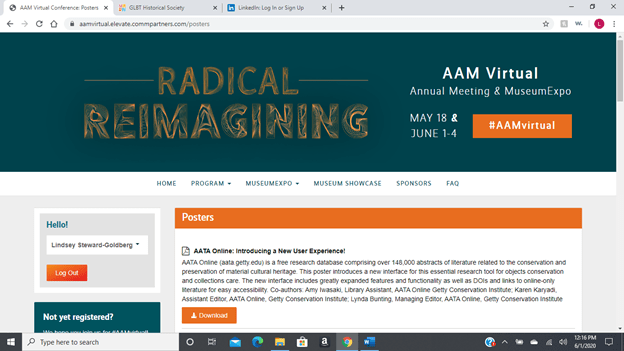
This past week I was able to attend the American Alliance of Museums’ (AAM) conference. Like the New York City Museum Educators Roundtable, AAM decided to hold the conference online to present content that will help move the museum field forward. The AAM virtual conference took place on May 18th, and June 1st through June 4th. Its’ theme this year was: Radical Reimagining. Since this is the first-time museum associations in the United States are holding conferences on the internet, there are bugs they would go through as multiple museum professionals interact with one another from the comfort and safety of their homes. I liked that in response to the murders, protests, and police brutality, AAM responded not only with a statement but made sure the sessions we attended continued the discussion of racism in this country. One of the sessions I attended today was the PSA of the Future with speakers from Poster House (the first museum about the history of posters) and Isometric Studio (a visual identity and graphic design consultancy based in New York City).
The PSA of the Future session, including a brief history of posters and PSAs, had an interactive workshop in which participants were encouraged to design our own posters. We were introduced to elements of poster design, have the opportunity to exchange ideas about the subject matter, and design our own posters in response to the Black Lives Matter movement. I shared the design I worked on in the social media platforms Twitter and Instagram after the session concluded:
When registration first opened for the conference, there have been concerns expressed across social media by museum professionals because of the fees AAM charged while many museum professionals are facing furloughs, layoffs, job hunting halts, et. cetera. They also made arguments that charging high fees contradicts not only the theme of the conference but also contradicts its efforts for a more diverse, inclusive, equitable, and accessible museum field. According to AAM’s website: Registration for the virtual conference is $235 for all AAM members and $345 for non-members. In addition to releasing a statement for their losing revenue reasoning, they also encouraged registrants to make donations in addition to the registration fees and sponsors were able to provide for a number of deeply discounted ($25) registrations. Even though I was one of the lucky individuals who was able to register for $25, I wonder how many people were actually able to receive it or were able to even pay that much.
Since I have not been to the AAM conference before this year, I was curious as to not only what the conference was like but how they would be able to handle operating a virtual conference. I enjoyed the sessions I was able to attend live while connecting with other conference participants was limited to sending messages during sessions, an open chat, and a few virtual networking events. A networking section was later added by the last day of the conference.
Because I did not receive an email that I was able to register for the conference at $25 until the Friday before the full conference began on June 1st, I missed the General Session due to previous engagements but attended the sessions for the rest of the day. Instead of attending the last few minutes of the General Session, I went to the MuseumExpo, as well as throughout the day, which includes various links to conference sponsors, booths with external links to services they have, tech talks, and virtual poster sessions. The virtual poster sessions were about twelve downloads of PowerPoint presentations on relevant topics in the museum field. I attended the following sessions on June 1st: Rethinking Experience Design for a New Reality — With Early Glimpses from National Audience Research, Moderated Open Chat, Choose Your Own Adventure: Providing Engaging Experiences at a Distance, and Planning for Success: Fundraising Management in a Changing Museum World.
The Rethinking Experience Design for a New Reality — With Early Glimpses from National Audience Research session had the following speakers: Elizabeth Kunz Kollmann, Museum of Science, Boston; Jen Benoit-Bryan, Slover Linett; Madeline Smith, Slover Linett; Peter Linett, Slover Linett; and Tim Hallman, Asian Art Museum. Slover Linett uses tools of research, evaluation, community dialogue, and experience design to help cultural organizations become more inclusive, innovative, and relevant. The speakers discussed the 6 Ps of Experience Design, which is a framework for the cultural sector from Slover Linett. The 6 Ps of Experience Design are: Programming, People, Place, Policies, Promises, Personality, and a Bonus “P”: Purpose. I have included a link to the framework in the resource section below for more details about the 6 Ps of Experience Design.
The Choose Your Own Adventure: Providing Engaging Experiences at a Distance session had Camille Tewell, North Carolina Museum of Art; Jacqueline Benitez, California Academy of Sciences; Matt Schullek, Ohio History Connection; and Tami Moehring, CILC – Center for Interactive Learning and Collaboration as its speakers. In the session, participants discovered how distance learning can help museums increase their reach. Also, we joined small group discussions led by the speakers to talk about developing content, infrastructure requirements, marketing, and making museums more accessible. In the Planning for Success: Fundraising Management in a Changing Museum World session, we heard Kate Brueggemann (Adler Planetarium) and Donna McGinnis (Naples Botanical Garden) share information about building a fundraising management plan that can leverage our institutions as we are preparing for re-opening our institutions.
I also attended a part of the Virtual Reception which was led by Songdivision, in which we were all in the Zoom calls (much like the ones we were in for the sessions) watching the group as they engaged us with live performances and a rock-and-roll game show. Because I have not experienced a reception on the virtual platform for a conference before, I decided to check it out and enjoyed the music they played.
The rest of the conference was a similar experience I had on the first day with some changes including a new moving and significant session that was added to take part in the discussion on racism, unrest, and the role of the museum field led by Lonnie Bunch (14th Secretary of the Smithsonian Institution), Dr. Johnnetta B. Cole (National Council of Negro Women, Inc. and Baltimore Museum of Art), and Lori Fogarty (Oakland Museum of California). I have included the link to where I logged in for the conference for an overview and specific details of the sessions that were offered throughout the four days.
Next week I am continuing the discussion about AAM and virtual conferences since there was a lot of detail to put into one blog post.
If you have attended virtual conferences, please share your experiences and impressions. Also, if you have any questions about the conferences I have attended please visit the contact page where my contact information is located.
This past week I participated in the annual New York City Museum Educators Roundtable (NYCMER) conference. I previously wrote about past experiences with the NYCMER conference in which I discussed not only the content presented and discussed but also about the locations each conference took place. It was different this year since we are in the middle of a pandemic, and the conference was moved to a virtual platform. The conference was free to attend with the option to donate money to receive NYCMER merchandise based on the tier level chosen. One of the ways NYCMER was able to transition as quickly as possible to move the conference to the virtual platform was, they found a computer platform that was specifically designed to host virtual conferences. NYCMER and the conference committee used Hopin, the first all-in-one live online events platform made for any size where attendees can learn, interact, and connect with people from anywhere in the world, to host this year’s conference.
When I first registered for the conference, I was not entirely sure how the conference is going to be held in the digital platform. I watched a ten-minute introduction video to the Hopin computer app, and was impressed with how much we would be able to do; to summarize the video, participants would be able to do what we usually did during the conference, including attending the keynote session, sessions, poster sessions, Peer Group meetings, and networking, but from home. Since we were exploring a new way of interacting with one another, it was not going to go smoothly. Every now and then there were some technical difficulties, but we all moved passed them. On the morning of the conference, I used my personalized link to log on and joined the rest of my colleagues.
I attended the Keynote session, and this year’s Keynote Speaker was Chloe Bass who is an artist and public practitioner, and the author of the book Art as Social Action: An Introduction to the Principles and Practices of Teaching Social Practice Art. Bass’s speech was a very inspiring and on point to what we are going through during this pandemic. One of the takeaways from her speech that I especially found to be important is to think about our staying away from others as “physical distancing” instead of “social distancing” since we can still communicate with one another without being physically in the same space; also she pointed out that “social distancing” implies that we should not be communicate with and be kind to one another. Then we went into our sessions in the Sessions section of Hopin.
As usual it was hard to decide which session I wanted to attend but I remembered that as a NYCMER member I would have access to resources from each session, and this year NYCMER members will also have access to all of the session recordings. In the end, I decided on sessions that not only interested me but ones I thought my professional skills will need improvement on. The sessions I chose were: Using Theatrical Techniques to Engage Your Audiences, History Engages Science: Connecting history and STEM programming, Addressing Absence: Telling the Stories of Underrepresented Groups, and Beyond the Walls: Museum Educational Programs in the Digital Space.
In the Using Theatrical Techniques to Engage Your Audiences session, participants including myself learned some best practices from professionals who use these techniques at their museums to encourage more effective engagement with their audiences. The speakers in this session were Erin Salthouse (Access Educator at the Intrepid, Sea, Air, and Space Museum), Elysia Segal (Lead Teaching Artist at the Intrepid Sea, Air & Space Museum), Julia Butterfield (a Program Associate at Historic Hudson Valley), and Maggie Weber (Director of Education of The Old Stone House of Brooklyn). They broke down the session into three sections describing what is a theater in museums, museum theatre performances, and third person living history. Museum Theatre is a live interpretive presentation with performers who engage visitors by portraying characters and conveying a story or dramatic narrative; when developing a program, they stated that it is important to keep in mind the age of your audience, the topic, style, format, and accessible. Third person living history means that the staff does not pretend to be characters from history, or anyone documented as living at the site. Also, they described process drama which allows students to be in the roles to learn empathy as well as being empowered by the decision-making process. In addition to the previously listed, they pointed out how theatrical skills can help every educator especially by using skills every museum educator can use: tone, volume, body language, et. cetera.
In the History Engages Science: Connecting history and STEM programming session, it was aimed to inspire connections and new ideas. The session speakers were Samantha Hartford (Miller/Historian in the NJ Morris County Park Commission) and Erich Morgan Huhn (Education Assistant at Historica Speedwell in Morristown, NJ). They broke down the way we approach both history and STEM, then took a look at ways these fields can overlap in effective programming and even collaborate to build something new. Both of them shared examples from their respective organizations that used both history and STEM to educate school, homeschool, scout, senior, and adult groups. Also, the conclusions they made were that incorporating STEM in programs allows museums to explore beyond the site, STEM connections are always appreciated but rarely sought at a historic site, and that living history, demonstrations, hands-on, and other types of education programs can sneak STEM in.
In the Addressing Absence: Telling the Stories of Underrepresented Groups sessions, participants including myself learned how educators at the Whaling Museum and Education Center of Cold Spring Harbor and the South Street Seaport Museum addressed these absences by developing new programs that told the stories of women and African-Americans through new programs. The speakers were Brenna McCormick-Thompson (Museum Educator at the Whaling Museum and Education Center in Cold Spring Harbor, NY) and Rebecca Manski (an independent educator currently based at the South Street Seaport Museum and Social Justice Tours). Both speakers talked about how they worked to refocus the narrative to include women more in the whaling industry narrative and African Americans more in the South Street waterfront narrative. McCormick-Thompson, for example, explained that by not telling women’s stories we lose the idea of what the economy was like in the whaling community since they were the ones who stayed behind to run their husbands businesses and fill their roles in advisory boards while they were out on the sea.
Also, both speakers split the participants into three separate groups (by providing links to two separate session spaces to split over 100 people into smaller groups by birthday month) to discuss the following questions: How can things change in society when we reintroduce these stories? What are the things stopping us? How can we effectively engage audiences? By discussing these questions, we begin to think about how we can create more inclusive programs and be able to share ideas to take steps towards creating new programming in our own museums and sites.
Between sessions in the morning and afternoon, we had opportunities to participate in networking, poster sessions, and peer group meetings. The Hopin conference platform has a networking section that allowed us to click on a connect button that selects a participating individual at random to connect with others at the conference. However, the challenge was to keep within a certain time limit that first began with a two-minute limit then it continued to increase after a number of participants told conference organizers that they kept getting cut off mid-sentence. The poster sessions were numerous case studies that discussed various topics in museum education, and we were invited to hop around in the Expo section of Hopin to listen to each one. Also, the peer group meetings this year were split into two booths: one was a video overview of the Peer Groups and the other was NYCMER Secretary & Peer Group Liaison, Sierra Van Ryck deGroot will be on hand to answer questions. After the break, we went to the last sessions of the day.
I chose to attend the Beyond the Walls: Museum Educational Programs in the Digital Space session that explored whether and how the physical “third space” of the museum can shift online from the perspective of the Bronx Museum, which is a small museum with very little digital presence until March. The speakers were Nell Klugman (Education Programs Manager at the Bronx Museum of the Arts) and Patrick Rowe (Director of Education at the Bronx Museum of the Arts). Klugman and Rowe described what their programs were like before the pandemic and converting to the virtual platform. After describing their programs that involved teens in interviewing artists, designing graphics for posters, and participating in art programs on anti-gun violence campaign, the speakers revealed how they adapted existing programs to the online platform and keep teens involved in the existing programs they were previously involved in before the pandemic. Also, they led an interactive discussion of how best to share resources, reach communities, and achieve goals during the COVID-19 pandemic and the future beyond it. Once the last sessions ended, we went back to the Stage section of the Hopin platform for concluding thoughts and thanking everyone involved in setting up this year’s NYCMER conference.
While I missed being able to meet with colleagues in person, I liked that we were still able to have the conference in the virtual platform. Also, the number of individuals who have signed up for the conference had doubled compared to the previous year; normally about 250 people attend the conference in New York City and this year over 500 people have registered for the conference (with more on a waiting list). There were more individuals outside of the New York area who have attended the conference. They came from places including but not limited to Texas, Arizona, San Francesco, California, Chicago, Illinois, et. cetera. Also, there were individuals from England and Canada attending the conference, according to the president and vice president of NYCMER. Even though I would like to attend NYCMER in person once again, if it is decided to do another virtual conference, I would be happy to attend to connect with more museum professionals.
With recent events allowing many individuals to work remotely, there are numerous online resources that are being shared for educational and entertainment purposes. Online resources are also available for museum professionals to explore. For instance, last week I heard about a new website called Museum Savvy which is a resource for museum, archive, conservation, cultural heritage, public history professionals, emerging professionals, and students. I explored the website and thought it was interesting not only because there were numerous resources available for museums and museum professionals, but I admired the pictures displayed on the site. Also, I think it is important to find out more about what is going on in the museum field around the world, especially during this pandemic, so it is great to see websites that have information and associations from international museums. The following is what I saw the website offers as of the date I wrote this post.
Museum Savvy features a blog that covers varying topics going on in the museum, cultural heritage, and public history field. One of the most recent blog posts shared information gathered about the coronavirus and resources available for museums. Other blog posts include museum jobs of the week and Museum Listservs (electronic mailing lists to allow sender to send one email to the lists). The blog has at least 100 categories on varying topics in alphabetical order from archaeology and archives to graduate school programs and museum studies. Also, their archive section included posts from October 2019, January 2020, February 2020, and March 2020.
The website also has a museum jobs page that is a free job board and links to websites that list museum jobs, internships and opportunities in the United States and abroad. This page has three links to relevant posts for opportunities. One of the links leads to the most recent blog post on museum jobs of the week. The other links leads to museum job websites and Canadian museum job websites. Museum Job Websites features links to national and regional job listings, state museum association job listings, and one link to international listings for The International Institute for Conservation of Historic and Artistic Works. A list of Canadian museum job websites, that was complied by the Museum Studies Collective (a networking and publishing site for students and emerging art/museum professionals based in Canada), included links to the Canadian Museum Association, the Ontario Museum Association, and the St. Lawrence Parks Commission.
Museum Savvy provides a museum studies page which lists topics and programs offered for museum studies that are in person and online located in the United States and throughout the world. There are twelve links on the page that lead to list of programs on the following topics: art programs, arts administration, history, anthropology, art & artifact conservation, cultural heritage, exhibits, collections management, education, historic preservation, digital humanities, and online programs. The page includes long lists of schools by state that offer museum studies programs specifically Bachelor’s degree, Master’s degree and certificate programs on varying concentrations. Museum Savvy has a list of online programs that originate in schools in the United States. Also, the page has lists of museum studies program from around the world in person and online. Museum Career Development is another page on Museum Savvy that lists professional networks, online courses, webinars, workshops, conferences, and career mentoring. Museum Professional Resources is a page on Museum Savvy that continuously update the list of resources on archival supplies, collections management, exhibits, education, artifact conservation, and Listservs & discussion groups.
If interested in learning more about this site, I included links below.
Note: Stay tuned for my next blog post that will focus more on virtual museum experiences that are being offered during this time. Stay safe out there and be good to one another!
In honor of Women’s History Month, I decided to address the importance of the conversation about gender and museums. I recently received the March/April edition of the Museum magazine from the American Alliance of Museums called “The Illusion of Identity”. The moment I saw the title I was confused since I did not understand what they were going for to describe the overall content of the magazine. It became clear that the magazine articles’ main topic was about gender. Not only is it a disconnect with the articles but it misrepresents what gender and identity are; gender and identity are not the same. Because I heard so much about the contributions made in the magazine, I decided to take a closer look at the articles for this edition, and see how each one adds to the conversation about gender and museums.
The articles were “The Life and Legacy of Harriet Tubman” written by Andrea DeKoter and Kimberly Szewcryk. It shared the life of Harriet Tubman, the central figure in the Underground Railroad, and how she influenced the writers quest for human rights and dignity. “Practicing What We Preach” by Paula Birnbaum is about students who co-curate a feminist art exhibition to test assumptions on inclusion. “The Art of Conversation: The National Museum of Women in the Arts”, written by Emma Filar, describes a conversation series called “Fresh Talk” focuses on the interplay between women, art, and social change. Kara Fedje and Jared Ledesma’s “Abstract Art, Concrete Goals” discussed what happened when The Des Moines Art Center diversified its audience with an exhibition on queer abstraction. “Beyond Binary” by Melissa Alexander and Dina Herring which was written about an exhibition on the many faces of gender identity unmasks the slippery nature of truths.
In the regular sections of the magazine, President and CEO of AAM Laura Lott provided some thoughts on women’s rights in “100 Years Later, Redefining Advocacy”. Lott shared a condensed history of the American Alliance of Museums, which was founded as the American Association of Museums in 1906 in New York City before it was relocated to Washington, D.C. in 1923. Also, she wrote about AAM’s recommitment to museum advocacy and the ability to have secured bipartisan congressional support for the Institute of Museum and Library Services (IMLS), as well as the National Endowment for the Humanities (NEH) and the National Endowment for the Arts (NEA). She also stated the AAM’s strategic plan asks museum professionals to think more broadly about advocacy. According to the segment, Lott pointed out that The Alliance aims to equip members and allies to make the case for museums and to help you tell your stories. AAM provides a toolbox for museum professionals to help advocate for museums since museum professionals are the best advocates to explain the significance of museums to policymakers and the public. Museum magazine also shared statistics about gender and sexuality.
The statistics suggest the conversation about gender and sexuality is important to address within museums. For instance, there is a 313 percent increase in Merriam-Webster dictionary searches for the pronoun “they” in 2019 vs. 2018; “they” was selected as the dictionary’s 2019 Word of the Day. Ninety-nine percent is the percentage of countries where women could vote with the Vatican City as the holdout. Also, there are four in ten history museum-goers who think history museums should be inclusive, including sharing stories of women and LGBTQ people. There are 142 countries that provide at least some legal protections based on sexual orientation, meanwhile 55 countries provide no protection and no criminalization. Seventy countries criminalize consensual same-sex sexual acts between adults. By looking at these statistics, it shows that while we have made so much progress in our society in terms of gender and sexuality, we still have a long way to go.
Gender equity in museums, for instance, is still important to not only discuss about but museums need to make more efforts to making museums more gender equitable for its professionals. Amy K. Levin’s point of view article called “No More Platitudes: Fifty years after women’s lib and Stonewall, we’re still behind in advancing gender equity in museums” calls for more systematic and significant change in being more equitable in the museums for both exhibitions and the workforce. Levin included an institutional checklist for gender equity which includes the mission statement; exhibition content; collections/acquisition policies; database/catalogue categories; volunteer guidelines; employee policies, benefits, and hiring practices; and focus groups/public consultations. The importance of gender equity is emphasized not only in this point of view article but also in previous blog posts I wrote.
The post “Gender Equity in Museums: An Important Issue that Should Be Addressed” is one of the examples of why gender and gender equity is important within the museum field. I reflected that
The most important lesson I learned, and what we all should take away from this program, is that gender equity is not a woman’s issue it is a human issue. We need to recognize that equity is for all of us, and we need to find out how we can bring more awareness to equity.
By educating ourselves about gender equity, we would be able to better serve the public that walks through the museum doors. In another previous post about my experience presenting in a professional development program on gender equity and museums, I shared the Gender Equity Museums Movement (GEMM)’s mission as well as emphasized the impact museums could have when they strive to be more equitable for their staff; it will affect the experience museum visitors have while engaging with the staff and exhibits. The recent edition of Museum magazine shows we are continuing to strive for more equitable museums, and still have a long way to go. Since museums are seen as trustworthy resources for varying information presented in our institutions, we should be the example of advocating for social justice and equity.
Each article presented in this magazine show museums and museum professionals should learn who their audiences are, and continue to adapt to their community’s changing values.


 Looking Back, Moving Forward in Museum Education!