The History of Museum Educators, Part Two: Children’s Museums

December 12, 2019

Last week I wrote about my reaction to part of this edition of the Journal of Museum Education, a publication by Museum Education Roundtable. I continued to read the Journal and after I finished reading the Journal, I thought I would give my thoughts on the rest of it. As I mentioned last week, the articles made me think about my previous experiences. This week while I read the rest of the Journal, I thought about my experiences in children’s museum. While these articles reminded me of my experiences, I always find more to learn in the Journal of Museum Education.

The most recent edition of the Journal of Museum Education, for instance, had a couple of articles focused on children’s museums. In the article “Museums for Somebody: Children’s Museum Professionals and the American Association of Museums (1907-1922)”, Jessie Swigger discussed the origins of children’s museums and the contributions of museum professionals in these children’s museums. Swigger discussed the first three children’s museums in the world opened in Brooklyn, New York (1899), Boston, Massachusetts (1913), and Detroit, Michigan (1917). She examined contributions of children’s museum professionals and museum education through presentations at the American Association of Museums (now known as the American Alliance of Museums) given by the curators of the first three children’s museums: Anna Billings Gallup’s (Brooklyn), Delia I. Griffin (Boston), and Gertrude A. Gillmore (Detroit). The review of papers delivered to their colleagues demonstrated how their pioneering educational approaches, including encouraging visitors to interact with objects and creating opportunities for children to become empowered and invested museum visitors, continue to shape the field. Also, the article pointed out the value of including children’s museum professionals in conversations on museum education. Another article about children’s museums revealed another example of the value of children’s museum professionals contributions to conversations on museum education.

In the article “What Caregivers Observe about Their Children’s Learning During a Visit to the Children’s Museum” by Jessica J. Luke, Eileen D. Tomczuk, Susan Foutz, Nicole Rivera, Lisa Brahms, Kari Nelson, Barbara Hahn, Melissa Swank & Kimberly McKenney, they pointed out that while significant research focused on caregiver-child interaction in children’s museums little is known about what caregivers might be observing or perceiving about their children’s learning. The article discussed a study conducted by the Children’s Museums Research Network to examine what caregivers observe about their children’s learning during a visit to the children’s museum. Data were collected through online questionnaires (N=223) and follow-up phone interviews (N=20) with caregivers recruited from eight children’s museums across the U.S. Results show that caregivers could identify numerous things they discovered about their child(ren) in the museum, including their interests, social skills, thinking/problem-solving skills, and emotional regulation. What contributed most to these discoveries was opportunities to watch their children play and interact with others, and to play with unique materials and activities that they don’t have access to at home. The signage and floor staff were seen as minimally important. These findings have implications for exhibit design and staff facilitation in children’s museums.

As a museum professional who has experience working in a children’s museum, I loved learning more about the history of children’s museums and what other children’s museum professionals have discovered about children’s learning in their research. The research reinforced what I learned about how children learned and interacted with museum exhibits. I learned in my experience in a children’s museum about the constructivist method which allowed children to get involved in the process of their own learning; what I learned in my experience is that the constructivist method cannot be relied on alone to educate children, and therefore a little bit of instruction is important to give children context to what they need to learn. In a couple of blog posts I have written, I wrote about children’s museums and my experience in a children’s museum.

The post “Maker Space: Museums Can Benefit from Having a Creative Space” is where I related what I learned in the children’s science museum Maritime Explorium and how I translate my experience from historic house museums into the newer experience. Another blog post I wrote was “Is Children’s Play Declining? What are Museums Doing to Encourage Playtime” in which I wrote about my reaction to an article in the Huffington Post called “Children’s Play is Declining, But We Can Help Reclaim It.”

By reading these articles in publications such as the Journal of Museum Education, museum professionals and museum educators share their knowledge and learn from one another to help move the museum field forward.

Resources:

Jessica J. Luke, Eileen D. Tomczuk, Susan Foutz, Nicole Rivera, Lisa Brahms, Kari Nelson, Barbara Hahn, Melissa Swank & Kimberly McKenney (2019) What Caregivers Observe about Their Children’s Learning During a Visit to the Children’s Museum, Journal of Museum Education, 44:4, 427-438, DOI: 10.1080/10598650.2019.1672136

Jessie Swigger (2019) Museums for Somebody: Children’s Museum Professionals and the American Association of Museums (1907–1922), Journal of Museum Education, 44:4, 345-353, DOI: 10.1080/10598650.2019.1663685

https://lookingbackmovingforwardinmuseumeducation.com/2017/06/23/maker-space-museums-can-benefit-from-having-a-creative-space/

https://lookingbackmovingforwardinmuseumeducation.com/2017/07/20/is-childrens-play-declining-what-are-museums-doing-to-encourage-playtime/

The History of Museum Educators: Why the Role Is Important Today

December 5, 2019

I recently received my copy of the Journal of Museum Education, a publication from Museum Education Roundtable, in the mail and I began to read this edition. This last edition for the year is about the history of museum educators. Once I heard about this edition, I decided to read it and give my thoughts about the history of museum educators as well as the significance of museum educators today. I started reading a few articles, and I plan to give my thoughts on the rest of the Journal once I finished reading it. Each article provided some more insight into the field I am a part of and made me think about my previous experiences as a museum educator in relation to what is discussed in the Journal.

There are a number of compelling articles and case studies that illustrate the role of museum educators as well as current trends that are influenced by the museum education community. The first article I read was “Where Does the History of Museum Education Begin?” written by the assistant editor Nathaniel Prottas. Since the beginning of my career as a museum educator, I have been curious about how museum education began and learned the complexity of museum education. After I read Prottas’ article, I realized that the origins of museum education are just as complex as museum education is today. He pointed out that Given the variety of museums that exist today, from science centers, to historic homes, to literary museums, a unified history of the field could never do our past justice. With multiple types of museums not just in North America but in Europe, Africa, and South America, we would not be able to pinpoint the exact origins of museum education. All museums have at least one thing in common: their missions are driven by education. When I continued to read the rest of the Journal, I began to learn even more about museum education background that fascinated me.

Another article I read, for instance, was “The Influence of Progressivism and the Works Progress Administration on Museum Education” written by Carissa DiCindio and Callan Steinmann. In this article, DiCindio and Steinmann described the Federal Arts Project (WPA-FAP) (1935-1943) of the Works Progress Administration which was a federally funded program designed through Franklin D. Roosevelt’s New Deal to keep visual artists at work during the Great Depression. Many art programs took place through museums and exhibitions that were brought to Americans with both public programs and outreach. Their article pointed out that there is a continued legacy of community-driven, education-centered approaches in museums today such as outreach initiatives, studio programs, and responsive community programs that seek to bring visual arts experiences to the public. It is a perfect example of how previous museum programs and policies influence current practices in museum education, and why it is important to learn from these experiences to then move forward in fulfilling educational missions in museums.

The next article that captured my attention was “Gallery Games and Mash-ups: The Lessons of History for Activity-based Teaching” written by Elliot Kai-Kee. Kai-Kee took a closer look at the late 1960s and early 1970s and found dissatisfaction with standard approaches that resulted in numerous experimental programs using approaches emphasizing movements, the senses, and feeling. He described the programs, such as Arts Awareness at the Metropolitan Museum of Art and Susan Sollins’ gallery games at the National Collection of Fine Arts in Washington, DC, that left a legacy of experiential, activity-based teaching. His argument for current experimental programs for museum mashups and gallery games is to build solid programs and pedagogy on the foundation of improvisation and experimentation museum educators still need a theory of activities in the museum. I think we can always learn from previous examples when developing our own activity-based lessons. Previous lesson plans help museum educators see what has been done to educate intended audiences, and by inferring what worked and did not work we are able to improve the quality of our programs and expand our program offerings. It is important to keep up to date with education theories being utilized to maintain relevance in the school communities.

I especially thought a lot about my previous experiences when I read the article “Museums and School Group Chaperones: A New Future for an Old Role” by David B. Allison. Allison pointed out that chaperones play a key role in the experience students have in museums, and in most museums the parents and caregivers are underutilized and underappreciated. His article proposed a new approach to how chaperones might be catalysts for learning during museum visits. As a result, with the framing of a two-year grant from the Institute for Museum and Library Services that resulted in a partnership with two school districts and the Denver Museum of Nature & Science, the Museum learned that chaperones are essential to ensuring inquiry-driven education guides field trips. I appreciated Allison’s article and his emphasis on the importance of chaperones. As a museum educator, I have dealt with chaperones with varying participation in the programs. I shared my experiences in a previous blog post about chaperones and how we should include their involvement in program.

My experiences, outlined in the post “Museum Education Programs: The Challenges of Having Chaperones Be Effective Participants”, showed me that each chaperone had different expectations about what the chaperones’ roles should be. Some were involved with engaging the students by assisting and working with them, and other chaperones were standing to the side paying attention to their phones and not engaging with what is happening within the program. The article Allison wrote for the Journal proves that we are still working on figuring out how to engage chaperones with the programs.

As I continue to read this edition of this Journal, I hope to continue to takeaway more knowledge to adapt for my own practices in my career.

Resources:

Nathaniel Prottas (2019) Where Does the History of Museum Education Begin?, Journal of Museum Education, 44:4, 337-341, DOI: 10.1080/10598650.2019.1677020

Carissa DiCindio & Callan Steinmann (2019) The Influence of Progressivism and the Works Progress Administration on Museum Education, Journal of Museum Education, 44:4, 354-367, DOI: 10.1080/10598650.2019.1665399

http://www.museumedu.org/jme/jme-44-4-the-past-in-the-present-the-relevancy-of-the-history-of-museum-education-today/

https://lookingbackmovingforwardinmuseumeducation.com/2017/06/16/museum-education-programs-the-challenges-of-having-chaperones-be-effective-participants/

How Important it is to Teach Historical Thinking Skills

November 14, 2019

I have learned, as a historian and public historian, that having and utilizing thinking skills are essential for understanding history and the current events surrounding us in our communities. Therefore, I emphasize it is significant to continue as well as improve how we teach historical thinking skills in schools. Before I became a historian and a public historian, I was a student in the public-school system with a passion for history. In addition to going to museums at a young age with my family, I remember reading biographies and history books for kids in the school library where I discovered my childhood hero Albert Einstein (I admired how smart he was, and that we both played the violin).

While attending public school, my history classes focused on learning the significant events in our nation’s history then as I got older there was deeper conversations about historical events in U.S. and World history. It wasn’t until I started college that I was introduced to the historical thinking skills I am more familiar with today. These memories of how history was taught while I was in public school and how I was introduced to historical thinking were sparked when I came across a blog post from Future-Focused History sharing Mike Maxwell’s article in the Social Education, a peer-reviewed journal of articles on theoretical and practical ideas from the National Council for the Social Studies.

What are historical thinking skills? According to the American Historical Association, historical thinking skills are comprised of a number of skills that students should take away from a history class: chronological, historical comprehension, historical analysis and interpretation, historical research skills, and analysis and decision-making on historical issues. Students who study history should understand how to distinguish past, present, and future to identify how events take place in time while being able to look for, find, and interpret information from the documents found from the past, or primary sources. The question that needs to be addressed is: how can improve on helping students develop better historical thinking skills?

Mike Maxwell, in preparation for his article and his book Future-Focused History Teaching: Restoring the Power of Historical Learning, conducted a seven-year study of contemporary history schooling. He concluded that there are two factors that limit historical thinking skills’ potential, and those are: useful thinking requires useful knowledge to think about; and historical thinking skills aren’t exclusive to history.

Historical thinking skills are especially important for future generations of historians to develop and utilize to uncover forgotten history and to keep history relevant. If we do not do a good job in educating students on historical thinking skills, we would be doing a disservice for the next generation of life-long learners. While it is good to educate students about historical events to provide context, this practice encourages students to take the information at face value and not take the time to delve deeper into history with any thinking skills. When we do not use skills, we can lose the skills and serious consequences in interpreting history emerge.

One of the skills, for instance, I remember was taken away from lessons in school was how to read and write in cursive. The problem with taking away cursive is the majority of documents analyzed were written in cursive, and historians utilize those skills to read and interpret documents. Without that skill, we will not be able to interpret documents that have not been previously interpreted and learn more about our past.

Even students who are not interested in pursuing history as a career benefit from learning how to use and develop critical thinking skills. Maxwell’s article in Social Education argued that historical thinking skills could be used in other school subjects taught to students. His article pointed out that

Like history teachers, teachers of mathematics, language, science, and other school subjects may encourage their students to distinguish between fact and opinion; view circumstances in a wider context; seek valid evidence and corroborating viewpoints; consider underlying assumptions, alternative explanations, and unintended consequences. Because such critical thinking processes are general in nature, the educational system does not need a separate discipline of history dedicated to teaching them; other school subjects can adequately handle the job.

Historical thinking skills do not necessarily need to only be used for studying history. They can be utilized in varying subjects as they all require teachers to help their students develop thinking skills for solving problems, developing their own opinions, and have a better understanding of what facts are. Critical thinking skills are used as a part of life in varying situations, which would lead students to becoming more well-rounded individuals.

Discussion Questions: What are your thoughts on historical thinking skills? Can you share examples of historical/critical thinking skills you have used in your work and/or daily life?

Resources:

Maxwell, Mike, “Historical Thinking Skills: A Second Opinion”, Social Education, Vol. 83 Issue 5: pg. 290-294. https://futurefocusedhistory.files.wordpress.com/2019/10/ncss-article-102019-1.pdf

https://futurefocusedhistory.blog/historical-thinking-skills-a-second-opinion/

https://www.historians.org/teaching-and-learning/teaching-resources-for-historians/teaching-and-learning-in-the-digital-age/the-history-of-the-americas/the-conquest-of-mexico/for-teachers/setting-up-the-project/historical-thinking-skills

https://www.socialstudies.org/publications/socialeducation

The History of Halloween and How Museums Celebrate

October 30, 2019

To celebrate Halloween, it is time to remind ourselves of how Halloween became the holiday we know in the twenty-first century. Halloween’s earliest root is the Pagan celebration and ancient Gaelic festival Samhain (pronounced “saah-win”) which marked the time of year when seasons changed, and many observers believed the boundary between this world and the outside world is at its thinnest to connect with the dead. Margot Alder explained in her book Drawing Down the Moon that Pagans, or Neo-Pagans, are varying religious groups with differing tradition, scope, structure, organizations, ritual, and names of their deities but regard one another as part of the same religious and philosophical movement; they share the same set of values and communicate with one another through a network of newsletters and websites, as well as regional and national gatherings. Her book went into detail about groups that attempt to recreate ancient European pre-Christian religions with leaders who developed key concepts and theories that are now common within the whole of Paganism. In an attempt to keep this post straight to the point, I will share how Samhain was celebrated, how it is celebrated nowadays, and how it led to the Halloween we now celebrate from resources I came across.

Early celebrations of Samhain involved a lot of ritualistic ceremonies to connect to spirits including celebrating in costumes (using animal skins) as a disguise themselves against ghosts, special feasts, built bon fires, and made lanterns by hollowing out gourds. During these celebrations, people would also tell each other fortunes. After the celebration was over, they re-lit the fires in their homes from the sacred bonfire to help protect them and keep themselves warm during the winter months.

Modern Pagans still celebrate the holiday with death as its central theme. According to Selena Fox of Circle Sanctuary, she pointed out

Although observances may include merry-making, the honoring of the Dead that is central to Samhain is a serious religious practice rather than a light-hearted make-believe re-enactment. Today’s Pagan Samhain rites, while somber, are benevolent, and, although centered on death, do not involve human or animal sacrifices. Most Samhain rituals are held in private rather than in public.

There are many ways that Pagans today celebrate Samhain. Like people of other faiths, they always honor and show respect for their dead but modern Pagans particularly mark these practices during Samhain. When loved ones recently die, they are remembered, and their spirits are often invited to join the living in the celebratory feast. They also spend time during Samhain formally welcome those born during the past year into the community. Because death symbolizes endings, Samhain is not only a time to reflect on mortality, but it is a time to take stock of the past and coming to terms with it before moving on and looking forward to the future. As Christianity grew, Samhain practices were adopted and branched out into religious holidays celebrating their saints.

When Christians adopted the practices, they celebrated it as All Hallows’ Eve on October 31st, followed by All Saints’ Day on November 1st, retaining the elements of remembering and honoring the dead. All Hallows’ Eve literally means “hallowed evening”, and both All Hallows’ Eve and All Saints’ Day paid homage to the holy saints, or “hallows”. The Church traditionally held a vigil on All Hallows’ Eve when worshippers prepare themselves with prayers and fasting prior to the feast. A third holiday, All Souls’ Day, was usually combined with the other celebrations and traditions from this holiday seem to be precursors of the modern Halloween celebrations. In some traditions, children went from door to door begging for soul cakes (or small cakes described as hot-cross buns, current-topped buns, or small round loaves) and state a traditional rhyme on the day: “A Soule-cake, a Soule-cake, Have mercy on all Christen soules for a Soule-cake”. This tradition evolved into trick-or treating that the candy-grabbing concept became part of the mainstream in the United States between early to mid-1900s when families would provide treats for children hoping they would be immune to the holiday pranks. How do museums relate to Halloween celebrations?

As with other holidays celebrated, museums look for opportunities to engage with visitors and participate within their communities. When museums began to focus on visitor engagement to remain relevant, more programs celebrating Halloween emerged. Current examples of Halloween museum programs are limitless so I will share some of the ones I came across.

Of course, the most popular place to visit during Halloween is in Salem, Massachusetts. There is a website about family friendly events that happen in Salem, especially during Halloween, called Haunted Happenings . Events include but not limited to The Salem Psychic Fair & Witches’ Market, Witch’s Brew Patisserie Tea, Black Cat Tales Book Signing and Discussion, Salem Haunted Magic Show presents Hysteria: Ghost Stories, 28th Annual Temple of Nine Wells-ATC Witches of Salem Magick Circle 2019 e.v. For Samhain Night Free Event, and Haunted Dinner Theater presents Clue Live.

Last Sunday, the New York Historical Society had an event called Beyond Spooky: Hallowe’en Family Party to celebrate their exhibition Beyond Midnight: Paul Revere. Some of the activities they had included get a ride on one of two visiting ponies, create your own horse on a stick, listen to spooky stories, craft secret messages with our Living Historian spymaster, and trick-or-treat for candy.

The Museum of the City of New York has a Halloween party on Halloween geared to families with children ages 6–12 years old. Adults and children attending the party can wear costumes to trick or treat on the spooky New York scavenger hunt, make fun Halloween themed accessories, and dance at the monster mash dance party. Not all Halloween celebrations in museums only target families to attend their public events.

In Connecticut, the New Britain Museum of American Art has an event called Spooky Speakeasy: 1920s Halloween Party! On Halloween partygoers will arrive at the Museum to experience the 1920’s-inspired nightclub to enjoy hors d’oeuvres, learn how to do the Lindy Hop and the Charleston from professional dancers, and listen to live music of the period performed by The Cartells. There is an event that is more for adults but kids can participate if they wish to participate in being scared.

On select dates between September 20th and November 9th, the Eastern State Penitentiary is holding an event for the Halloween season called Terror Behind the Walls at Eastern State Penitentiary which is America’s largest haunted house. It consists of six haunted attractions included in one admission price: Lock Down (zombie inmates and guards), Machine Shop (interactive attractions with maniacal surgeons, dentists, and nurses), Infirmary, Blood Yard, Quarantine 4D, and Break Out (inmates using visitors to aid in their escape). No matter how you celebrate this year, I hope everyone stays safe and has a wonderful time.

Happy Halloween! Blessed Samhain!

Resources and Additional Resources:  

Adler, Margot. Drawing Down the Moon: Witches, Druids, Goddess-Worshippers, and Other Pagans in America, New York: Penguin Group, 1979; revised edition 2006, pp. 3, 243–99.

Morton, Lisa. The Halloween Encyclopedia, Second Edition, Jefferson, NC: McFarland & Company, 2011.

Skal, David J. Death Makes a Holiday: A Cultural History of Halloween, New York: Bloomsbury, 2003.

https://www.countryliving.com/entertaining/a40250/heres-why-we-really-celebrate-halloween/

https://www.circlesanctuary.org/index.php/celebrating-the-seasons/celebrating-samhain

http://www.bbc.co.uk/religion/religions/paganism/holydays/samhain.shtml

http://www.bbc.co.uk/religion/religions/christianity/holydays/halloween_1.shtml

Halloween Event at the Jack the Ripper Museum, London: https://www.jacktherippermuseum.com/

Hershey’s Chocolate Tastings, Hershey, PA: https://hersheystory.org/hersheys-chocolate-tastings/

My Impressions of Salem Witch Museum: https://lookingbackmovingforwardinmuseumeducation.com/2018/10/04/patron-request-museum-impressions-salem-witch-museum/

Philadelphia Museum Impressions: Science History Institute

October 17, 2019

Another museum I visited during the AASLH Annual Meeting in Philadelphia was the Science History Institute. On the last day of the Annual Meeting, I decided that this will be one of the museums I wanted to see before I left. According to the website, the Science History Institute collects and shares stories of innovators and of discoveries that shape our lives. The Institute also preserves and interprets the history of chemistry, chemical engineering, and the life sciences. Inside the Institute, there are four programmatic areas that address specific parts of the non-profit organization’s overall mission: an archive and library for historians and researchers, a fellowship program for visiting scholars around the world, a community of researchers who examine historical and contemporary issues, and an acclaimed museum that is free and open to the public. The Institute also has a state-of-the-art conference center located within the building.

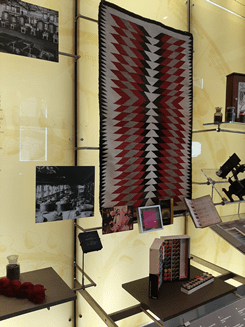
Because I did not have much time before I was leaving the city, I visited the museum and the exhibits. The Institute’s museum exhibits include an array of artifacts, scientific instruments, and art utilized to create exhibitions, public programs, and other materials showcasing the research and diverse collections. Making Modernity, a permanent exhibit, shows visitors how chemistry has touched our lives and visitors can trace the scientific progress in the laboratory, the factory, and their homes; the exhibit’s mission is to help visitors learn how chemistry created and continues to shape the modern world.  Throughout the exhibit, there are scientific instruments and apparatus, rare books, fine art, and the personal papers of prominent scientists. Making Modernity also have varying topics that range from alchemy, synthetics, and the chemical-instrument revolution to chemistry education, electro-chemistry, chemistry sets, and the science of color.

During my visit, I noticed that each part of the museum showcased scientific artifacts that described the evolution of everyday materials we may take for granted nowadays. For instance, one of the many sections I was impressed with was called The Chemical Body: A New View of Health which showed technical innovations in the 19th century that led to discoveries of vitamins and techniques for analyzing the body’s chemical and cellular makeup.

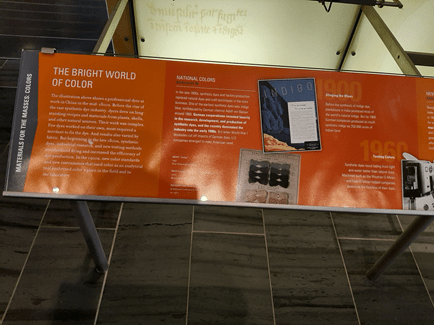
Another example of a section that stood out to me was The Bright World of Color which shares the changes in creating dyes from natural resources to using industrial research, synthetic dyes, and new testing methods to improve dye production. It reminded me of my research while I was in college about the history of cochineal used as red dyes. I enjoyed how much detail the exhibit labels went into each section of the museum exhibit especially in the Bright World of Color.

I was also impressed with another part of the exhibit which features an interactive multimedia learning experience which showcases the collections of art, scientific instruments, rare books, and other artifacts. The installation has a two-story high video column and a pair of high-resolution, interactive tables known as Object Explorer; visitors can explore the history and science behind various everyday objects by placing them on an interactive table to investigate the object’s history and the stories of the materials they are made of. For instance, I took a Pyrex measuring cup and placed in on the interactive table which revealed information about the history of glass and how the quality of glass was improved to eventually be used as the measuring cup.

Also, there was another exhibit I viewed while I was inside the Science History Institute called What Was the Real Age of Alchemy? Inside the exhibits there were various paintings and artifacts that revealed alchemy was change, creativity, and curiosity which shaped the modern understanding of modern science.

If you are visiting Philadelphia, I recommend spending a lot of time at the Science History Institute for there is so much to see and learn.

Resources:

https://www.sciencehistory.org

https://www.sciencehistory.org/museum

Interpretation: The Importance of Storytelling in Museum Programs

October 3, 2019

I recently started to have discussions about interpretation and storytelling for current projects I am working on, and they have inspired me to reflect on interpretation in museums and historic sites. Since officially beginning my career in the museum field in 2012, I learned about the importance of translating historical narrative for visitors to understand and to be engaged with the experience. As I continued my career, the discussions among museum professionals I noticed focus on using storytelling methods to get visitors’ attention.

Interpretative programs are significant for all history museums, historic house museums, and historic sites since how visitors see them and enjoy their experiences in these places would affect the way they viewed museums. The Technical Leaflet, a publication of the American Association for State and Local History (AASLH), called Telling the Story: Better Interpretation at Small Historical Organizations written by Timothy Glines and David Grabitske went into detail about interpretation and what small organizations can do better for their programs. Glines and Grabitske pointed out that Historical interpretation translates human stories from the past into meaningful thoughts for people in the present. As museum professionals our educational missions we strive for are to tell human stories people can identify with to have a better understanding of the history we present in our museums.

When I began graduate school and my career, I began to see the importance of relating human stories to the public and taking visitor input into account for interpretation. At the Connecticut’s Old State House, for instance, there were many frequently asked questions visitors have asked during tours that inspired staff to do more research to include in the tour narrative. In my blog post sharing my memories about the internship, I stated

I sat in on staff meetings to find out what common questions were asked during tours we did not already have answers for and I used those questions to do research to answer them. I regularly visited the Connecticut State Library to do research, and recorded answers into the Google Doc so we would be able to answer them in the future.

By finding out information visitors want to know most about, we would be able to have visitor input in the narrative. When interpretative programs are developed it is important to understand who the audience is and how to capture their attention to explain our relevance within the community and the overall historical narrative. Marcella Wells, Barbara Butler, and Judith Koke’s book Interpretive Planning for Museums: Integrating Visitor Perspectives in Decision Making pointed out that museum planners must apply intentional effort and deliberation if they are to fully integrate visitor perspectives into their plans. In other words, there must be full commitment to incorporate visitor perspectives when considering planning interpretive programs. I saw the start of fleshing out this important point when I was working in Hartford on an interpretive project.

Something I have thought about when I gave tours at Connecticut Landmarks before the project started is the amount of information I tell visitors. Throughout the tours, I would figure it out the appropriate balance for each group of visitors. Glines and Grabitske also stressed the importance of sharing the right amount of information when storytelling. According to Glines and Grabitske, they pointed out that: we must pay attention to the interests of our visitors by telling meaningful stories, making sure not to fatigue them mentally with breathless depth or fatigue them physically with no chance to take it all in. When I started giving tours, I noticed there was a ton of information provided to each educator giving tours. It would be impossible to include all of it in one tour which is why it is important for us to chose what information to include in the narrative we tell. I also noticed that at that point I was more focused on making sure I hit each point than telling a story. The interpretive project I worked on with Connecticut Landmarks seemed to be moving towards telling a story.

While I was at Connecticut Landmarks’ Butler-McCook House, I joined the rest of the staff in interpretive planning meetings to draw in more visitors to the historic house. We realized that by using a theme, not only were we working towards visitors making connections, but it also focused on telling a narrative. Because there are many themes that are found in the Butler and McCook family history, there are different narratives visitors can choose to learn about and keep coming back to see something different than their previous visits. I briefly talked about this experience in my memories blog on Connecticut Landmarks’:

During my time at the Butler-McCook House, I was a part of the team that worked on revamping the tours by picking a theme of the house and researching the theme for a more engaging visitor experience. Each of us picked one theme to research on our own to present to the rest of the Connecticut Landmarks team, and I chose the Industrial Revolution and its impact on Hartford and the family.

The purpose of the theme I chose for a new tour was to show the Industrial Revolution had an impact on the city of Hartford especially on its residents including the Butlers and the McCooks. I chose five key objects that will support the theme and its purpose including Tall Case Clock which was made approximately 1750 by Benjamin Cheney, and this is an example of a locally made piece that was made before the Industrial Revolution to show the differences between craftsmanship and factory made items. Another example of a key object was the Mill Ledger C, 1818-1826 which was John Butler’s, one of the family’s ancestors’, ledger which recorded payments to men and women who labored in his paper mill; this revealed what the employees were paid for their labor in early industrial work. After selecting key objects, I chose key documents and photographs then created a tour outline highlighting the narrative relevant to the Industrial Revolution theme.

To read a copy of the interpretive project, I included a link here. The Industrial Revolution was an important theme for the tour since we are all affected by technological advances, and to help visitors understand the impact of the Industrial Revolution it is important to use relevant examples.

Another example of using examples to help visitors connect with the historical narrative was while I taught school programs at the Noah Webster House & West Hartford Historical Society. In one of the chambers inside the house, I talked to the kids about the history of Noah Webster and his work on the first American published dictionary; I also discussed the objects that were displayed in the room. One of the kids asked me about how the bed warmer was used and I did so by describing the process and after asking them if they have seen the movie Pirates of the Caribbean I told them about how one of the characters used a similar bed warmer in one of the scenes. By connecting this object to something they have seen before in modern times, they were able to make that connection and use it to refer to it at a later point when they shared their experiences.

When I move forward in working on a current interpretative project, I will not only keep in mind the experiences I have had but incorporate more lessons I will continue to learn each step of the way.

Resources:

American Association for State and Local History, Technical Leaflet # 222, “Telling the Story: Better Interpretation at Small Historical Organizations”, History News, volume 58, number 2, Spring 2003.

Wells, Marcella; Butler, Barbara; Koke, Judith, Interpretive Planning for Museums: Integrating Visitor Perspectives in Decision Making, Walnut Creek, CA: Left Coast Press, Inc., 2013.

https://lookingbackmovingforwardinmuseumeducation.com/2019/02/07/museum-memories-connecticuts-old-state-house/

https://lookingbackmovingforwardinmuseumeducation.com/2019/04/25/museum-memories-connecticut-landmarks-historic-houses-in-hartford/

https://lookingbackmovingforwardinmuseumeducation.com/2019/05/23/museum-memories-noah-webster-house/

Philadelphia Museum Impressions: Museum of the American Revolution

September 26, 2019

I wrote last time about my museum impressions on Independence Hall when I was down in Philadelphia for the AASLH Annual Meeting. Another place I visited during the first day of the conference was the Museum of the American Revolution. Since I was participating in a networking event later in the day, I did not spend the time I would have wanted to spend in the Museum since as soon as I entered the exhibit I knew I could spend an entire day exploring the place and utilizing the interactive supplemental materials.

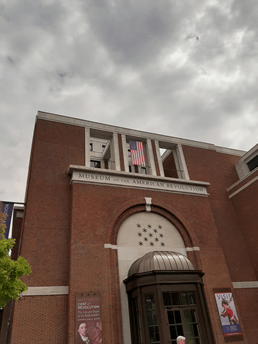
The Museum’s Entrance

Located not too far from the Independence Hall, the Museum of the American Revolution explores the American Revolution through its unmatched collection of Revolutionary-era weapons, personal items, documents, and works of art. Since it opened in April 2017, the Museum’s aim is to inspire visitors to gain a deeper appreciation for how this nation came to be and feel inspired to consider their role in the ongoing promise of the American Revolution. After getting my admission ticket, I decided to start by going upstairs to see the exhibits.

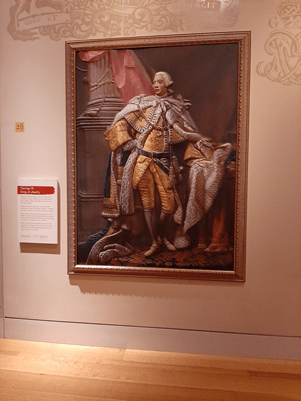
Portrait of King George III

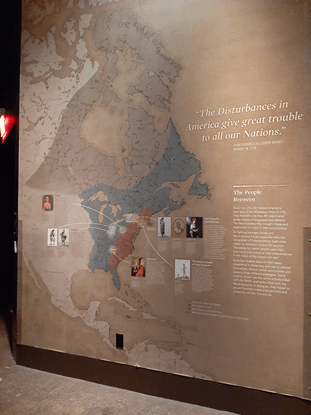
The second floor contained the core exhibition which explores the origins of the American Revolution, the fight for independence, and the on-going legacies of the Revolution.  Throughout the exhibition, the collections and the narrative were guided by these questions which invites visitors to answer them while they explore:

How did people become Revolutionaries?

How did the Revolution survive its darkest hour?

How Revolutionary was the war?

What kind of nation did the Revolution create?

I enjoyed that the Museum guides visitors through the exhibit by introducing these questions for them to keep in mind because it could help them think about what they see, read, and interact with and the significance of the Revolutionary War. Another example of having visitors think more about what really happened during the Revolutionary War were the “Closer Look” markers I found as I went through the exhibit. One of the “Closer Look” labels asked the question When was the term “American Revolution” first used? This question made me happy as a public historian since introducing these questions puts the visitor in the perspective of a historian and challenges the usual way history is taught in the American school system (assuming there is a clear answer for each question posed).

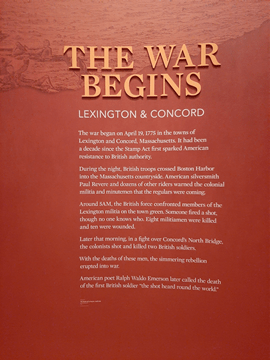
After exploring the origins of the American Revolution section of the exhibit, I proceeded to the fight for independence section. I read about the Battle of Lexington and Concord and saw the collections from the era.

As I moved through the exhibit, I noticed several more interactive supplements that made the experience more engaging. For instance, there is a map that lights up when a button is pressed to show the soldiers movements during battles such as the Battle of Princeton (1777). Also, in the room where the life-size replica privateer ship is located, there is a piece of the replica tar-covered rope inside a box, visitors were encouraged to smell it.

I also appreciated that within the exhibit there is a section within the exhibit that discussed the narrative of the forgotten allies, the Oneida Nation, that joined the colonists in the fight during the American Revolution. Not many talks about the Native American involvement and contributions to the American Revolution, and this exhibit includes a video describing how the Oneida Nation decided to join the colonists.

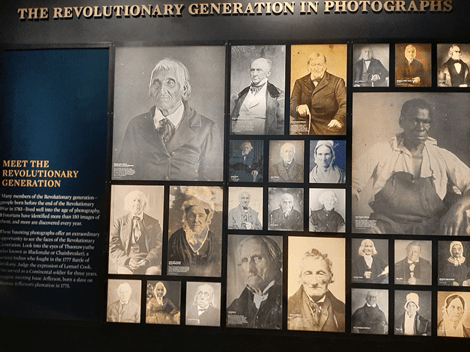
Towards the end of the exhibit, there is a section dedicated to the Revolutionary Generation through photographs. According to the Museum’s text, the last known Revolutionary War veterans had their photographs taken and died shortly after the Civil War. Also, I liked that the exhibit ended with visitors meeting the future of the American Revolution which has a wall covered with mirrors since it is a subtle way of explaining to visitors what these veterans were fighting for.

I did not explain everything I have seen because there was so much that the post would be too long, and I really encourage everyone reading the blog to visit the Museum of the American Revolution when one gets the opportunity. Since my visit, I found out that there is a virtual tour available on the Museum’s website so if one is not able to get there in person yet there is another way to see the Museum. It is a museum I am willing to visit again when I can visit Philadelphia again.

To find out more about the Museum, click here for the Museum’s website: http://www.amrevmuseum.org/

If you have been to the Museum, what were the things that you observed? If you have not visited yet, what would you like to learn more about or expect to see?

Digital Resource Examination: The Inclusive Historian’s Handbook

September 19, 2019

Resources for public historians and museum professionals are numerous, and as both fields are talking about and taking action to being more inclusive there is a demand for resources to help museums, historic sites, and its staff become more inclusive. There are books, professional development sessions, webinars, articles, et. cetera professionals develop and utilize to move the fields forward. I participated in the American Association for State and Local History (AASLH)’s webinar this afternoon about the new digital project, The Inclusive Historian’s Handbook first released in August 2019 during the AASLH Annual Meeting in Philadelphia. The Inclusive Historian’s Handbook is co-sponsored by AASLH and the National Council for Public History (NCPH). In the webinar, Kimberly Springle (Executive Director of the Charles Sumner School Museum and Archives and an advisory committee member) and Will Walker (associate professor of history, Cooperstown Graduate Program, SUNY Oneonta and an editor for the Handbook) presented the website and explained how they envision the site to be used.

The Inclusive Historian’s Handbook is a digital resource that is free and open to all on the internet, and the authors of the entries on the site are experienced public historians and museum professionals. According to Springle and Walker, the goals for the Handbook are

To share a knowledge base that invites more people to engage in history projects,

To center equity, inclusivity, diversity, and public service,

To provide concrete examples of how to make history work more relevant.

I always appreciate projects that has several professionals collaborate to make a difference in the field. I appreciate that one of their approaches for being more inclusive is inviting individuals of varying backgrounds from professionals to individuals who work with historical collections but do not call themselves historians. By having so many contributors, we would have a lot of perspectives represented in each entry. When contributors send in their entries, there are editors and advisors that work together with contributors to make sure their content is as clear and concise as possible. The topics are limitless, and the list the presenters shared proved how extensive the list is and there is always more to write about for the Handbook.

They first shared a list of twenty-one current entries in the Inclusive Historian’s Handbook. A few examples of current entries include accessibility, civic engagement, heritage tourism, memorials and monuments, sexuality, and historic preservation. They also had a list of entries that are in progress of editing including but not limited to activism, oral history, leadership, K-12 history education, and Holocaust history. Lastly, they included a list of proposed entries including but limited to advisory boards, Civil Rights history, decolonizing museums, difficult history, boards and governance, documentary films, gender, and hiring. The editors and Advisory Committee members are still encouraging individuals to contribute to the Handbook by using the contact form on their website.

Participants in the webinar also were asked to answer two short polls in which of the 20 proposed entry categories. In the polls, we chose three categories from each one we were most interested in reading about. I think this would also be helpful for the Handbook to include these polls for visitors to the website so it will help both the Advisory Committee, editors, and contributors know what entries need to be included in the Handbook. Also, I like that the target audience for the Handbook is more inclusive.

Springle and Walker emphasized that the audience for the Handbook is anyone who is seeking to be more inclusive, equitable, and service-oriented in their work not just for paid professionals or academic scholars. Their hope with this digital resource project is that the content is accessible to all individuals who are doing historical work. Also, they had a list of suggested ways to use the Handbook including but not limited to personal reflection, staff development/team building, teaching/mentoring, collaboration/partnerships, resource mining, and contribute. Each suggested way to use the Handbook is significant to help the study of history evolve and inspire people to continue discussing important topics we need to keep fresh in our minds. It will also help museum professionals move forward within the field by delving into important topics we need to continue to address (especially hiring and boards and governance). This is a living digital resource that will be useful for all who seek inclusivity in history, and hopefully future editions will help continue important discussions.

To learn more, check it out here: www.inclusivehistorian.com

Remembering 9/11: 18 years later

September 11, 2019

Normally I would be posting a blog post on Thursdays but today I decided to write a short post in addition to my Thursday post because I had a number of thoughts as I remember the 18th anniversary of the 9/11 attacks. I read various articles today about remembering those attacks on the World Trade Center and the Pentagon, and the people who have lost their lives on that day. I saw comparison pictures of the New York City skyline and area the day of the attacks and what they look like today. It is hard sometimes to think that it had been so long ago, and yet it felt like it had been a short time ago at the same time. Eighteen years later, I can still vividly remember where I was when I learned about the news and saw the attacks on the television. When the attacks happened, I was in middle school in my hometown of Franklin, Massachusetts and I was in class as I learned about what was happening in New York City. Even though we were in the middle of a history lesson, my teacher turned the television on so my classmates and I can learn about what is going on as it happened. I remember talking about what happened with my mother and sisters after school on the ride home, and later watching the news coverage.

Now that I live on Long Island, New York, I see more of how New Yorkers felt on that day and how they remember. I am also happy about how many people are able to help those in need on that day and even now as 4,000 New York volunteers board the Intrepid to pack a million non-perishable meals for New York families and 100,000 non-perishable meals for victims of Hurricane Dorian (according to an article I read on amny.com released the day before). These actions remind me of how our country, even as it faces so much over the past few years, can still come together to remember and help others. I am happy that we still commemorate this day to remind us of not only what happened and those who have lost their lives on that day but those men and women in the police and fire departments, and volunteers, who worked hard to save lives. I will never forget!

Below I have included articles I have read today and the 9/11 Memorial Museum website for more information:

https://www.amny.com/news/intrepid-9-11-volunteer-1.36140377

todayincthistory.com/2019/09/11/september-11-9-11-terrorist-attacks-hit-close-to-home/

https://americanhistory.si.edu/blog/handwritten-note-september-11-2001

gvshp.org/blog/2019/09/11/remembering-the-world-trade-center-and-its-aftermath-of-its-destruction/

abcnews.go.com/US/us-marks-18th-anniversary-911-terrorist-attacks/story?id=65530195&cid=social_twitter_abcn

https://news.yahoo.com/911-then-and-now-18-years-later-182946226.html

https://www.911memorial.org/

Humanities Indicators Results Reaction: Visitors Historic Sites and Museums on the Rise

August 15, 2019

This past Monday, I discovered an interesting study that was examined and presented by Humanities Indicators. For those who are not familiar with them, Humanities Indicators is run by the American Academy of the Arts and Sciences. The Academy is an honorary society that recognizes and celebrates the excellence of its members, and it is an independent research center convening the leaders from across disciplines, professions, and perspectives to address significant challenges. Humanities Indicators, according to the website, presents data which are quantitative descriptive statistics that chart trends over time in aspects of the humanities that are of interest to a wide audience and for which there are available data. As the title suggests, the results from the study revealed the number of visitors coming to historic sites and museums is on the rise.

On the results page, it revealed that the results were updated this month, so we know they continuously update the information as new studies have been completed. In the report, it stated according to the National Endowment for the Arts’ Survey of Public Participation in the Arts (SPPA), the percentage of people making at least one such visit fell steadily from 1982 to 2012, before rising somewhat in 2017. The recent results make me hopeful that the numbers will continue to increase especially since we need to preserve the historic sites, parks, and collections for future generations to learn about our past, and learn how we remember and preserve the past. It is important now more than ever to help educate people and future generations why history is significant in understanding how the country came to the current state it is in. I continued to read the study to learn about the findings they discovered about historic sites and museums.

There were a few findings and trends they reported on the webpage to explain the rise of visitors to historic sites and museums. For instance, the number of American adults who visited historic sites has changed in a few ways:

In 2017, 28% of American adults reported visiting a historic site in the previous year. This represented an increase of 4.4 percentage points from 2012 (the last time SPPA was administered), but a decrease of 8.9 percentage points from 1982 (Indicator V-13a). The bulk of the decline in visitation occurred from 2002 to 2008.

The Indicator V-13a refers to the bar graph that measures the percentage of U.S. adults by age who toured a park, monument, building, or neighborhood for historic or design value in the previous 12 months between 1982 and 2017. What did not surprise me too much was the bulk of the decline between 2002 and 2008 since it was the years leading up to the recession and I assume not many people were willing or able to travel as much (of course there is more than one reason for the decline). Other findings and trends that were shared by Humanities Indicators include:

From 1982 to 2017, the differences among age groups with respect to rates of historic site visitation decreased. For example, in 1982, the rate of visitation among 25-to-34-year-olds (the group most likely to visit a historic site in that survey) was approximately 11 percentage points higher than that of the youngest age group (18-to-24-year-olds), and more than 17 points higher than that of people ages 65–74. By 2017, however, the visitation rate of 25-to-34-year-olds had dropped to within five percentage points of the younger cohort and was virtually identical of that for the older group.

Much of the recent growth in visits to historic sites occurred among parks classified as national memorials and was driven by a particularly high level of visitation at sites that did not exist in 1995, such as the Franklin Delano Roosevelt Memorial (3.3 million visitors in 2018), the Martin Luther King, Jr. Memorial (3.6 million visitors), and the World War II Memorial (4.7 million visitors). As a result, visits to national memorials increased more than 300% from 1995 to 2016, even as the number of sites increased just 26% (from 23 to 29). In comparison, visits to national monuments increased only 3%, even as the number of sites in the category increased by 9% (from 64 to 70). From 2016 to 2018, the number of visits fell in every category, with the largest decline occurring at the memorial sites (down 10%), and the smallest drop at national monuments (3%).

When I read the study not only was I beginning to see hope in the future of museum and historic site visits, but I also began to get curious about how historic sites and museums visits were influenced by people outside the country visiting the United States. Is there a study out there that showed foreign visitors at the historic sites, parks, museums? Were the patterns like what has been presented in this study?

I would also be interested in the number of families that visit the historic sites and museums. Are there similar patterns found in this study for family visitors? It would be worth looking into both foreign visitors and families.

To find out the rest of the findings and the charts that visually represented the results they discovered, I included a link to the original site they presented the study. They also included a study on attendance of art museums, and I included the link to this one as well.

Resources:

Historic Sites Visits: https://www.humanitiesindicators.org/content/indicatordoc.aspx?i=101

Art Museum Attendance: https://www.humanitiesindicators.org/content/indicatordoc.aspx?i=102

American Academy of the Arts and Sciences: https://www.amacad.org/

Humanities Indicators: https://www.humanitiesindicators.org/default.aspx