Virtual Museum Impressions: Peabody Essex Museum

October 29, 2020

Since it has been a while, I decided to plan another virtual trip to a museum. In a previous visit to Salem, Massachusetts, I was not able to visit the Peabody Essex Museum and decided to write about my virtual experience. According to their website, the Peabody Essex Museum is a museum of international art and culture that is dedicated to connecting art to the world. Also, the staff and board strive to create experiences that transform people’s lives by broadening their perspectives, attitudes, and knowledge of themselves and the world through exhibitions, programs, publications, media, and other related activities.

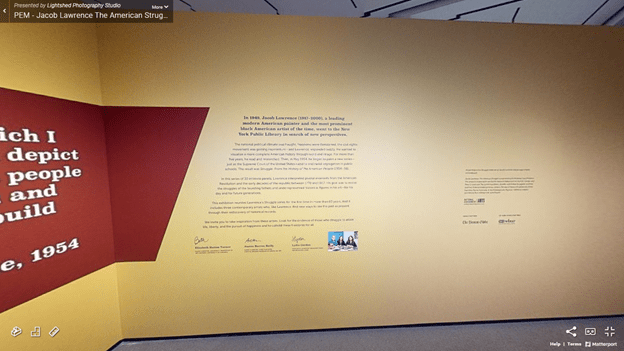
During my visit to the Peabody Essex Museum, I took virtual tours of their exhibits that were available on their website. Each tour has a 360-degree experience within their spaces powered by Matterport Lightshed Photography Studio; to move around in the space, I clicked on the rings and used the mouse to zoom in/out, and to look all around. The exhibits I explored were Jacob Lawrence: the American Struggle, Asian Export, Fashion & Design, Maritime, Where the Questions Live, Art & Nature Center, and Powerful Figures.

Jacob Lawrence was a leading modern American painter and the most prominent black American artist of the time. In the exhibit Jacob Lawrence: the American Struggle, his pieces were his responses to the fraught national political climate and according to the exhibit panel he wanted to visualize a more complete American history through word and image. The exhibit is a series of 30 paintings that interpret pivotal moments in from the American Revolution and the early decades of the republic between 1770 and 1817; his goal was to revive the struggles of the founding fathers and underrepresented historical figures in his art for his day and for future generations.

A couple of the paintings include ones that interpret the Boston Tea Party and Paul Revere’s Ride. Each painting included a quote from historical figures or primary sources on the side panels next to them. For instance, his interpretation of the Boston Tea Party had a quote from a song of 1773 which stated:

Rally Mohawks!

            Bring out your axes,

            and tell King George

            we’ll pay no taxes

            on his foreign tea…

While exploring the exhibit, I thought that the interpretations were interesting and visually striking especially since I was used to seeing paintings like the Signing of The Declaration of Independence by John Trumbull as an example of historical interpretation in art. I believe Lawrence achieved his goal with his painting series and I enjoyed the virtual experience.

The Peabody Essex Museum not only provides virtual tours but there are also at-home programs inspired by the museum. For instance, there is a program called PEM Pals that is located on PEM’s YouTube channel. PEM Pals is a weekly program dedicated to art, stories and learning for children under the age of 5 and their caretakers; each new episode are streamed at 10:30am Eastern Standard Time on Wednesdays. There is also Drop-In Art Activities that provides video tutorials to create various projects including but not limited to: milk jug elephants, egg carton ladybugs, cotton swab tree painting, plastic bottle chandelier, map making, and bubble bottle. Another example of at-home programs is Explore Outside in which participants are encouraged to go outdoors to investigate the world with nature-based activity sheets for bird watching, neighborhood tree trek, and scavenger hunts.

One of the exhibits that are available in person with a sample of objects from the exhibit available online was The Salem Witch Trials 1692. It is on view from September 26, 2020 to April 4, 2021. The exhibit explored the hysteria that involved more than 400 people and led to the deaths of 25 innocent people (men, women, and children) between June 1692 and March 1693. There are many unfounded theories about the Salem Witch Trials about how the hysteria started, and interest in the Trials still persist to this day. If you are able to see it in person, I recommend visiting this exhibit.

I hope to visit the Peabody Essex Museum in person one day. To learn more about the Museum, check out the links below.

Happy Halloween!!

Links:

Peabody Essex Museum

The Salem Witch Trials 1692

Learning from 1692 by Dinah Cardin

Virtual Tours

Halloween in the Museums 2020

October 23, 2020

I decided to write a bonus post to share some examples of activities museums are doing for Halloween during this pandemic. While Halloween will look different this year, there are ways to still celebrate while being safe. Museums, whether the experience is virtual or in person, are a great example of resources on what to do this Halloween season. Each one on the list I have complied below includes a link with more information about each of these museums and events. Also, each listing that has in-person gatherings include safety guidelines to protect one another while participating in the events.

The following list includes:

Children’s Museum of New Hampshire: They have both Halloween kits for pick up and a virtual experience combining the fun of Halloween and science.

New York State Museum: New York State Museum’s Halloween Spooktacular is a series of free virtual experiences featuring storytelling, craft demos, science, and a close-up look at the Museum’s costume collections.

Litchfield Historical Society: There is an event called Scarecrows in the Meadow in which families can socially distant walk through displays of scarecrows while enjoying games and self-guided crafts. The event is ongoing until October 31st.

Queens County Farm Museum: There are a number of events occurring at this museum including Halloween on the Farm which is family friendly includes admission to the Amazing Maize Maze, hayrides, kids crafts at the Con Edison Ecology booth and trick-or-treating with the farm animals.

Norwalk Historical Society: This virtual event is a fundraiser that is selling tickets, $10 per household, for the movie Haunting at Mill Hill. Once the tickets are purchased, the movie link will be sent to the email used to purchase the tickets.

New York Botanical Garden: The Great Pumpkin Path, October 3 – November 1, 2020, 10 a.m.–6 p.m.

Mount Vernon Fall Harvest Festival: If you are in the area, there is a harvest festival at George Washington’s home, Mount Vernon. October 24-25, 2020.

Green-Wood Cemetery: The cemetery is celebrating Día de Los Muertos starting on October 23rd, and a community altar will be installed in the Historic Chapel.

This is not a complete list. I hope this list will be a starting point for anyone looking for something to do this Halloween. If you know of other museums doing virtual and/or in-person events for Halloween, please share in the comments.

I have also included a link to the post I wrote last year which includes the history of Halloween here: The History of Halloween and How Museums Celebrate

What are your plans for Halloween this year?

Books I Want to Read for the Rest of 2020

October 1, 2020

It has been a while since I released a list of books that I am interested in reading on this site. I decided to compile a list of books that I either already have in my collections that I want to read (or re-read) or books that I have heard about and I want to put on my list of books to read. There are a few books on the list that I was introduced to during the American Association for State and Local History (AASLH) virtual conference in the Author Talks sessions. This is not a complete list of books but rather it is a sample of books I would like to read. I plan to write a couple more posts to add more books to the list until the end of 2020, and then I will start another list of books for 2021. Here is the following list:

  1. Doing Women’s History for the Public: A Handbook for Interpreting at Museums and Historic Sites by Heather Huyck https://rowman.com/ISBN/9781442264175/Doing-Women’s-History-in-Public-A-Handbook-for-Interpretation-at-Museums-and-Historic-Sites
  2. Exploring the History of Childhood and Play through 50 Historic Treasures by Susan A. Fletcher https://www.amazon.com/Exploring-Childhood-Historic-Treasures-Americas/dp/1538118742/
  3. Why Learn History (When It’s Already on Your Phone) by Sam Wineburg https://press.uchicago.edu/ucp/books/book/chicago/W/bo23022136.html
  4. A Leader’s Guide to Solving Challenges with Emotional Intelligence by David R. Caruso, PhD and Lisa T. Rees, ACC, MPA. https://www.goodreads.com/book/show/38899539-a-leader-s-guide-to-solving-challenges-with-emotional-intelligence
  5. Exploring Women’s Suffrage through 50 Historic Treasures by Jessica D. Jenkins https://www.amazon.com/Exploring-Suffrage-Historic-Americas-Treasures/dp/1538112795
  6. Leadership Matters Leading Museums in an Age of Discord, Second Edition by Anne W. Ackerson and Joan H. Baldwin https://www.amazon.com/Leadership-Matters-Leading-American-Association/dp/1538118319

What books are you reading in 2020? It does not have to be books about the museum field nor about history. I will be releasing a blog post about this year’s AASLH Annual Meeting and Conference soon. In the meantime, check out the conversations on Twitter using the hashtag #AASLH2020 and I will post some pictures (well…screenshots) from the conference on the Looking Back, Moving Forward in Museum Education’s Facebook page and Instagram.

Also check out a previous list I wrote a few years ago here: https://wp.me/p8J8yQ-1s

And here is a list I wrote for 2019: https://wp.me/p8J8yQ-we

Back to School During a Pandemic

September 17, 2020

Last week many students have begun to go back to school on virtual platforms or a hybrid of in person and virtual schools as we continue to face this pandemic. Museums are preparing to help parents, guardians, teachers, and students once again by working to maintain as well as build relationships with our communities to understand the emotional needs, and providing resources to assist in their education plans. In a previous blog post What Kind of Learning Are We Doing?, I pointed out that

We continue to figure out each day how to proceed teaching and learning while we are facing this pandemic. It is most likely hard at first to figure out a new routine for education especially for parents and guardians who are suddenly have to deal with finding ways to educate their children; for students who have to adjust to not being able to interact with their peers and teachers as they are used to; and for educators who have to figure out quickly how to transition their lessons into an online format.

This is still true as the new school year begins. The families I know have to figure out ways to continue their children’s education at home, at school, or a hybrid of both remote and onsite schooling. Each family faces their own challenges in finding out ways to engage children in their lessons. Museums should continue to work to keep the needs of their communities in mind as they continue to offer remote experiences for its visitors.

There are many examples museums have for education programs that vary on subjects covered and community support. Below I have included a list of resources that share what some museums are doing to help educators at home and at school in assisting with educating their students.

Announcement: Starting next week, I will be participating in this year’s AASLH Annual Meeting which has been moved to online due to the pandemic.

Links:

What Kind of Learning Are We Doing? The State of our Education during the Pandemic

USA Today: These online learning tips will help parents prepare for a successful school year, even if it is virtual.

https://www.aam-us.org/2020/09/01/my-primary-school-is-at-the-museumduring-the-pandemic/

https://www.aam-us.org/2020/09/02/never-waste-the-walls-what-pk-12-schools-can-learn-from-museum-design/

https://sites.google.com/view/museum-distance-learning/home

https://www.historians.org/publications-and-directories/remote-teaching-resources

https://cthumanities.org/bring-connecticut-history-to-life-in-your-classroom-with-teach-it-from-connecticut-humanities/

https://edsitement.neh.gov/teachers-guides/digital-humanities-and-online-education

Virtual Offerings:

https://www.mountvernon.org/education/distance-learning-programs/

https://marktwainhouse.org/teachers-students/

https://chs.org/history-to-go/

https://chs.org/education/online-learning/

Museum of Science, Boston: https://www.mos.org/explore/mos-at-home

https://www.explorableplaces.com/places/the-paul-revere-house

Plimoth Patuxet (formerly Plimoth Plantation): https://plimoth.org/learn-1 ; https://plimoth.org/plimoth-online

Old Sturbridge Village: https://www.osv.org/virtual-village/

https://www.nytransitmuseum.org/learn/schoolgroup/

https://www.morrisjumel.org/learning-from-home

https://www.morrisjumel.org/virtual-education-survey-2

https://madmuseum.org/online

https://www.nyhistory.org/education

https://www.tenement.org/visit/virtual-school-programs/

https://www.frauncestavernmuseum.org/digital-content

https://nassaumuseum.org/museum-from-home/#remote-learning

Nelson-Atkins Museum: https://nelson-atkins.org/nelson-atkins-at-home/learn-at-home/

The Field Museum: https://www.fieldmuseum.org/educators/learning-resources/learning-home

The Durham Museum: https://durhammuseum.org/education/digital-learning/at-school/

Reaction: Museums Are Being Tasked With Radically Transforming the Way They Work.

September 3, 2020

I saw this op-ed on Artnet news via Twitter written by post-graduate Interpretive Fellow at the Museum of Fine Arts, Houston, Aaron Ambroso, titled “Museums Are Being Tasked With Radically Transforming the Way They Work. Here Are 6 Practical Steps They Can Take to Do That”. This is an interesting piece because it is important that museums should transform the way they work, and it is important to hear multiple perspectives on what is going on in the museum field. What also drew my attention to this piece was the responses to this op-ed. A number of tweets argued that the misconception that “all museums are art museums” was present within the piece. It is a misconception that is spread both within and outside of the museum field in webinars, newspaper articles, et. cetera. The problem with implying that “all museums are art museums” is not every advice, suggestion, or guideline fits with all museums, and by talking about museums in general while only highlighting the art experience it alienates other history, science, natural history, children, and many more types of museums that are working on transforming the work they do. I decided to take a closer look to see for myself what Ambroso had to say about museums transforming the way they work and where the misconception came from.

Since the op-ed was released on Artnet news, which is an extension of Artnet (the leading online resource for the international art market, and the destination to buy, sell, and research art online), it seems that the intended audience for this piece is art museums. The title of the piece and the arguments made within the piece, however, suggests that it addresses all museums. As I read the piece, I noticed that Ambroso discussed museums while heavily using examples of art museums. For instance, he stated that

Museums around the country have done pathbreaking and important work addressing issues of political neutrality, and many have made explicit discussions of race, sex, and class a central part of exhibitions and programming. Yet still too often, museums display works of art with an exclusive focus on qualities that are supposed to speak in universal ways, or with blinders about the way art objects may be read in problematic ways by disadvantaged communities.

For example, is it best to emphasize a 16th-century British portrait’s technical and formal qualities? Or should we recontextualize 16th-century symbolic objects, which were closely tied to the upper nobility, to better understand the historic inequality of the present? Too often, issues of technique and formal composition can be seen as implicitly neutral—as if they do not evince a particular perspective with an implicit value system.

The previous statements might make sense for art museums, but it may not make sense for other types of museums such as history, science, natural history, and children’s museums.

In response to the steps presented in the op-ed piece, I have mixed reactions to what was being presented in the piece. I agree that it is important for museums to connect with the community museums are located in. Ambroso pointed out the importance of connecting with the community:

Museums must go beyond the expertise of curatorial and education staff and understand themselves as interacting with specific communities across often fraught social and geographic boundaries. Many museums have come a long way in co-creating with indigenous communities. But there are also communities only miles away from museums that may feel as far away socially as people from another continent.

My concern is with the section that Ambroso labeled as “Let’s Be Neutral, Please”. While he pointed out that museums need to continue to question the history of neutrality and acknowledge the active role they play in stage-crafting the art experience, I think the title of the neutrality section was misleading since it could be easily misinterpreted as his suggestion that museums should be neutral.

Ambroso’s op-ed expressed interesting points that are important for art museums to consider when working on transforming their interactions within the community and within their walls during these hard times. If opinions are shared on what museums in general should do when reforming their practices, they should reflect on how they can be applied to all museums and not one specific type of museum. When articles are written about museums and webinars are presented for museums, it is important to develop the information that apply for all types of museums not just art museums. Every museum has not only their focused subject matter their exhibits, programs, and collections support but they have their own budget sizes, communities they serve, locations, et cetera that any specific advice or guideline does not apply to their needs.

I recommend reading the piece to see more of what they wrote on reforming museums in the link below.

Links:

https://news.artnet.com/opinion/museum-ethics-op-ed-1904895

https://news.artnet.com/

Services Examination: Curious Experience Design

August 27, 2020

Earlier today I came across a group on LinkedIn promoting Curious Experience Design and I decided to take a closer look at their website to see what it is. It has been a while since I released a post examining services and websites geared towards museums, therefore I thought that I would find out what this was about. Curious Experience Design, according to their site and social media pages, designs immersive experiences that enliven the mundane and invite participants to get curious. On their website, they revealed that they not only provide services for museums, but they also worked on projects for festival entertainment, birthday parties, bachelor and bachelorette parties, concerts, open houses, corporate events, team building, brand activation, library programs, college events, prom after-parties, and more.

Their site also described what they designed within their site and in their portfolios they shared on the site. According to the site, they design multimedia games, immersive events, and education programs. They believe that at the core the art of game design is a process of designing experiences and the media is only a tool to create an engaging game experience. Also, I liked that they stated “You don’t need the flashiest technology to impress” because each museum has the opportunity to provide engaging interactive games/exhibits and education programs; while museums have varying budgets to spend on exhibits and programs, there are opportunities to create engaging ones with the resources they have to implement. For the immersive events, they blended live-action role playing and immersive theater, and encouraged participants to wear costumes and become characters themselves.

In addition to multimedia games and immersive events, they also developed educational programs for museums and classrooms between primary school and college. They expressed their belief that learning should be fun since learners can be motivated to engage with subjects being taught by creating compelling stories and challenging players through exploratory play. There are museums, including ones I have previously worked for, that are working towards incorporating more storytelling and interaction to help students in education programs not only take away the important lessons but also gain memorable experiences from. The examples of projects they have worked on were shared on their website in the portfolio section.

One of the projects they worked on took place at the Bostonian Society in which they created an immersive game. According to the portfolio, the educational immersive game was designed to put players into the events that let to the American Revolution on the exact locations the events took place. Inside the portfolio, they stated

Participants were assigned to use a guidebook to locate interpreters on the streets of downtown Boston. Once located, the interpreters, playing 18th-century characters, drew the players into the political intrigues of 1765 with riddles, ciphers and secret plots. Players undertook a series of challenges, culminating in a participatory reenactment of a colonial protest march through the modern, urban streets.

I appreciate that in this program that the participants were able to be in the same locations where the events took place because it would help them become more engaged with the history if they were able to either be in the locations physically or in simulated locations.

If you are curious to learn more, visit their website I have included below.

Links:

https://www.curiousxp.com/

https://www.curiousxp.com/blog/echoes-of-the-past

Reflections on Museum Education Since COVID Arrived in the United States Part 1

August 20, 2020

It has been at least six months since the United States was on lockdown due to the pandemic, and there has been a lot of changes that have occurred especially within the museum field. Usually I would write a reflection about the museum field in the past year in December however I decided to share my reflections on museum education to describe what I have seen that is happening in the field. Throughout the months I have been writing about how the museum field responded to the pandemic. For instance, I wrote “Museums Offering Virtual Experiences during the Pandemic” which focused on how more museums are developing virtual programs and engaging with communities in the virtual realm.

There were other posts that also described how museums handled the news of the pandemic and professional development programs that are moved online. In “What Kind of Learning Are We Doing? The State of our Education during the Pandemic”, I shared information I learned in an AASLH program about how museums should also help the communities cope with the drastic changes the pandemic has brought not just focus on providing education programs. I also attended a number of professional development programs that were moved to the online platform such as the New York Museum Educators Roundtable (NYCMER) conference and the American Alliance of Museums (AAM) conference. I included a few links to the posts and relevant pages of blog posts in the list below. As the pandemic continues, it is important to also take a moment to reflect and practice self-care before continuing to do any work before being quarantined and overworking burns us out.

Another inspiration for this blog post was Joan Baldwin’s post on Leadership Matters called “The Museum Crisis: Does Reflection Help?” Baldwin’s post described the importance of pausing and reflecting on one’s work in leadership and museums. She pointed out that

A reflective practice allows us to avoid making the same mistakes again and again. It asks us to acknowledge where we went off course, imagine a second chance and aspire to a better outcome. Okay, so why does any of that matter when, if there is a resurgence of COVID, your museum may close? Organizationally, it may not matter. But if you’re lucky enough to serve a museum or heritage organization that is open and weathering the COVID/post-George Floyd storm, then reflection, both personal and organizational, will help you emerge from the same old place, doing the same old thing, just well enough.

When the pandemic reached the United States, the Three Village Historical Society closed its physical location and continued its operations from each person’s homes. The Education Committee, myself included, met with one another through Zoom to plan the next steps in running education programs. In each meeting we had, we planned virtual programs that were both inspired by existing programs that we usually implement in person and by programs we have learned about that we adapted to teach Three Village history. As we face the upcoming fall season, it is important that we also reflect on how we will proceed to help schools as they make decisions on re-opening their doors at the capacity they chose to start the new school year.

During these months, I was asked to present at an online forum for the Museums Galleries Scotland called “Moving Forward with Learning and Engagement: re-connecting, adapting and collaboration during and post lock-down” to share the perspective of Looking Back, Moving Forward in Museum Education and participate in the group discussion answering questions such as How can we sustain and build on the connections we have made during lock down?

I am grateful for each experience I have had especially during these hard times, and while it is hard to stay motivated in the pandemic there is a way to help ourselves with mental health and general wellbeing. Reflection could help in addition to many self-care practices.

Link:

How are Museums Dealing with the Coronavirus?

Museums Offering Virtual Experiences during the Pandemic

COVID-19 Blog Posts

Professional Development

The Museum Crisis: Does Reflection Help?:

https://leadershipmatters1213.wordpress.com/2020/08/10/the-museum-crisis-does-reflection-help/

Charging Admission to Museums during this Pandemic: A Discussion

August 13, 2020

As some museums are either considering or planning to reopen their doors, there is some discussion about charging admission to visit both virtually and in-person. The pandemic has caused numerous financial hardships for many people, museums, nonprofits, theaters, stores, et. cetera. Museums charging admission is not a new topic in the field, but it has especially been relevant within the last months as museums consider re-opening their doors. In order to figure out how to keep museums running financially, museum professionals have been talking about whether or not to charge admission for some virtual experiences.

A conclusive answer for all museums would be hard to reach since each museum have their own budgets and their own limitations, and the pandemic created even more limitations for museums. In the blog post I wrote a couple of years ago What We Can Do About Admission Fees to Our Museums? I pointed out that

Many museums have different admission policies based on their operation budgets and funding they may or may not receive from donors and sometimes the government. The decision on what the admission prices to museums is not an easy one to make. Many museum professionals and visitors debate over what would be an appropriate amount to pay admission to museums.

With the pandemic continuing to financially effect museums among other recreational, educational, and businesses, the previous statement I made in that post is still true now but with more things to consider. It is not only museums, schools, businesses, et. cetera that are struggling but families and individuals are also struggling, and for many spending money on trips to museums (that have re-opened their physical sites to certain extents) is not a priority.

Museums are considering varying options to address the admissions issue. The Three Village Historical Society in East Setauket, New York, for instance, decided on suggested donations for their virtual events. One museum in Germany decided to do an experiment with a different way of charging admissions. In the post shared on the American Alliance of Museums website, they shared information from the experiment by the Weserburg Museum of Modern Art in Bremen, Germany when they decided to change their admission policy to a “pay as you stay” model; there were two test phases that occurred in December 2019 and March 2020 when visitors paid one Euro per ten minutes, and in their results they revealed that while changing the admission to exist prices was a challenge the efforts had exceeded their expectations. Some of their findings include

The results of our experiment show that this pricing approach, which so far only existed in theory, not only worked in museum practice, but produced positive results. We must, of course, gather more data to understand the effects better, and it is in no way obvious that the system would work in other museums. It is also unclear what the effects would be in the long run. Available studies suggest that prices are rarely the decisive factor in the decision about whether or not to visit the arts, at least in Europe. We must also assume that the promotional effects wear off over time. But even if it is only a minor contribution – if a novel pricing model such as this can support our mission to be accessible, visitor oriented and open to new audiences, we should not leave this stone unturned.

When I read the article, I thought that “pay as you stay” model is an interesting option that museum professionals should examine to see if it would work for their museums. Since the United States especially has many museums of varying types, sizes (physical and budget), et. cetera, one model would not work for all of them. Colleen Dilenschneider released some information on her study on admissions to cultural institutions in the post Still Worth It? Admission Cost During the Pandemic for Cultural Entities (DATA). In the post, Dilenschneider pointed out a few things, including but not limited to, that people believe cultural entities are not less worthy of admission costs and that leaders should take a thoughtful approach to the decisions that need to be made about admissions rather than a reactive action. She also described value-for-cost perceptions which is a metric to help professionals understand how much perceptual value derived from an experience relative to its admission price unique to their institutions. For instance, the data informs three conditions as perceptions are being examined keeping data factors in mind:

Value of 100 = Optimally priced. This is the goal! This value means that the organization is priced and perceived such that the cost is not a significant barrier to engagement… while also not leaving money on the table!

Value less than 100 = Value disadvantaged. The lower the value, the proportionately greater the potential barrier to attendance the price point poses. For some organizations, this also represents an opportunity to improve the experience so it’s perceived as more worthy of one’s time and money.

Value greater than 100 = Value advantaged. The higher the value, the more money the organization proportionately risks “leaving on the table.” People would pay more for this experience without it jeopardizing attendance numbers.

In the end, the decision to charge admission is what all museums face but factors such as budgets and funding influences their decision to charge or not charge admission.

I recommend taking a closer look at the resources I mentioned in the list below.

What are your views on admissions to museums, cultural institutions, et. cetera during this pandemic (either virtually, in-person, or a hybrid)?

Links:

“Pay As You Stay” – an alternative pricing model for museums?

What Can We Do About Admission Fees to Our Museums?

Three Village Historical Society

Still Worth It? Admission Cost During the Pandemic for Cultural Entities (DATA)

How Museums Can Generate Revenue Through Digital Content and Virtual Experiences

Should Museums Die? A Conversation about Reforming the Museums

August 6, 2020

Last weekend there was a Death to Museums unconference that was livestreamed on August 1st and 2nd, and is now available to view on their YouTube channel. According to their website, Death to Museums is inspired by 2019 edition of FWD:Museums, a journal produced by students and faculty in the Museum and Exhibition Studies program at the University of Illinois at Chicago:

At the time of publication, the journal questioned whether museums can continue “business as usual” or if they should be reimagined anew. We find renewed relevance in this theme at a moment when museums are collapsing before our very eyes. We challenge the idea of returning to “normal” once the pandemic ends when “normal” means inequality, instability, extremely low wages, and an embarrassing lack of diversity across museum staff. Instead, we want to harness the collective potential of museum workers working towards radical change.

The way they challenged the idea of returning to “normal” was the unconference, and on each day there were presentations covering a wide-range of topics that focused on the goal to challenge oppressive museum practices and change the practices for the better. Some of the sessions include but not limited to A Proposal to White Museums, Museum Empathy and Compassion Fatigue: How Museums Can Support Staff Wellness, Not “Now, More Than Ever”—How Museums Can Talk Straight in Weird Times, Museum Internships Past, Present, and Future: Dismantling Systems of Powers from the Ground Up, and Dismantling Barriers to Progressive Action. I recommend watching all of the sessions to see for yourselves the discussions about reforming museum practices.

While we are all focusing on protecting each other and staying safe during the pandemic, museum professionals are taking advantage of this opportunity to discuss the changes that need to be made and had needed to be made for a long time now. Among the many calls for change in the museum field, museum professionals discuss the issues museums have not made enough progress in resolving especially during this pandemic including poor pay, anti-union, gender pay gap, and other inequitable and inhumane behaviors that turned museum professionals away from the field. I have also discussed some of the issues that were presented in the sessions in previous blog posts, especially under the What’s Going on in the Museum Field section. Reform in the museum practices is really needed, and before making changes we also need to address as well as acknowledge the foundations of museums that led us to this point. The changes we need to make not only should be focused on the institutions but also on the individuals working in the museums such as encouraging more self-care.

What do you think about death to museums? What would you want to see from museums moving forward?

Check out the links below on death to museums and related discussions.

Links:

https://deathtomuseums.com/

https://leadershipmatters1213.wordpress.com/2020/08/03/is-calling-for-their-death-the-path-to-fixing-museums-a-leadership-agenda-2021/

https://news.artnet.com/opinion/limits-of-care-and-knowledge-yesomi-umolu-op-ed-1889739?

What’s Going on in the Museum Field

Museum Educator: A Vital Role in the Museum-Community Partnership

July 23, 2020

While all museum roles within the building are important in their own functions to keep the museum running, museum educators are especially significant now as we figure out life and learning in this next normal. I have been reading for months through social media my museum field colleagues’ posts on layoffs, furloughs, and not being able to continue job hunting due to the pandemic; many of those posts were from museum educators who find themselves furloughed, laid off, or their job hunting became harder or completely stopped. Also, the Tenement Museum Union announced on Twitter that 76 employees were laid off, including all of their part-time educators. It is sad to see so many museum educators are being let go when they are needed especially during this time for more engaging programs. Museums should find ways to survive through the pandemic, but I do not believe that letting museum educators go is the solution.

I do not claim that there is one solution or method to keeping the museum afloat in this unprecedented time since all museums are facing varying circumstances that effect their ability to function onsite and/or virtually. A recent survey shared by the American Alliance of Museums revealed unsettling information about the state of museums:

One-third (33%) of respondents were not confident they would be able to survive 16 months without additional financial relief, and 16 percent felt their organization was at significant risk of permanent closure. The vast majority (87%) of museums have only 12 months or less of financial operating reserves remaining, with 56% having less than six months left to cover operations. Forty-four percent had furloughed or laid off some portion of their staff, and 41 percent anticipated reopening with reduced staff.

It is a reality that many museums are facing in the United States, and a huge loss for the communities that rely on the resources museums offer. Numerous considerations need to be addressed but we should not consider letting go staff members as the number one option on keeping museums financially supported. When we let go of the majority of our museum educators, we face a number of consequences.

Over the years I have been writing about museum education, I expressed the importance of the museum educators’ role in not only the museum but in the communities they serve as well. In the “Museum Education Challenges: Why We Need Museum Educators” post, for instance, I have discussed the demand for digital content for museum programming and how museums need to adapt to increasingly changing needs of the community:

Like schoolteachers in the classroom, museum educators were forced to learn to adapt quickly to teaching lessons that are normally taught in person now online in varying platforms including Zoom, Google, and YouTube. Even though most museum educators have already begun teaching on the online platform before the pandemic, not all museums had utilized teaching programs online. Providing education programs is a continuous process for museum educators and losing personnel in the education department would be a disservice to our museums, communities, and our nations.

If we do not have enough museum educators to meet the demands of the schools, camps, scouts, home schools, et. cetera looking for help with virtual lessons and resources, our museums would not be able to claim that they are part of the community they serve. Another example of a blog post I wrote to discuss the importance of museum education in the museum and community is the one called “How Education Theory is Used in Museums”. In this post, I wrote about how museums develop programs based on not only museum association standards but also on the state and national standards for education:

By developing an education policy in museums, it will help guide the education department in when drafting programs that will hopefully be accessible to its audiences, fulfill its mission, and appeal to teachers looking for outside the classroom opportunities.

If we lose the majority of our educators, we will create a disconnect between museums and educational institutions including but not limited to public schools, private schools, and home school groups. While it is possible that the majority of museums may not consider letting go of higher-level museum education professionals, we cannot make the assumption that all museums will not let go of their education managers or directors. As education standards change, and as school districts change how their school years will be executed, museums need to keep up with the changes and maintain contacts with other educators to prevent themselves from falling behind as well as being able to develop education programming relevant to the school groups that come to visit both in person and online.

In other words, each of the previous blog posts I mentioned both within this post and in the resource section below point out that letting go of museum educators is disconnecting ourselves from the communities we claim to be a part of and serve. I came across a post called “Caution: Laying Off Museum Educators May Burn Bridges to the Communities Museums Serve” in which an evaluator shares their perspective of the importance of museum educators especially within the K-12 community. Some of the points they made were:

The teachers highly value the respect and support they receive from museum educators.  The work of K-12 educators is hard and can go unnoticed.  But of all the museum educators I know, they consider K-12 educators essential to the well-being of our students and communities.  As such, museum educators’ frame their work as bolstering the self-regard and confidence of K-12 educators.

Sometimes the students point out something they see to the museum educator, but other times the conversation is completely un-museum related—they just seem to seek adult engagement and interest.  These individual museum educators are important to them.  This was underscored to me when I administered assessments to students in the program.  Students, knowing they were doing something related to the museum program, immediately asked me where are their museum educators (Adam, Ah-Young, Alicia, Barbara, Lindsey, Sarah, Suzannah)? They were notably disappointed to see me instead of their friends at the museum.

The kinds of relationships I have observed as an evaluator clearly demonstrates to me that museum educators are essential to a museum’s missions.  Museum educators are often the name and face of the museum to the community.  If these names and faces go away, I worry museum will have burned bridges into their communities.

As a museum educator myself, I especially agree with the observation that museum educators create connections with the students they teach within the programs. I remember a number of instances throughout my career in the museum education field when some kids are working on projects and decided to create another project so they can give me a present as a way to thank me, and I remember how the kids would be comfortable sharing stories with me (museum and non-museum related). When visiting museums, children especially have the opportunity to connect with the world they live in and with the real-world concepts, artifacts, and documents to fully grasp the lessons they learn in the classroom. Museum educators help children and other audiences bridge the gap between the classroom and the world around us.

 Like many museum professionals right now, I do not have the solution that would solve all problems museums are facing in the pandemic. The best we can do for now is to figure out the main priority to help museums survive, and getting rid of museum educators is not the priority we should have.

Resources:

https://www.npr.org/sections/coronavirus-live-updates/2020/07/22/894049653/one-third-of-u-s-museums-may-not-survive-the-year-survey-finds

https://www.aam-us.org/2020/07/22/a-snapshot-of-us-museums-response-to-the-covid-19-pandemic/

https://www.aam-us.org/wp-content/uploads/2020/07/2020_National-Survey-of-COVID19-Impact-on-US-Museums.pdf

https://hyperallergic.com/578201/tenement-museum-education-staff-layoffs/

Caution: Laying Off Museum Educators May Burn Bridges to the Communities Museums Serve

Museum Education Challenges: Why We Need Museum Educators

How Education Theory is Used in Museums

Education Programming: How Important Flexibility is in School Programs

The Importance of Education Management in Museums